
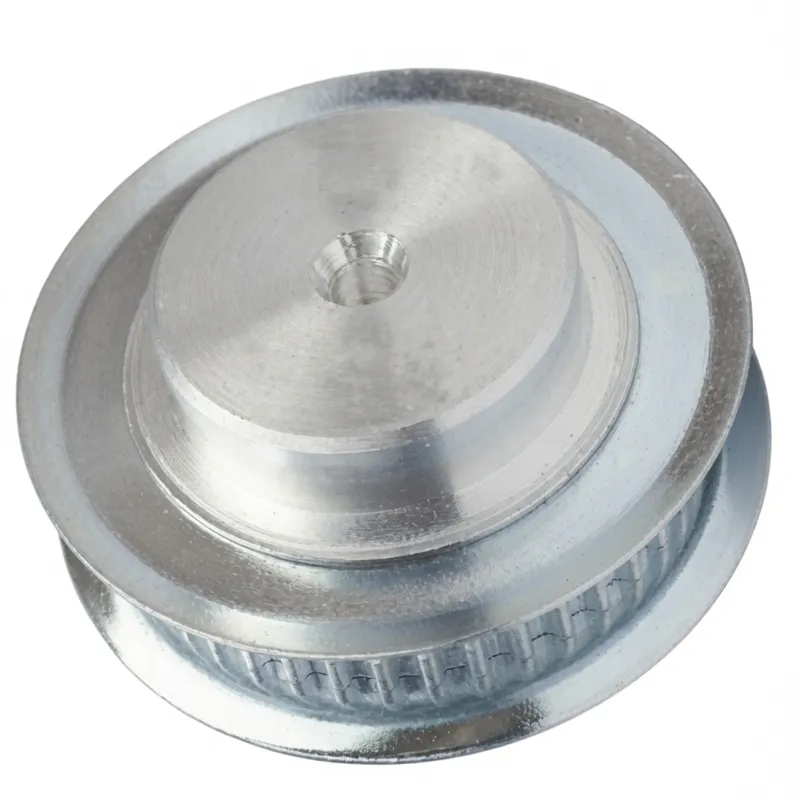
Poulie de distribution EP-T 10 mm en aluminium à alésage droit — Largeur de courroie 25 mm
The EP-T10 10mm Aluminum Straight Bore Timing Pulley for 25mm Belt Width engineered for high-load applications using 25mm wide belts with a 10mm pitch. Available in tooth counts from 12 to 60, these pulleys (Type 6F/6) maintain a consistent face width (F) of 30mm and length (L) of 40mm. Bore diameters (Dm) range significantly from 28mm to 110mm, accommodating heavy-duty shafts, while outer diameters (De) span 36.35mm to 189.10mm. Most models include flanges (Type 6F) for reliable belt tracking, with specific flange numbers provided for compatibility. Ideal for industrial automation and machinery requiring precise synchronization and reduced rotational inertia at higher torque levels.
Poulie de distribution EP-T 10 mm en aluminium à alésage droit — Largeur de courroie 25 mm
The EP-T 10MM Aluminum Straight Bore Timing Pulley is a precision-engineered power transmission component built to DIN 7721 standards. Designed for a 10 mm pitch and matched to a 25 mm belt width, this aluminum straight bore timing pulley delivers reliable synchronous motion across a broad range of industrial and automation applications. Whether you are integrating it into a new drive system or sourcing a timing pulley replacement, this series provides consistent tooth engagement, low backlash, and extended service life.
Manufactured from high-grade aluminum alloy, the T-series pulley combines a lightweight construction with outstanding dimensional accuracy. The straight bore design simplifies installation and enables fast shaft fitting without the need for additional bushing hardware, making it a practical option for engineers who need a dependable metric timing pulley that mounts quickly and runs quietly.
1. Technical Specifications — T10 Series Straight Bore Timing Pulley (Pitch 10 mm, Belt Width 25 mm)
All dimensions are in millimeters. The table below lists the complete DIN 7721 T10 parameter set for this metric timing belt pulley series. Column definitions: Dp = Pitch diameter; De = Outside diameter; Df = Flange diameter; Dm = Hub diameter; F = Belt width seat (mm); L = Hub length (mm); d = Bore diameter (mm); Bride n° = Flange part reference.
| Code de pièce | Dents | Taper | Matériel | Dp (mm) | De (mm) | Df (mm) | Dm (mm) | F (mm) | L (mm) | d (mm) | Bride n° |
|---|---|---|---|---|---|---|---|---|---|---|---|
| 12T10-40 | 12 | 6F | AL | 38.20 | 36.35 | 42 | 28 | 30 | 40 | 6 | 13 |
| 14T10-40 | 14 | 6F | AL | 44.56 | 42.70 | 48 | 32 | 30 | 40 | 8 | 11 |
| 15T10-40 | 15 | 6F | AL | 47.75 | 45.90 | 51 | 32 | 30 | 40 | 8 | 16 |
| 16T10-40 | 16 | 6F | AL | 50.93 | 49.10 | 54 | 35 | 30 | 40 | 8 | 18 |
| 18T10-40 | 18 | 6F | AL | 57.29 | 55.45 | 60 | 40 | 30 | 40 | 8 | 21 |
| 19T10-40 | 19 | 6F | AL | 60.48 | 58.65 | 66.5 | 44 | 30 | 40 | 8 | 24 |
| 20T10-40 | 20 | 6F | AL | 63.66 | 61.80 | 66.5 | 46 | 30 | 40 | 8 | 24 |
| 22T10-40 | 22 | 6F | AL | 70.03 | 68.20 | 75 | 52 | 30 | 40 | 8 | 27 |
| 24T10-40 | 24 | 6F | AL | 76.39 | 74.55 | 83 | 58 | 30 | 40 | 8 | 29 |
| 25T10-40 | 25 | 6F | AL | 79.58 | 77.75 | 83 | 60 | 30 | 40 | 8 | 29 |
| 26T10-40 | 26 | 6F | AL | 82.76 | 80.90 | 87 | 60 | 30 | 40 | 8 | 31 |
| 27T10-40 | 27 | 6F | AL | 85.95 | 84.10 | 91 | 60 | 30 | 40 | 8 | 32 |
| 28T10-40 | 28 | 6F | AL | 89.12 | 87.25 | 93 | 60 | 30 | 40 | 8 | 33 |
| 30T10-40 | 30 | 6F | AL | 95.49 | 93.65 | 97 | 60 | 30 | 40 | 8 | 35 |
| 32T10-40 | 32 | 6F | AL | 101.86 | 100.00 | 106 | 65 | 30 | 40 | 10 | 38 |
| 36T10-40 | 36 | 6F | AL | 114.59 | 112.75 | 119 | 70 | 30 | 40 | 10 | 43 |
| 40T10-40 | 40 | 6F | AL | 127.32 | 125.45 | 131 | 80 | 30 | 40 | 10 | 47 |
| 44T10-40 | 44 | 6 | AL | 140.05 | 138.20 | — | 88 | 30 | 40 | 10 | — |
| 48T10-40 | 48 | 6 | AL | 152.78 | 150.95 | — | 95 | 30 | 40 | 16 | — |
| 60T10-40 | 60 | 6 | AL | 190.98 | 189.10 | — | 110 | 30 | 40 | 16 | — |
Note: "—" indicates no flange on that specific model. Type 6F = flanged both sides; Type 6 = unflanged. All dimensions per DIN 7721.
10MM Belt Width Aluminium Straight Bore Timing Pulley
2. Five Key Advantages of the EP-T 10MM Straight Bore Timing Pulley
Lightweight Aluminum Construction
Fabricated from aluminum alloy, this aluminium timing pulley weighs significantly less than its steel counterparts. The reduced rotating mass lowers the inertia load on drive motors — a measurable benefit in high-cycle automation equipment, packaging lines, and servo-driven axes where responsiveness and energy efficiency matter.
DIN 7721 Compliance for Global Interchangeability
Every dimension — pitch diameter, flange geometry, tooth profile — follows DIN 7721 specifications. This means the pulley integrates seamlessly with any DIN-compliant timing belt pulley and belt in your existing system. It functions as a direct metric pitch timing pulley replacement and eliminates costly retooling when upgrading or repairing drive trains.
Wide Tooth Count Range for Flexible Ratio Selection
The series spans 12 to 60 teeth, giving design engineers the freedom to select the exact transmission ratio required. Whether pairing two EP-T pulleys for a timing pulley and belt drive or combining them with a timing belt idler pulley for belt tensioning, the available tooth range covers virtually every speed reduction or speed-increase scenario at the 10 mm metric pitch.
Ready-to-Mount Straight Bore
The straight bore accepts standard shaft diameters directly, with no intermediate bushing required. This simplifies inventory management for maintenance teams and reduces the total part count in a drive assembly. For applications where rapid field replacement is necessary, this straight bore timing pulley for sale in stock sizes ships ready to install without additional machining.
Precision-Machined Tooth Profile for Synchronous Accuracy
Each pulley tooth is machined to tight tolerances, ensuring consistent engagement with the mating T10 synchronous belt. This translates to low positional error, smooth torque transmission, and minimal tooth wear over the pulley's operating life. For systems requiring precise angular positioning — such as CNC axes, indexing tables, or timing belt drive pulley arrangements — the tight tooth geometry of this aluminum timing pulley delivers measurable accuracy advantages over cast or sintered alternatives.
3. Fonctionnement d'une poulie de distribution à alésage droit
This T10 metric timing pulley operates on the principle of positive engagement between evenly spaced pulley teeth and the corresponding tooth pockets of a synchronous timing belt. Unlike friction-based V-belts or flat belts, there is no reliance on belt tension to transfer torque — the teeth lock mechanically, eliminating slip entirely. This means the angular relationship between the drive and driven shaft is maintained throughout operation, an essential characteristic for any motion-critical system.
In the T10 profile, each tooth is trapezoidal in cross-section with a 10 mm pitch — the distance measured from one tooth center to the next along the pitch line. When the pulley rotates, each belt tooth seats squarely into the corresponding pulley groove, transfers the tangential force, and then exits cleanly. The result is quiet, vibration-free power transfer across the full load range.
The straight bore fits directly over a shaft and is secured typically by a keyway and set screw arrangement. The flanged design (Type 6F in smaller sizes) keeps the belt tracking laterally, preventing walk-off during high-speed or reversing operation. Together, these engineering choices produce a robust, low-maintenance timing belt pulley suitable for continuous duty cycles in demanding environments.
4. Material and Surface Treatment
Aluminum Alloy (AL)
The EP-T 10MM series is fabricated from high-strength aluminum alloy — the standard material grade for this product family. Aluminum offers an excellent strength-to-weight ratio, natural corrosion resistance, and superior machinability. It supports the tight dimensional tolerances required by DIN 7721, and the material responds well to anodizing treatments that further improve surface hardness and wear resistance. For environments where weight reduction is a priority — robotics, overhead conveyors, medical packaging equipment — aluminum is generally the first material of choice among metric timing pulleys suppliers.
Surface Finish Options
Standard units leave the machining center with a clean, bright-cut aluminum surface. For applications requiring enhanced corrosion protection — coastal environments, food processing, pharmaceutical cleanrooms — hard anodizing is available as an upgrade. Hard anodizing increases surface hardness to approximately 400 HV and adds a uniform oxide layer that resists wear from belt engagement cycles. Where stainless steel components are used elsewhere in the drive train, please note that a stainless steel timing pulley option is also available for full corrosion-resistant system builds. Custom surface treatments can be discussed during the quotation process.
5. Application Scenarios of Straight Bore Timing Pulley
The EP-T 10MM Aluminum Straight Bore Timing Pulley is a versatile component deployed across a broad spectrum of industries. Its combination of low weight, dimensional precision, and metric interchangeability makes it relevant anywhere synchronous timing belts and pulleys are specified. Below are the primary application areas where this series delivers proven performance.
Industrial Automation and Robotics
In automated assembly lines, pick-and-place robots, and gantry systems, this T10 aluminum timing pulley provides the backlash-free drive performance that servo and stepper motors depend on. The T10 metric pitch handles moderate torque loads typical of articulated arm axes and linear slide actuators, and the aluminum construction keeps the overall moving mass low — which matters when acceleration and deceleration cycles are rapid and frequent.
CNC Machining Centers and 3D Printing
Axis drive systems in CNC routers, milling machines, and additive manufacturing equipment rely on synchronous timing belt drive pulleys for accurate, repeatable positioning. The T10 profile is a well-established choice for axis drives handling intermediate torque, and the availability of timing pulley standard sizes across the 12-tooth to 60-tooth range gives machine builders the flexibility to configure the exact gear ratio their feed rate and resolution requirements demand.
Food and Beverage Packaging
Packaging lines involve continuous high-cycle operation where belt systems must maintain precise phase relationships between stations. An aluminium timing pulley holds up well in environments where hygiene standards require regular washdown, especially when combined with anodized surface treatment. The T10 pitch belt seat width of 30 mm with a 25 mm belt is appropriate for conveyors, labeling machines, and filling head drives found throughout the food and beverage sector.
Medical Equipment and Laboratory Automation
In medical imaging equipment, laboratory liquid handlers, and diagnostic instruments, every moving axis is held to stringent accuracy tolerances. The precise tooth profile of this metric timing pulley replacement component ensures repeatable positioning, while aluminum construction satisfies weight budgets in portable or bench-top equipment. The non-magnetic nature of aluminum is an additional benefit in MRI-adjacent environments where ferrous metals cannot be used.
Textile and Printing Machinery
Weaving machines, printing presses, and finishing equipment run at high speeds with demanding duty cycles. Synchronous drives using timing belt pulleys are preferred over chain drives in these environments because they eliminate the lubrication requirements and noise associated with chain systems. The T10 aluminum pulley maintains belt tracking effectively through its flanged design, reducing the risk of belt walkoff during multi-hour production runs.
Agricultural Machinery and Outdoor Equipment
Modern precision agriculture equipment uses servo-driven components for seed metering, variable rate application, and field mapping drives. The robust tooth engagement of a DIN 7721 aluminum straight bore timing pulley replacement suits these working environments, where shock loads from terrain variation must be absorbed without compromising positional accuracy. The lightweight aluminum construction is also valued in equipment where overall machine weight affects fuel efficiency and tire compaction on soil.
6. Relevant Standards and Regulations by Region
When sourcing metric timing belt pulleys for industrial machinery, buyers across different regions must verify compliance with applicable mechanical safety and product standards. The following summarizes the most relevant frameworks for the EP-T series.
European Union — Machinery Directive 2006/42/EC and EN ISO 4413
In the EU, power transmission components installed within machinery must meet the requirements of the Machinery Directive 2006/42/EC. Drive systems using timing belt pulleys fall within the scope of this directive when incorporated into CE-marked end equipment. DIN 7721 is harmonized with ISO standards and is accepted throughout the EU, German, and broader continental European markets. Engineers must ensure the complete drive assembly — pulley, belt, and guarding — meets EN ISO 4413 (hydraulic and pneumatic power systems) and EN ISO 12100 (risk assessment), where applicable. The new EU Machinery Regulation 2023/1230, which replaces Directive 2006/42/EC, took effect progressively from 2023 with a transition period running to January 2027.
United States — OSHA 29 CFR 1910.219 and ANSI/ASME Standards
In the United States, the Occupational Safety and Health Administration (OSHA) standard 29 CFR 1910.219 governs mechanical power transmission apparatus, including belt and pulley systems. Any exposed timing pulley or belt drive operating in a workplace environment must be properly guarded in accordance with these requirements. Additionally, ANSI/ASME B29.1 and related belt standards apply to the selection and use of timing belts and pulleys in American industry. Buyers sourcing from global suppliers should verify that the pulley dimensions and tolerances match their system requirements before final procurement.
United Kingdom — PUWER 1998 and BS Standards
Post-Brexit, the UK operates under its own Provision and Use of Work Equipment Regulations 1998 (PUWER), which requires that power transmission equipment including belt drives be safe, maintained, and appropriately guarded. British Standards relevant to timing drive design include BS 4548 and the retained equivalent of DIN/ISO metric standards. Equipment placed on the UK market also requires UKCA marking for relevant categories, replacing CE marking for goods manufactured after December 2024.
Australia and New Zealand — AS/NZS 4024 Series
In Australia and New Zealand, the AS/NZS 4024 series (Safety of Machinery) sets out requirements for guarding power transmission systems, including belt and pulley drives. Procurement teams sourcing a belt aluminum straight bore timing pulley for equipment deployed in these markets should confirm that their machine guarding and drive design meets the relevant parts of AS/NZS 4024. The metric pitch system (DIN 7721 compatible) is fully compatible with Australian engineering practice, which follows ISO metric standards rather than inch-based conventions.
India, Southeast Asia, Japan, and South Korea
In India, BIS (Bureau of Indian Standards) aligns with ISO metric standards for mechanical power transmission components. Japan follows JIS (Japanese Industrial Standards) B 1856 for synchronous drive systems, which specifies pulley geometry closely aligned with ISO and DIN conventions — ensuring that a DIN 7721 aluminum straight bore timing pulley will mesh correctly with JIS-conforming belts of the same pitch. South Korea follows KS (Korean Standards), and Taiwan follows CNS, both of which adopt metric pitch definitions consistent with this product series. For ASEAN markets including Vietnam, Thailand, and Indonesia, ISO metric standards are widely accepted for industrial equipment import and compliance documentation.
7. Related Products — Complete Drive System Solutions
We supply the full range of components needed to build or service a synchronous belt drive. Pairing our Aluminum Straight Bore Timing Pulley with compatible accessories from the same supplier eliminates cross-sourcing delays and ensures dimensional compatibility across the entire drive train.
Barres dentées standard à pas métrique
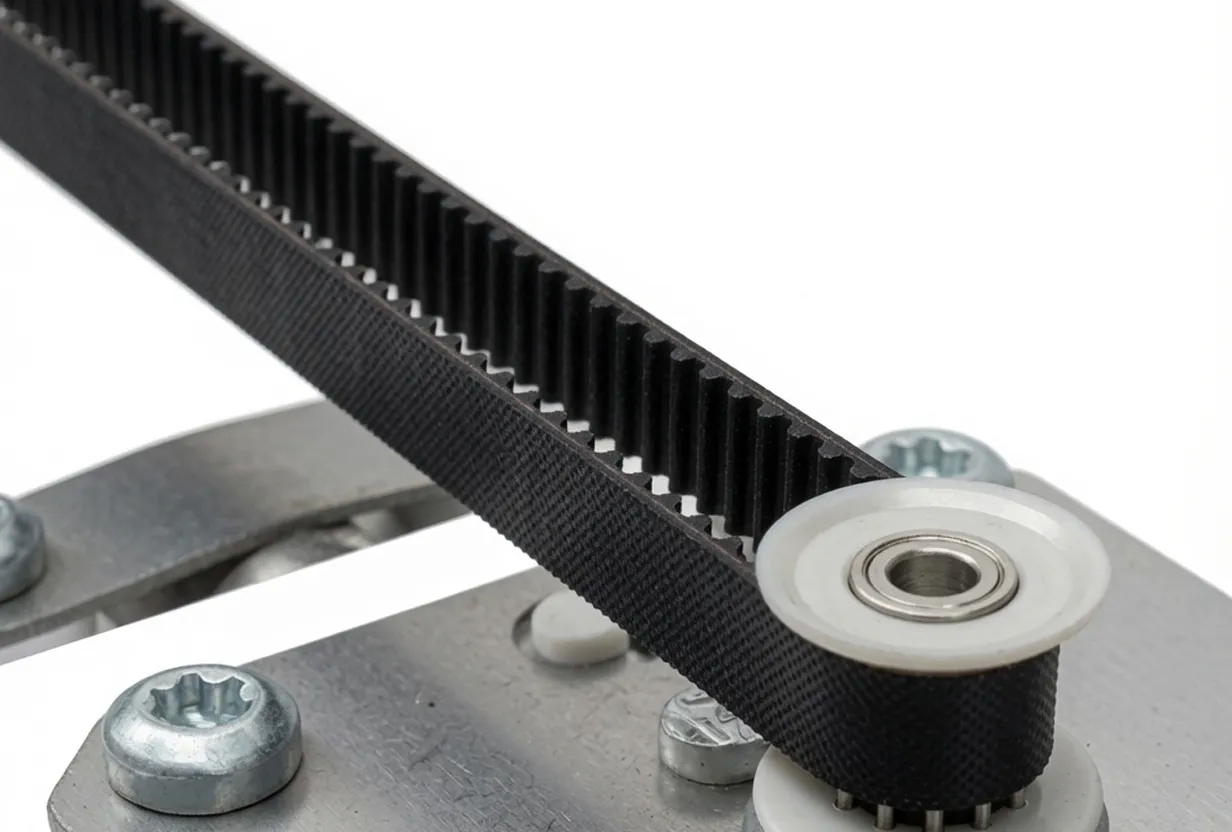
Our Metric Pitch Standard Toothed Bars are dimensionally matched to the T10 pulley tooth profile, delivering plug-and-play linear drive compatibility. When combined with the EP-T timing pulley, toothed bars provide a linear alternative to rotary belt loops — ideal for rack-and-pinion style linear actuators in automation equipment, medical devices, and precision positioning stages. One supplier, one set of tolerances, zero mismatch risk.
Poulie en V (poulie à courroie trapézoïdale)
Where synchronous precision is not required but high-torque, low-cost drive transmission is, our V-belt pulley range complements the timing pulley product family. In many industrial drive systems, a combination of a timing belt tensioner pulley arrangement with V-belt drives for primary power distribution and timing pulleys for precision positioning axes represents the most cost-effective architecture. Visit our V-Pulley product page for the full catalog and specifications.

8. About Us
We are a dedicated straight bore timing pulley manufacturer and supplier with deep experience in precision power transmission components. Our facility is equipped with CNC turning centers, gear hobbing machines, and precision inspection equipment, allowing us to hold the tight dimensional tolerances that DIN 7721 demands across every production run. Every pulley leaves our facility after dimensional verification against the published specification table.
Our product portfolio covers the full range of synchronous drive components: T-series timing pulleys, taper bore pulleys, idler pulleys, flanged and unflanged variants, and custom timing belt pulleys machined to customer drawings. We supply timing pulley stock items for same-week dispatch, and we offer custom order scheduling for non-standard tooth counts, bores, materials, or flange configurations.
Atelier


Foire aux questions
Éditeur : PXY
Produits similaires
-
Poulie de distribution EP-T 5MM en aluminium à alésage droit - Largeur de courroie 25 mm
-

Poulie de distribution EP-T5 en aluminium à alésage droit de 5 mm avec courroie de 10 mm de large
-
Poulie de distribution EP-T 10 mm en aluminium à alésage droit — Largeur de courroie 50 mm
-

Poulie de distribution en aluminium EP-T2.5-16 — Pas de 2,5 mm pour une largeur de courroie de 6 mm