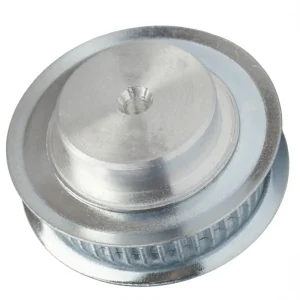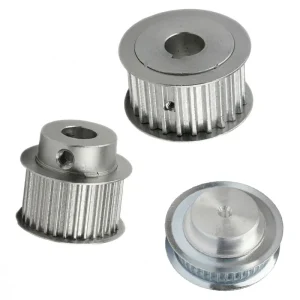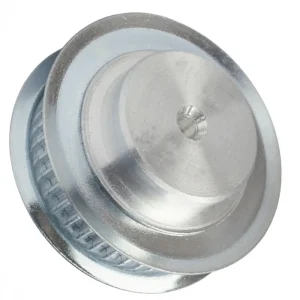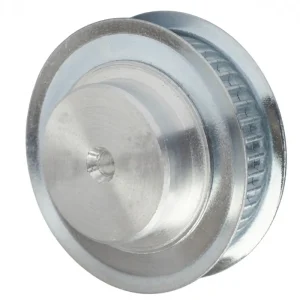

EP-T5 5MM Aluminum Straight Bore Timing Pulley With Belt Width 10MM
The EP-T5 5mm Aluminum Straight Bore Timing Pulley for 10mm Belt series features lightweight aluminum timing pulleys engineered for precision drives using 10mm wide belts with a 5mm pitch. Available in tooth counts from 10 to 60, these pulleys (Type 6F/6) maintain a consistent face width (F) of 15mm and length (L) of 21mm. Bore diameters (Dm) range from 8mm to 65mm, accommodating diverse shaft sizes, while outer diameters (De) span 15.05mm to 94.65mm. Most models include flanges for reliable belt tracking, with specific flange numbers provided for compatibility. Ideal for automation, robotics, and light machinery requiring accurate synchronization and reduced rotational inertia.
DIN 7721 Timing Pulley T Series
EP-T5 5MM Aluminum Straight Bore Timing Pulley
With Belt Width 10MM
A precision-machined aluminum straight bore timing pulley conforming to DIN 7721, with a 5 mm pitch matched to 10 mm wide T5 timing belts. Covering 10 to 60 teeth across 21 models for synchronized drive applications in automation, robotics, and precision machinery worldwide.
1. Technical Specifications — T5 Series, Pitch 5 mm, Belt Width 10 mm
The table below provides the complete dimensional data for all standard models in the EP-T5 21 series (T5 pitch, 10 mm belt width code 21). All dimensions in mm. Dp = Pitch Diameter, De = Outside Diameter, Df = Flange Diameter, Dm = Hub Diameter, F = Belt Width Reference, L = Hub Length, d = Bore Diameter.
| Part Code | Teeth | Type | Material | Dp (mm) | De (mm) | Df (mm) | Dm (mm) | F (mm) | L (mm) | d (mm) | Flange No. |
|---|---|---|---|---|---|---|---|---|---|---|---|
| 10T5–21 | 10 | 6F | AL | 15.92 | 15.05 | 19.5 | 8 | 15 | 21 | – | 3 |
| 12T5–21 | 12 | 6F | 19.10 | 18.25 | 23 | 11 | 15 | 21 | – | 1 | |
| 14T5–21 | 14 | 6F | 22.29 | 21.45 | 25 | 13 | 15 | 21 | – | 2 | |
| 15T5–21 | 15 | 6F | 23.88 | 23.05 | 28 | 16 | 15 | 21 | – | 4 | |
| 16T5–21 | 16 | 6F | 25.47 | 24.60 | 32 | 18 | 15 | 21 | – | 5 | |
| 18T5–21 | 18 | 6F | 28.65 | 27.80 | 32 | 20 | 15 | 21 | – | 6 | |
| 19T5–21 | 19 | 6F | 30.25 | 29.40 | 36 | 20 | 15 | 21 | – | 8 | |
| 20T5–21 | 20 | 6F | 31.83 | 31.00 | 36 | 22 | 15 | 21 | – | 8 | |
| 22T5–21 | 22 | 6F | 35.02 | 34.15 | 38 | 23 | 15 | 21 | – | 9 | |
| 24T5–21 | 24 | 6F | 38.21 | 37.40 | 42 | 24 | 15 | 21 | – | 13 | |
| 25T5–21 | 25 | 6F | 39.80 | 38.95 | 44 | 26 | 15 | 21 | – | 12 | |
| 26T5–21 | 26 | 6F | 41.39 | 40.60 | 44 | 26 | 15 | 21 | – | 12 | |
| 27T5–21 | 27 | 6F | 42.98 | 42.20 | 48 | 30 | 15 | 21 | 8 | 11 | |
| 28T5–21 | 28 | 6F | 44.58 | 43.75 | 48 | 32 | 15 | 21 | 8 | 11 | |
| 30T5–21 | 30 | 6F | 47.76 | 46.95 | 51 | 34 | 15 | 21 | 8 | 16 | |
| 32T5–21 | 32 | 6F | 50.94 | 50.10 | 54 | 38 | 15 | 21 | 8 | 18 | |
| 36T5–21 | 36 | 6F | 57.31 | 56.45 | 64 | 38 | 15 | 21 | 8 | 23 | |
| 40T5–21 | 40 | 6F | 63.66 | 62.85 | 66.5 | 40 | 15 | 21 | 8 | 24 | |
| 42T5–21 | 42 | 6F | 66.86 | 66.00 | 70 | 40 | 15 | 21 | 8 | 26 | |
| 44T5–21 | 44 | 6 | 70.05 | 69.20 | – | 45 | 15 | 21 | 8 | – | |
| 48T5–21 | 48 | 6 | 76.42 | 75.55 | – | 50 | 15 | 21 | 8 | – | |
| 60T5–21 | 60 | 6 | 95.52 | 94.65 | – | 65 | 15 | 21 | 8 | – |
All dimensions in mm. Type 6F = flanged both sides. Type 6 = no flange. Bore d = – indicates unfinished bore (user-machined to shaft size). AL = aluminum alloy.
2. About Our Aluminum Straight Bore Timing Pulley With Belt Width 10MM
The EP-T5 is a DIN 7721-compliant straight bore timing pulley manufactured in aluminum, designed for use with T5-profile timing belts at a 10 mm belt width. The T5 pitch of 5 mm places this series firmly in the compact, high-speed drive category — smaller pitch means more teeth in contact at any given arc of wrap, producing smoother torque transfer and reduced per-tooth load at the operating speeds typical of servo-driven automation axes and stepper motor positioning systems. With 21 standard models spanning 10 to 60 teeth, the EP-T5 10 mm series covers an exceptionally wide range of speed ratios and drive geometries from a single standardized component family.
Each model in this aluminum straight bore timing pulley range is machined to the type code 6F for the 10 to 42-tooth variants — meaning a flanged configuration that keeps the T5 belt seated laterally on the pulley face — and type code 6 for the larger 44, 48, and 60-tooth models where the wider hub diameter (Dm up to 65 mm) provides adequate belt guidance through the housing design. The straight bore (d) starts at 8 mm for models from 27 teeth upward, while the smallest 10 to 26-tooth variants ship with an unfinished bore indicated by “–” in the catalog, allowing the user to machine the bore to their required shaft diameter. The consistent hub length L of 21 mm across all models simplifies drive shaft layout across different tooth-count selections within the same machine design.

3. Five Key Product Advantages
Conformance to the German DIN 7721 standard for metric pitch timing pulleys ensures that this T5 series straight bore timing pulley is dimensionally interchangeable with T5 belts and mating pulleys from any manufacturer who also references DIN 7721. For European OEM machine builders and global automation engineers who source replacement belts and pulleys from multiple suppliers across different purchasing cycles, this standards compliance is the key guarantee of interoperability and a major procurement advantage over non-standard or proprietary drive components.
Aluminum construction reduces the rotating inertia of the drive system compared to steel or cast iron pulleys of equivalent size. In servo and stepper motor-driven positioning axes — which make up the majority of T5 timing pulley applications — lower inertia translates directly to faster acceleration and deceleration, shorter cycle times, and lower motor heating during high-duty-cycle operation. The aluminum alloy used in this aluminium timing pulley series also provides a natural oxide layer that resists corrosion in normal indoor automation environments without requiring additional surface treatment.
Every model in the EP-T5 10 mm series shares an identical hub length L of 21 mm and belt width F of 15 mm. This dimensional consistency is a deliberate design feature that simplifies machine layout: once a designer selects the T5 10 mm belt width for a drive axis, the axial space claimed by the pulley on the shaft is fixed regardless of the tooth count selected. Changing the speed ratio of the drive by substituting one tooth count for another requires no modification to the shaft length, bearing spacing, or housing width — a significant benefit for modular machine designs where drive ratio optimization continues after initial layout is frozen.
Twenty-one standard models from 10 to 60 teeth give engineers the ability to achieve speed ratios from 1:1 up to 6:1 using only standard catalog parts within this series. Intermediate ratios can be achieved through careful pairing of drive and driven pulleys from the range. For example, a 15-tooth drive pulley combined with a 30-tooth driven pulley gives a precise 2:1 speed reduction — both available as standard timing pulley stock items. This range breadth reduces the need for custom timing pulleys in most standard automation and positioning applications.
The 6F type designation on models from 10 to 42 teeth indicates that these pulleys are supplied with a retaining flange on both sides of the toothed belt-running surface. Flanges prevent the T5 timing belt from walking off the pulley edge during operation, which can otherwise occur when the belt runs under lateral load in open-frame machines, or when small misalignments between shafts cause a gradual belt tracking drift. Reliable belt tracking without external guide rails reduces machine assembly complexity and eliminates the need for a separate timing belt tensioner pulley with lateral guide function in most drive configurations.
4. Working Principle
The EP-T5 straight bore timing pulley operates on the principle of positive-engagement synchronous drive. The trapezoidal tooth profile machined into the pulley's outer circumference — conforming to the DIN 7721 T5 tooth form — meshes precisely with the corresponding tooth cavities on the inner surface of a T5 timing belt. When the motor shaft rotates the drive pulley, each tooth of the timing belt pulley pushes against the mating belt tooth in the engaged arc. Unlike V-belt or flat-belt drives where power transfer depends on friction, every rotation of the drive pulley moves the belt by exactly (N × pitch) millimetres, where N is the number of engaged tooth pitches. This produces zero-slip synchronous motion at the driven pulley or linear motion at the belt's loaded strand.
The pitch diameter formula for this straight bore timing pulley follows the relationship Dp = (N × 5) / π, which gives pitch diameters from 15.92 mm for the 10-tooth model to 95.52 mm for the 60-tooth model in this series. The outside diameter De is always 0.76 to 0.87 mm smaller than Dp — a consistent offset that reflects the T5 tooth depth — ensuring that the belt pitch line aligns with the theoretical pitch circle at which the speed ratio calculation is based. The flange diameter Df on 6F type models is sized to exceed De by 4 to 8 mm, creating a raised rim that physically prevents the belt from sliding off the pulley face during operation, particularly important in high-speed automation drives where lateral belt forces are intermittent and difficult to predict analytically.
Belt tension in a T5 timing belt drive system is set during installation to achieve adequate contact force between belt tooth root and pulley tooth flank across the full arc of contact on the drive pulley. Unlike friction drives, a timing belt drive does not require high pretension to transmit torque — only enough tension to prevent belt tooth jump under peak torque conditions. For most EP-T5 10 mm belt width applications, the T5 belt manufacturer's recommended installation tension is in the range of 20 to 40 N, which is easily achieved by deflecting the belt at mid-span between pulleys during assembly. This low installation tension means shaft and bearing loads from the timing belt drive are comparatively small, extending bearing life in the machine.
5. Material: Aluminum Alloy
The EP-T5 series aluminum straight bore timing pulley is manufactured from a high-strength aluminum alloy — typically equivalent to EN AW-6061 T6 or EN AW-6082 T6 — which offers a well-balanced combination of machinability, corrosion resistance, tensile strength, and weight efficiency for precision timing pulley applications. The alloy's tensile strength in the T6 heat treatment condition typically exceeds 290 MPa, which is more than adequate for the tooth root bending stresses encountered in standard T5 10 mm belt width drives at the speeds and torques for which this series is rated.
The natural oxide layer that forms on aluminum surfaces in ambient air provides effective corrosion protection in typical indoor automation environments — electronics assembly, laboratory equipment, packaging machinery — without requiring paint or plating. For applications in more aggressive environments — occasional moisture exposure, mild chemical splash, or requirements for a specific color coding for visual identification — the aluminum alloy substrate of this aluminium timing pulley is readily anodizable to produce hard, wear-resistant anodic oxide coatings in natural silver, black, or other colors. Anodizing also slightly reduces the effective bore and outside diameter dimensions, so users intending to anodize after machining should allow appropriate machining stock on the bore and flange diameters.
The choice of aluminum over steel for this T5 series reflects the application context: T5 timing belt drives are most commonly used in compact, high-speed positioning axes driven by stepper or servo motors where reducing rotating inertia directly improves dynamic response. An aluminum T5 pulley weighs approximately one-third of a steel pulley with identical dimensions, which significantly reduces the reflected inertia at the motor shaft. This inertia reduction is especially important in multi-axis machine designs where the combined inertia of all drive pulleys can otherwise mismatch the motor rotor inertia and compromise servo tuning stability across the machine's operating speed and load range.
6. Application Scenarios
The EP-T5 aluminum straight bore timing pulley with 10 mm belt width addresses the compact end of the synchronized drive market, where space is constrained, motor inertia matching is critical, and position accuracy must be maintained across many millions of duty cycles. The following represent the primary deployment contexts for this series.
3D Printing and Additive Manufacturing
Desktop and industrial 3D printers — FDM, SLA, and SLS variants — use T5 timing belt drives for their X, Y, and sometimes Z positioning axes. The EP-T5 10 mm series straight bore timing pulley is sized precisely for the motor shaft diameters and frame dimensions of most common 3D printer drive systems. Aluminum construction reduces the axis inertia seen by the stepper motor, enabling faster acceleration and sharper directional changes in the print head or build platform without losing step position. Manufacturers of desktop printers in Germany, Japan, and the United States frequently source metric timing belt pulleys of this specification for both OEM production and after-market repair.
Collaborative and Industrial Robotics
Collaborative robot arms and small-scale SCARA systems use compact T5 timing belt stages to transmit servo motor torque to secondary joints and end-effector axes. The T5 5 mm pitch provides fine angular resolution per motor encoder count when driving through the gear reduction inherent in the pulley ratio, and the low mass of the aluminum T5 pulley minimizes added link inertia in each robot joint. Robotics integrators in South Korea, France, and Taiwan specify T5 series aluminum timing pulleys for end-of-arm tooling drives, camera pan-tilt units, and wafer handling gripper mechanisms where compact dimensions and precise repeatability are both required simultaneously.
Laboratory and Medical Automation
Automated liquid handling systems, PCR thermocyclers, slide staining platforms, and diagnostic instrument sample carriages use T5 timing belt drives to move sample racks, pipette heads, and reagent dispensing mechanisms with sub-millimetre repeatability. The compact pitch and low belt tension requirement of T5 drives make them ideal for precision laboratory equipment where space is constrained and any vibration transmitted through the mechanism can affect analytical results. Regulatory environments such as FDA 21 CFR Part 820 (USA) and CE/IVD Directive compliance (EU) require that component suppliers for medical automation equipment can provide dimensional inspection records and material traceability, which we supply on request.
Textile and Sewing Machinery
Computerized embroidery machines, cutting plotters for fabric, and yarn feed systems in circular knitting machines use T5 belt drives to synchronize multiple thread carrier or cutting head axes at high cycle rates. The T5 series aluminum timing belt drive pulley's combination of low inertia and precise tooth engagement makes it well-suited to the rapid direction reversals in X-Y embroidery head drives, where overshooting the commanded position due to high inertia would produce a stitch position error visible in the finished product. Textile machinery manufacturers in India, Bangladesh, and Italy represent significant end-user markets for T5 series aluminum pulleys in 10 mm belt width configurations.
Camera, Optics, and Sensor Positioning
Motorized pan-tilt camera mounts, telescope focuser drives, spectrophotometer grating positioners, and laser scanner beam deflection stages all use T5 timing belt drives to translate motor rotation into precise angular or linear movement of the optical component. In these applications, backlash — the dead zone of motion when the drive reverses direction — must be minimized. A properly tensioned T5 timing belt drive has essentially zero backlash compared to a gear train, which makes it the preferred choice for optical positioning where bidirectional accuracy is essential. The aluminum T5 straight bore timing pulley's low mass also avoids adding vibration to sensitive optical measurement setups.
7. Regulatory Framework and Standards Compliance
Timing pulleys used in machinery and equipment sold globally are subject to a range of national and international standards and regulatory frameworks. For buyers and OEM engineers specifying the EP-T5 aluminum straight bore timing pulley in regulated applications, the following compliance context is relevant.
DIN 7721 — Metric Pitch Synchronous Belt Drives (Germany / EU)
DIN 7721 is the German standard adopted throughout the European Union for metric pitch timing belt drive systems. The T5 profile is defined under this standard along with T2.5, T10, T20, and AT series profiles. Conformance to DIN 7721 ensures that the EP-T5 timing pulley tooth geometry, pitch measurement procedure, and dimensional tolerances are consistent with European belt manufacturers’ T5 product specifications. For German and EU OEM machine builders who import timing pulleys, DIN 7721 conformance simplifies the vendor qualification process and provides the technical basis for CE documentation of the belt drive sub-assembly within the machine’s overall CE technical file.
ISO 13050 — Synchronous Belt Drives, Vocabulary and Definitions
ISO 13050 provides the international vocabulary and measurement definitions for synchronous belt drive components, including the definition of pitch diameter, outside diameter, and belt width for timing pulleys. Products described using ISO 13050 terminology — including the Dp, De, Df, and Dm dimensions tabulated in this product page — use a common technical language that is understood by engineers, procurement managers, and quality teams across all major engineering markets worldwide, from North America and Europe to Japan, South Korea, and India.
EU Machinery Directive 2006/42/EC
Machinery incorporating timing belt drives sold in European markets must comply with the Machinery Directive. Drive guarding requirements, failure mode documentation, and belt tension specification form part of the technical file that CE-marked machine manufacturers must prepare. Suppliers of timing belt pulleys for European OEM equipment builders should be able to provide dimension inspection records, material certificates, and tooth form conformance data to support the machine builder’s technical documentation obligations under the directive. We provide this documentation on request.
GB/T 11362 — Chinese National Standard for Synchronous Belt Pulleys
As a China timing pulley manufacturer, our production of T5 metric timing pulleys references GB/T 11362 for synchronous belt pulley dimensional specifications and material requirements. This standard aligns with DIN 7721 and ISO metric pitch timing pulley profiles, ensuring that products manufactured to GB/T 11362 are dimensionally compatible with European and international T5 timing belt products. The standard covers aluminum, steel, and cast iron timing pulleys and specifies dimensional tolerance grades applicable to standard catalog and custom timing pulleys alike.
FDA 21 CFR Part 820 — Medical Device Quality System (USA)
Timing pulleys used in FDA-regulated medical device manufacturing equipment or incorporated directly into medical devices must be sourced from suppliers who can support the device manufacturer’s Design History File and Device Master Record documentation requirements. We provide material test certificates, dimensional inspection records, and CoC documentation for EP-T5 pulleys supplied to medical device OEM customers. Buyers should specify documentation requirements at the time of inquiry to allow inclusion in the order fulfillment process.
ICONTEC NTC Standards — Colombia and Andean Region
In Colombia, Ecuador, Peru, and Bolivia — all Andean Community member states — power transmission components used in industrial machinery must reference applicable ICONTEC NTC standards aligned with ISO international norms. Buyers in Colombia sourcing metric timing pulleys for locally manufactured automation equipment should verify that their equipment supplier’s design documentation references the applicable international standard (DIN 7721 or ISO) to ensure compatibility between the EP-T5 pulley and the T5 timing belts available from their local belt distributors.
8. Related Products
The EP-T5 series timing belt pulley is one component within a broader family of synchronized drive products. The following complementary items support complete drive system assembly and one-stop procurement.
Metric Pitch Standard Toothed Bars
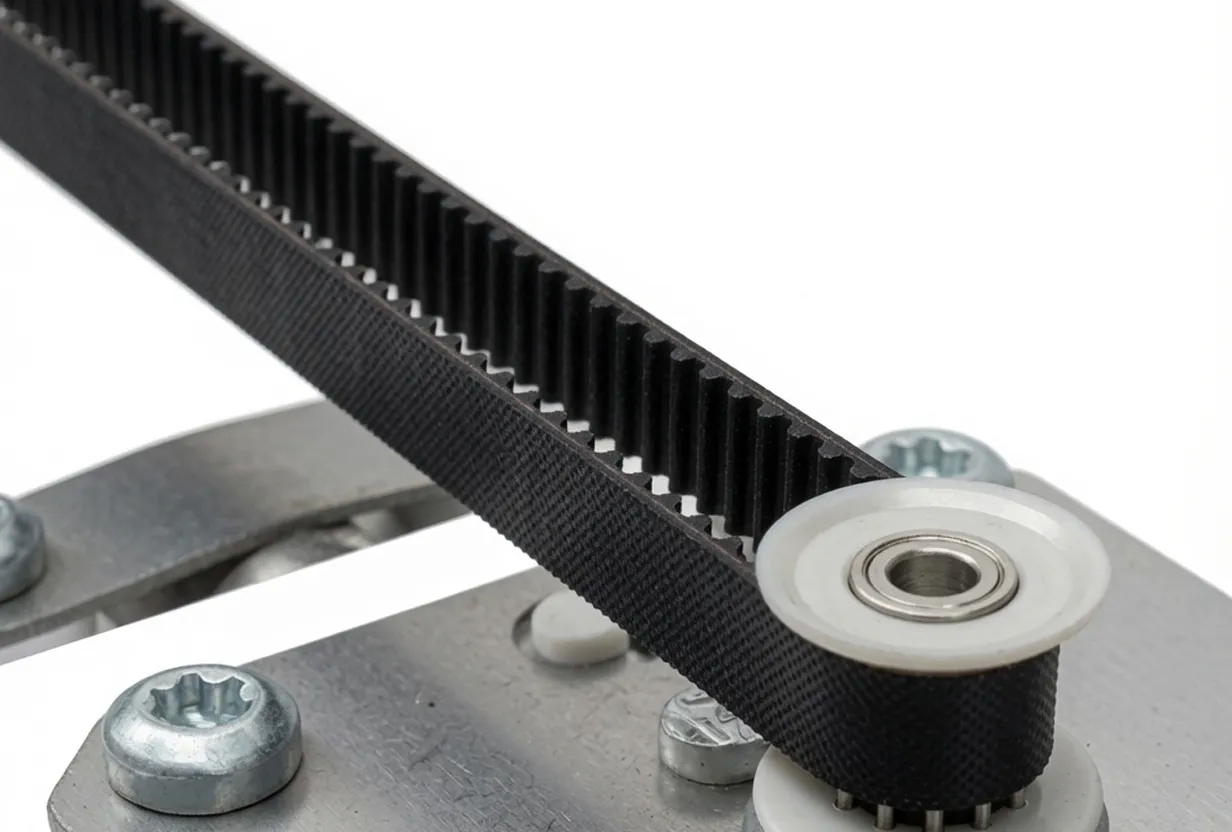
Metric Pitch Standard Toothed Bars complement timing pulleys by enabling linear synchronous drives using the same T5 belt. When a toothed bar replaces the driven pulley in a drive layout, the rotating pulley drives the bar in a linear direction with the same zero-slip synchronization as a rotary timing belt drive. T5 toothed bars are dimensionally compatible with T5 timing belts and pulleys from the EP series, making it possible to build complete X-axis linear drives using a single belt, a drive pulley, and a toothed bar rack — with no separate rack-and-pinion or leadscrew mechanism required.
V-Pulley

Our V-Pulley range provides the non-synchronous complement to the EP T5 timing pulley series. In machine designs that combine a high-torque V-belt primary drive from the main motor with a timing belt secondary drive for precision positioning axes, sourcing both V-pulleys and timing pulleys from a single manufacturer simplifies the supply chain and ensures consistent quality standards across all belt drive sub-assemblies in the machine. Our V-Pulley products are available in standard groove profiles across a broad diameter and shaft size range, compatible with all standard V-belt cross-sections.
9. About Us
We are a precision timing pulley manufacturer specializing in metric and inch pitch synchronous belt drive components for global industrial, automation, robotics, and medical equipment markets. Our production range covers T series (T2.5, T5, T10, T20), AT series, L series, XL series, and HTD series pulleys in aluminum, steel, and cast iron, across both standard catalog models and custom timing pulleys finished to customer bore and keyway specifications. As an established China timing pulley manufacturer, we export to customers in North America, Europe, Southeast Asia, Japan, South Korea, Australia, and Latin America.
Our quality management system operates under ISO 9001 certification. We maintain dimensional inspection records for all production batches and can provide material test certificates on request for customers with OEM equipment qualification or regulatory documentation requirements. Contact our sales team with your tooth count, bore requirement, quantity, and delivery location to receive a formal quotation with lead time confirmation. Whether you need a standard straight bore timing pulley from our T5 stock range or a custom variant with finished bore and keyway, we are ready to assist with technical selection and fast dispatch.
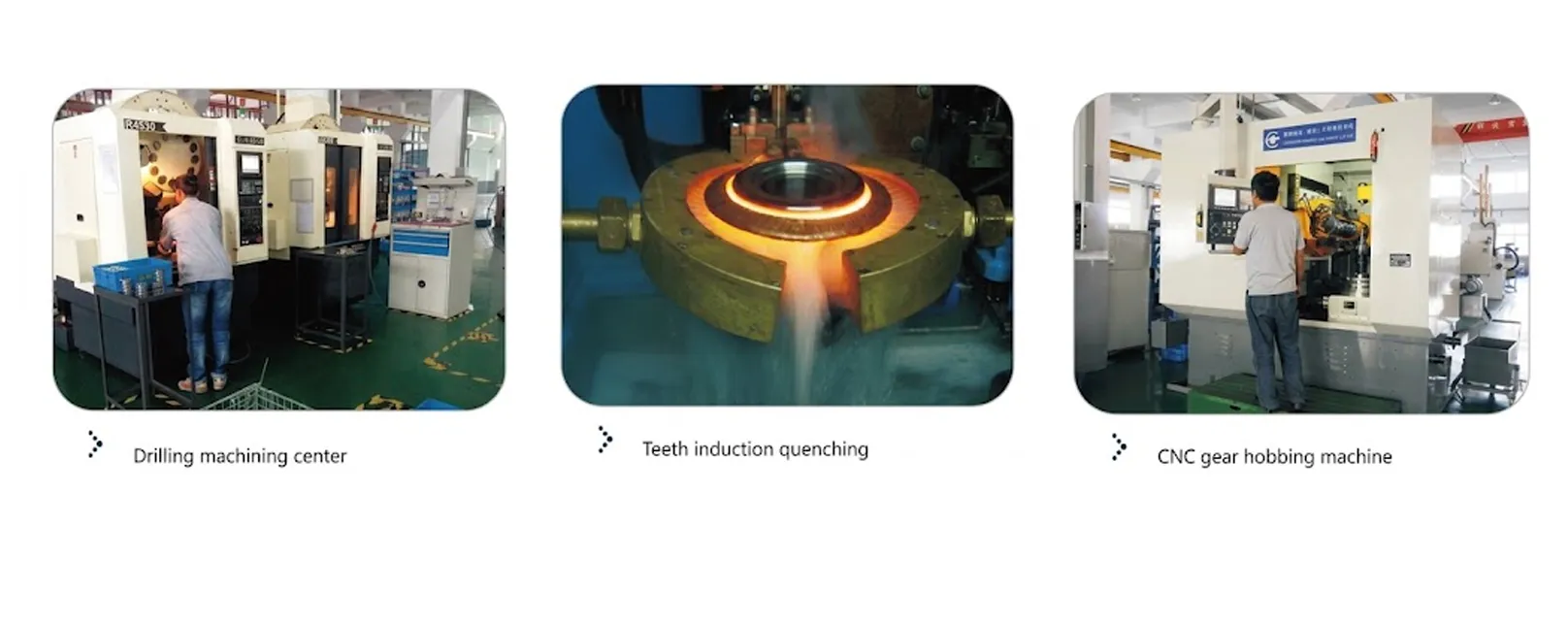
Workshop



Frequently Asked Questions
Questions from engineers, procurement managers, and distributors worldwide about the EP-T5 aluminum straight bore timing pulley series and T5 timing belt drive systems.
Q1. What is a straight bore timing pulley and how is it different from a taper lock timing pulley when used in a German automation system?
Q2. Where can I buy aluminum straight bore timing pulleys in T5 10mm belt width with fast delivery to Europe or the United States?
Q3. How do I calculate the correct tooth count for an aluminum T5 timing pulley to achieve a specific speed reduction ratio in my 3D printer or robotic arm?
Q4. What is the difference between an HTD timing belt pulley and a T5 straight bore timing pulley and which type is better for a high-torque servo axis in Japan or South Korea?
Q5. How do I get a quote for custom aluminum timing belt pulleys with a finished bore and keyway for a medical device assembly project in the United States or Canada?
Q6. What timing belt should I use with the 20T5–21 T5 series pulley and what does the “21” in the part code indicate?
Q7. Are aluminum T5 timing pulleys in stock nearby for same-week dispatch to customers in Australia or Southeast Asia for urgent machine repair projects?
Q8. What is the difference between a flanged (type 6F) and unflanged (type 6) T5 timing pulley and which type should I choose for my drive design?
Q9. Which timing pulley standard sizes are available in the T5 series and how do I find a replacement for my existing T5 aluminum pulley from a different supplier?
Q10. Where do I find a reliable metric timing pulley manufacturer that can supply both standard and custom T5 aluminum pulleys for an OEM project in India or Brazil?
Editor: PXY