
Descripción del Producto
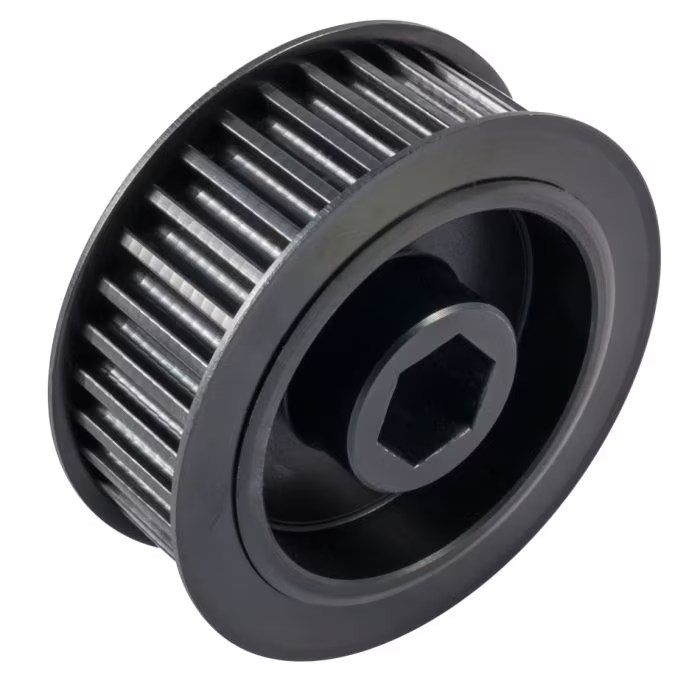
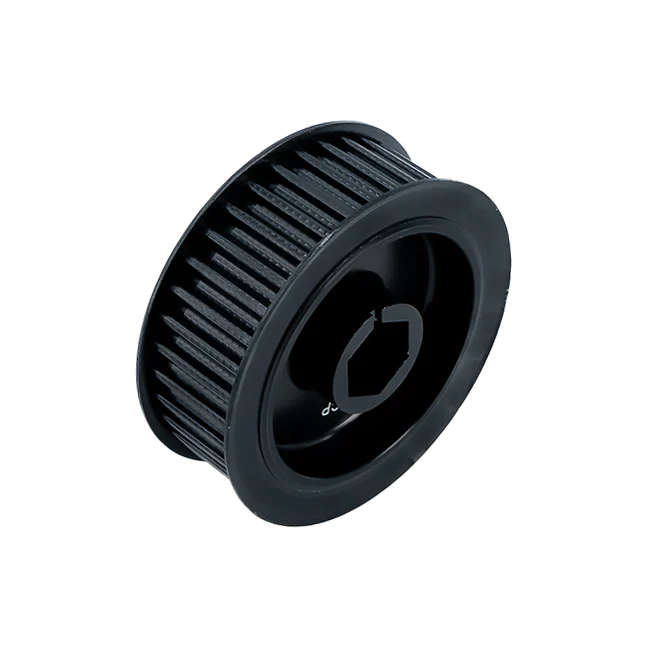
High Torque 45# Steel Timing Belt Tensioner Pulley With P2m P3m P5m P8m
Synchronous belt pulley transmission is composed of an annular belt with equidistant teeth on the inner peripheral surface and a belt pulley with corresponding teeth. During operation, the belt teeth mesh with the tooth slots of the belt pulley to transmit motion and power. It is a new belt transmission that integrates the respective advantages of belt transmission, chain transmission and gear transmission.
Descripción del Producto
1.High temperature resistance,Self lubrication,Wear resistance,Flame retardant properties
2.Good quality products
3.Competitive prices
4.Fast delivery
5.Best after-sale service
6.Brand: iHF or OEM/ ODM
7.Good service:satisfactory service before and after sale.
8.Direct manufacturers
| Product | standard timing belt pulley & idler pulley |
| Customized | OEM, drawings or samples customized |
| Teeth type | Normal Torque Drive Type:MXL,XL,L,H,XH,XXH High Torque Drive Type:S2M,S3M,S5M,S8M,HTD2M,HTD3M,HTD5M,HTD8M,P2M,P3M,P5M,P8M High Precision Position Drive Type:2GT,3GT,5GT,8YU Light Load Drive Type:T5,T10,T20 Heavy Load Drive Type:AT5,AT10,AT20 |
| Basic shape | Type A,Type B,Type D,Type E,Type F,Type K |
| Adaption | Adapt to 1/4 inch,5/16 inch,1/2 inch, 3/8inch, 2/25inch, 1/5inch belt |
| surface treatment | Natural color anodizing,Black anodizing,Hard anodizing,Ni-plating,Blackening |
| Material | 6061(aluminum),S45C(45# steel),SUS304(Stainless steel) |
| Bore | Pilot bore, Taper bore and Customized bore. |
| Tolerance Control | Outer diameter ±0.005mm Length dimension ±0.05mm |
| Standard | DIN, ISO/GB, AGMA, JIS |
| Teeth Accuracy | DIN Class 4, ISO/GB Classs 4, AGMA Class 13, JIS Class 0 |
| Weight | Max 15Tons |
| testing equipment | projecting apparatus,salt spray test,durometer,and coating thickness tester,2D projector |
| producing equipment | CNC machine,automatic lathe machine,stamping machine,CNC milling machine,rolling machine,lasering,tag grinding machine etc. |
| Machining Process | Gear Hobbing, Gear Milling, Gear Shaping, Gear Broaching,Gear Shaving, Gear Grinding and Gear Lapping |
| Application industry | Robot industry,Medical industry,Making machine industry,Automation industry,3C industry equipment,Packaging industry,UAV industry,New energy industry. |
Perfil de la empresa
Embalaje y envío
| lead time | 10-15 working days as usual,30days in busy season,it will based on the detailed order quantity |
| Delivery of samples | by DHL,Fedex,UPS,TNT,EMS |
Preguntas frecuentes
| Main Markets | North America, South America, Eastern Europe , West Europe , North Europe, South Europe, Asia |
| How to order | * You send us drawing or sample |
| * We carry through project assessment | |
| * We give you our design for your confirmation | |
| * We make the sample and send it to you after you confirmed our design | |
| * You confirm the sample then place an order and pay us 30% deposit | |
| * We start producing | |
| * When the goods is done, you pay us the balance after you confirmed pictures or tracking numbers. | |
| * Trade is done, thank you! |
/* March 10, 2571 17:59:20 */!function(){function s(e,r){var a,o={};try{e&&e.split(“,”).forEach(function(e,t){e&&(a=e.match(/(.*?):(.*)$/))&&1
| Certification: | CE, ISO |
|---|---|
| Pulley Sizes: | Type A |
| Proceso de fabricación: | Forging |
| Material: | Stainless Steel |
| Tratamiento de superficie: | Pulido |
| Solicitud: | Machinery Parts |
| Muestras: | US$ 10/Piece 1 unidad (pedido mínimo) | |
|---|
| Personalización: | Disponible | Solicitud personalizada |
|---|
Can timing pulleys be used in both simple and complex machinery?
Yes, timing pulleys can be used in both simple and complex machinery. Here’s an explanation:
Timing pulleys are versatile components that are widely utilized in a range of mechanical systems, irrespective of their complexity. Whether the machinery is simple or complex, timing pulleys offer several advantages that make them suitable for various applications.
In Simple Machinery:
Timing pulleys are commonly found in simple machinery where the power transmission requirements are relatively straightforward. For example, in small appliances such as electric fans or hand drills, timing pulleys can be used to transfer power from the motor to the rotating components. The simple design and ease of installation make timing pulleys a convenient choice for these types of applications.
In Complex Machinery:
Timing pulleys also find extensive use in complex machinery where multiple components need to be synchronized and powered efficiently. In industries such as automotive, robotics, printing, packaging, and manufacturing, complex machinery often relies on timing pulley systems to achieve precise coordination and power distribution.
The versatility of timing pulleys lies in their ability to handle various power transmission requirements. They can transmit power over long distances, accommodate different torque loads, and operate at high speeds. Timing pulley systems can be configured with different gear ratios by selecting pulleys of varying sizes, enabling customization based on the specific needs of the machinery.
Moreover, timing pulleys can be combined with other mechanical components such as tensioners, idler pulleys, and gears to optimize the performance of the machinery. These additional components help maintain proper tension, increase or decrease rotational speed, and ensure smooth operation.
Whether the machinery is simple or complex, timing pulleys offer benefits such as accurate timing, reliable power transmission, load distribution, and reduced wear and friction. These advantages contribute to the overall efficiency, performance, and longevity of the machinery.
In summary, timing pulleys are versatile components that can be used in both simple and complex machinery. Their flexibility, reliability, and ability to handle various power transmission requirements make them a valuable choice across a wide range of applications.
How do timing pulleys contribute to precision and accuracy in machinery?
Timing pulleys play a significant role in enhancing precision and accuracy in machinery. Here’s an explanation of how timing pulleys contribute to precision and accuracy:
1. Synchronization of Components:
Timing pulleys ensure precise synchronization of different components in a machinery system. By using toothed timing belts or chains that mesh with the teeth on the pulleys, rotational motion can be accurately transferred from one pulley to another. This synchronization is vital for applications where precise coordination is essential, such as in robotics, printing presses, and conveyor systems.
2. Accurate Timing:
Timing pulleys, in combination with timing belts or chains, enable precise timing of operations in machinery. The teeth on the belt or chain engage with the teeth on the pulley, allowing for accurate positioning and control of the driven components. This accuracy in timing ensures that specific actions or tasks occur at the desired intervals, resulting in precise operation and improved overall performance.
3. Consistent Speed and Motion:
Timing pulleys contribute to maintaining consistent speed and motion in machinery. The teeth on the timing belt or chain engage with the teeth on the pulley, preventing slippage and maintaining a constant speed ratio between the driving and driven pulleys. This consistency in speed and motion is crucial for applications that require uniform movement, such as in CNC machines or automated assembly lines.
4. Reduced Backlash:
Timing pulleys help minimize backlash, which refers to the slight movement or play that can occur when there is a change in the direction of motion. The positive engagement between the teeth on the timing belt or chain and the pulley teeth reduces backlash, ensuring that there is minimal or no lost motion. This reduction in backlash contributes to improved precision and accuracy in the machinery.
5. Repeatable Performance:
Timing pulleys enable repeatable performance in machinery. The precise engagement between the teeth on the belt or chain and the pulley ensures that the same motion or action is replicated consistently. This repeatability is essential in applications that require consistent and accurate results, such as in automated manufacturing processes or precision measuring equipment.
6. Tolerance for High Loads:
Timing pulleys are designed to handle high loads while maintaining precision and accuracy. The toothed design and robust construction of timing pulleys allow them to transmit power effectively, even under heavy loads. This capability to withstand high loads without compromising precision ensures reliable performance in demanding applications.
7. Compatibility with Automation and Control Systems:
The precise and accurate nature of timing pulleys makes them compatible with automation and control systems. They can be easily integrated into computerized control systems, allowing for precise positioning and control of machinery components. This integration enhances the overall precision and accuracy of the system.
In summary, timing pulleys contribute to precision and accuracy in machinery by enabling synchronization of components, accurate timing, consistent speed and motion, reduced backlash, repeatable performance, tolerance for high loads, and compatibility with automation and control systems. These characteristics make timing pulleys a fundamental component in achieving precise and accurate operation in various mechanical systems.
¿Qué es una polea de distribución y cómo se utiliza en los sistemas mecánicos?
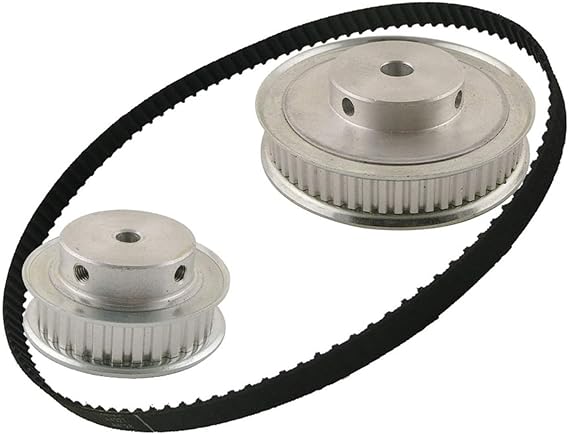
Una polea de distribución, también conocida como polea síncrona, es un tipo de polea diseñada específicamente para funcionar con correas dentadas o correas de distribución. Presenta ranuras o dientes en su superficie circunferencial que engranan con los dientes correspondientes de la correa. Las poleas de distribución se utilizan en sistemas mecánicos que requieren una transmisión de potencia precisa y sincronizada, donde la sincronización y el posicionamiento exactos son cruciales. A continuación, se explica la función y el uso de las poleas de distribución en los sistemas mecánicos:
1. Transmisión de potencia:
La función principal de una polea de distribución es transmitir el movimiento rotacional y la potencia entre dos o más ejes en un sistema mecánico. Los dientes de la polea engranan con los de la correa de distribución, creando un sistema de transmisión positiva. Este engranaje positivo garantiza que la polea y la correa se muevan juntas sin deslizarse, proporcionando una sincronización precisa y una transmisión de potencia óptima.
2. Sincronización:
Las poleas de distribución se utilizan para sincronizar la rotación de diferentes componentes en un sistema mecánico. Mediante el uso de correas y poleas de distribución compatibles, el movimiento de rotación de la polea motriz se transmite con precisión a las poleas conducidas. Esta sincronización es fundamental en aplicaciones que requieren una sincronización precisa, como en motores, impresoras, máquinas CNC y robótica.
3. Control de velocidad y par motor:
Las poleas de sincronización permiten controlar la velocidad y el par en sistemas mecánicos. Al variar el diámetro o el número de dientes de las poleas, se pueden lograr diferentes relaciones de velocidad entre los ejes motriz y conducido. Esta característica permite ajustar la velocidad de rotación y el par según los requisitos específicos de la aplicación.
4. Posicionamiento e indexación:
Las poleas de distribución se utilizan frecuentemente para el posicionamiento y la indexación precisos de componentes en sistemas mecánicos. Los dientes de la polea y la correa de distribución garantizan un movimiento y posicionamiento exactos de las piezas, lo que permite un movimiento repetible y controlado. Esto hace que las poleas de distribución sean idóneas para aplicaciones como líneas de montaje automatizadas, impresoras 3D y sistemas de control de movimiento de precisión.
5. Bajo mantenimiento:
Las poleas y correas de distribución requieren un mantenimiento mínimo gracias a su diseño. El perfil dentado evita el deslizamiento y elimina la necesidad de ajustes constantes de tensión. Además, funcionan con un mínimo de ruido y vibración, lo que reduce el desgaste del sistema y aumenta su fiabilidad general.
6. Variaciones y configuraciones:
Las poleas de distribución están disponibles en diversos tamaños, materiales y configuraciones para adaptarse a diferentes aplicaciones. Pueden fabricarse con materiales como aluminio, acero o plástico, según los requisitos del sistema. Además, pueden tener diferentes perfiles de dientes, pasos y número de dientes, lo que permite personalizarlas según las necesidades específicas de transmisión de potencia.
En resumen, las poleas de sincronización son poleas especializadas que se utilizan en sistemas mecánicos para proporcionar una transmisión de potencia precisa y sincronizada, una sincronización y posicionamiento exactos, control de velocidad y par, y un funcionamiento que requiere poco mantenimiento. Su uso es frecuente en aplicaciones que requieren un movimiento fiable y controlado, como motores, robótica, máquinas CNC y sistemas automatizados.


Editor por CX
2024-02-07