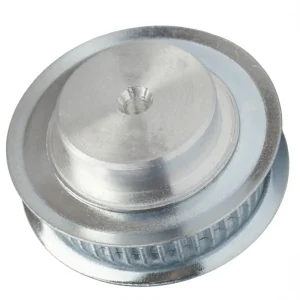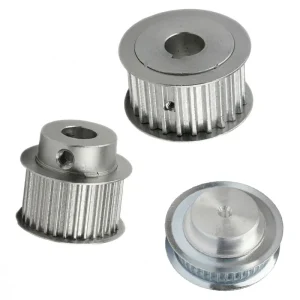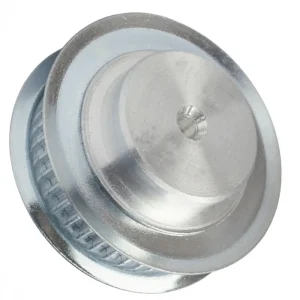
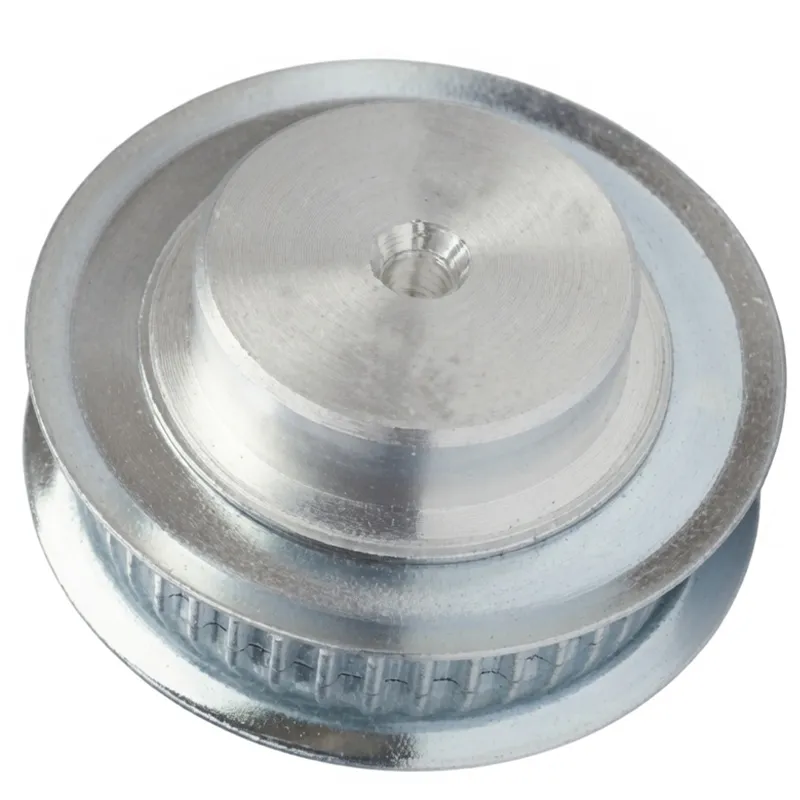
ईपी-टी 5 मिमी एल्युमिनियम टाइमिंग पुली, बेल्ट की चौड़ाई 16 मिमी | स्ट्रेट बोर टाइमिंग पुली
The EP-T5 5mm aluminium timing pulley for 16mm Belt Width series features lightweight aluminium timing pulleys designed for precision drives using 16mm wide belts with a 5mm pitch. Available in tooth counts from 10 to 60, these pulleys (Type 6F/6) maintain a consistent face width (F) of 21mm and overall length (L) of 27mm. Bore diameters (Dm) range from 8mm to 65mm, accommodating diverse shaft requirements, while outer diameters (De) span 15.05mm to 94.65mm. Most models include flanges (Type 6F) for reliable belt tracking, with specific flange numbers provided for compatibility. Ideal for automation, robotics, and light machinery requiring accurate synchronization and reduced rotational inertia.
T5 Series | China Timing Pulley | 5 mm Metric Pitch
EP-T5 5 mm Pitch
एल्युमिनियम टाइमिंग पुली
T5 pitch 5.000 mm • 16 mm belt width • 10 to 60 teeth • All Type 6F / Type 6 • F = 21 mm • L = 27 mm • ISO 9001:2015 certified
1. Technical Specifications — EP-T5-27 Aluminium Timing Pulley
T5 Series • Pitch 5.000 mm • Belt width 16 mm • Material: Aluminium • F = 21 mm (all sizes) • L = 27 mm (all sizes)
Dp = Pitch Diameter (mm) • De = Outside Diameter (mm) • Df = Flange OD (mm) • Dm = Hub OD (mm) • d = Bore diameter (mm; – = solid, customer to bore)
| भाग कोड | दाँत | प्रकार | सामग्री | डीपी (मिमी) | दे (मिमी) | डीएफ (मिमी) | डीएम (मिमी) | एफ (मिमी) | एल (मिमी) | डी (मिमी) | फ्लेंज क्रमांक |
|---|---|---|---|---|---|---|---|---|---|---|---|
| 10T5‑27 | 10 | 6F | AL (Aluminium) | 15.92 | 15.05 | 19.5 | 8 | 21 | 27 | – | 3 |
| 12T5‑27 | 12 | 6F | 19.10 | 18.25 | 23 | 11 | 21 | 27 | – | 1 | |
| 14T5‑27 | 14 | 6F | 22.29 | 21.45 | 25 | 13 | 21 | 27 | – | 2 | |
| 15T5‑27 | 15 | 6F | 23.88 | 23.05 | 28 | 16 | 21 | 27 | – | 4 | |
| 16T5‑27 | 16 | 6F | 25.47 | 24.60 | 32 | 18 | 21 | 27 | – | 5 | |
| 18T5‑27 | 18 | 6F | 28.65 | 27.80 | 32 | 20 | 21 | 27 | – | 6 | |
| 19T5‑27 | 19 | 6F | 30.25 | 29.40 | 36 | 20 | 21 | 27 | – | 8 | |
| 20T5‑27 | 20 | 6F | 31.83 | 31.00 | 36 | 22 | 21 | 27 | – | 8 | |
| 22T5‑27 | 22 | 6F | 35.02 | 34.15 | 38 | 23 | 21 | 27 | – | 9 | |
| 24T5‑27 | 24 | 6F | 38.21 | 37.40 | 42 | 24 | 21 | 27 | – | 13 | |
| 25T5‑27 | 25 | 6F | 39.80 | 38.95 | 44 | 26 | 21 | 27 | – | 12 | |
| 26T5‑27 | 26 | 6F | 41.39 | 40.60 | 44 | 26 | 21 | 27 | – | 12 | |
| 27T5‑27 | 27 | 6F | 42.98 | 42.20 | 48 | 30 | 21 | 27 | 8 | 11 | |
| 28T5‑27 | 28 | 6F | 44.58 | 43.75 | 48 | 32 | 21 | 27 | 8 | 11 | |
| 30T5‑27 | 30 | 6F | 47.76 | 46.95 | 51 | 34 | 21 | 27 | 8 | 16 | |
| 32T5‑27 | 32 | 6F | 50.94 | 50.10 | 54 | 38 | 21 | 27 | 8 | 18 | |
| 36T5‑27 | 36 | 6F | 57.31 | 56.45 | 64 | 38 | 21 | 27 | 8 | 23 | |
| 40T5‑27 | 40 | 6F | 63.66 | 62.85 | 66.5 | 40 | 21 | 27 | 8 | 24 | |
| 42T5‑27 | 42 | 6F | 66.86 | 66.00 | 70 | 40 | 21 | 27 | 8 | 26 | |
| 44T5‑27 | 44 | 6 | 70.05 | 69.20 | – | 45 | 21 | 27 | 8 | – | |
| 48T5‑27 | 48 | 6 | 76.42 | 75.55 | – | 50 | 21 | 27 | 8 | – | |
| 60T5‑27 | 60 | 6 | 95.52 | 94.65 | – | 65 | 21 | 27 | 8 | – |
All dimensions in millimeters. F = 21 mm and L = 27 mm are constant across all 22 T5-27 part numbers. Bore (d = –) indicates solid hub with no pre-bored hole — customer bores to required shaft diameter. Custom bore diameters, anodizing, and hard-coat surface treatments available on request.
2. About Our EP-T5-27 Aluminium Timing Pulley
The EP-T5-27 is a precision-machined एल्युमिनियम टाइमिंग पुली manufactured to the T5 metric pitch standard, with a tooth pitch of 5.000 mm. The T5 series sits in the light-duty segment of the metric synchronous belt drive family — above the T2.5 series (2.5 mm pitch) and below the T10 series (10 mm pitch) — providing the combination of compact pitch diameter and moderate load capacity that suits high-speed, low-mass drive applications in automation, robotics, medical devices, and office equipment. The T5-27 designation indicates T5 pitch profile with 16 mm belt width compatibility, with the belt width suffix code 27 specifying the matched flange and face width for standard 16 mm T5 timing belts.
The product range covers 23 part numbers from 10 teeth (Dp 15.92 mm) to 60 teeth (Dp 95.52 mm), all manufactured in aluminium alloy throughout. Aluminium is the standard material for T5 series timing pulleys in the 16 mm belt width class because the small pitch diameters and light transmitted torques in T5 drives do not require the higher strength of steel, while the low density of aluminium minimises the rotational inertia of the pulley — an important parameter in servo-driven automation applications where fast acceleration and deceleration cycles require the drive inertia to be kept as low as possible.
The F flange-to-flange dimension is maintained at 21 mm and the hub length L at 27 mm across all 23 standard part numbers, providing the dimensional consistency across the T5-27 range that simplifies machine design and spare-part standardization. This series is supplied with the bore pre-machined to the standard dimension listed in the dimensional table — ranging from no pre-bore (– indicated in the table) for the smallest pulleys where the hub diameter is too small for a standard bore, up to 8 mm for the 27-tooth and larger sizes. All sizes with a bore can be re-bored or keyway-broached by the customer to any required shaft diameter up to the maximum available from the hub diameter.
3. Five Key Product Advantages of Aluminium Timing Pulley
Aluminium alloy (6061-T6 or equivalent) has a density approximately one-third that of steel, directly reducing the rotational inertia (J = ½mR²) of the timing pulley at any given pitch diameter. In servo motor and stepper motor driven automation systems — where the torque available to accelerate the load is limited and fast cycle times require high angular acceleration of the driven inertia — minimising pulley inertia is a primary design goal. The EP-T5-27 range allows drive designers to achieve the required belt speed and torque ratio while keeping total drive inertia within the servo motor rated inertia range, enabling tighter control loops and faster cycle times.
The 23 part numbers in the T5-27 series cover pitch diameters from 15.92 mm (10 teeth) to 95.52 mm (60 teeth), supporting reduction ratios from near-unity through to 6:1. Having the full tooth count range available from a single China timing pulley supplier eliminates sourcing delays that arise when non-standard tooth counts must be special-ordered from multiple vendors.
Both the flange width (F = 21 mm) and hub length (L = 27 mm) are constant across all 23 part numbers in the T5-27 series. This dimensional uniformity means that every pulley in the drive train — whether at the motor shaft or the driven axis — occupies the same axial space and accepts the same width timing belt. Machine designers can route T5 timing belts past multiple pulleys without adjusting axial spacing, and maintenance teams can replace any pulley in the system with a same-tooth-count unit from stock without any machine adjustment, since all T5-27 pulleys share identical mounting dimensions.
The T5 tooth profile is defined by ISO 5296-1 (Synchronous Belt Drives — Metric Pitch) and is internationally standardized, ensuring that T5-27 pulleys from our facility mesh correctly with T5 timing belts from any compliant supplier worldwide. This standard profile compatibility is the fundamental interchangeability guarantee that global OEM machine builders rely on when sourcing replacement timing pulleys for installed machines — the replacement pulley must produce the same tooth contact geometry and pitch diameter as the original, regardless of which manufacturer supplies it.
All Type 6F pulleys (10 to 42 teeth) carry flanges with outer diameters listed in the Df column of the dimensional table. These flanges provide positive lateral retention of the T5 timing belt during operation, preventing belt edge walk-off under axial forces generated by shaft misalignment, belt entry angle variation, or lateral vibration in the drive system. The Type 6 pulleys (44, 48, and 60 teeth) omit separate flanges and rely on drive geometry for belt tracking — a standard approach at larger T5 pitch diameters where belt tension across the wide arc of contact provides natural retention.
4. Working Principle — How the T5 Aluminium Timing Pulley Drives a Synchronous Belt System
The T5 एल्युमिनियम टाइमिंग पुली and T5 timing belt form a positive meshing synchronous drive system — each belt tooth engages a matching pulley tooth space as the belt wraps around the pulley, transmitting torque without slip at a fixed velocity ratio. This zero-slip characteristic distinguishes timing belt drives from friction-based drives (V-belt, flat belt), making the T5-27 series the standard choice for any automation axis where position accuracy must be maintained over thousands of cycles without recalibration.
The pitch of the T5 series is exactly 5.000 mm — the center-to-center distance between adjacent pulley teeth. The pitch diameter is Dp = (Teeth × 5.000) / π. For the 20-tooth T5-27 pulley, Dp = 20 × 5.000 / π = 31.83 mm, matching the table. The outside diameter (De) is approximately 0.87 mm less than Dp for the T5 profile, reflecting the standard T5 dedendum correction. The pitch diameter — not the outside diameter — is used for all center distance and belt length calculations. Mixing these two diameters in a center distance calculation produces a drive that is either too tight or too slack at actual installation, causing either accelerated belt wear or reduced load capacity from insufficient belt tension.
In the T5-27 series, the aluminium hub provides sufficient wall thickness between the bore and the tooth root for the torque levels typical of T5 belt drives. The T5 profile is sized for belt widths of 10, 16, and 25 mm; the T5-27 suffix specifies the 16 mm width. Larger belt widths can transmit proportionally higher torque, but the T5-27 range — with F = 21 mm matching the 16 mm belt edge clearance requirement — is the standard medium-duty T5 configuration covering the majority of automation, robotics, and light industrial drive applications globally.
The bore (d) dimension identifies the standard pre-machined bore for each part. Where d is shown as – (no bore), the hub is supplied as solid aluminium ready for customer boring. Where d = 8 mm is listed (27-tooth and larger), a pre-drilled 8 mm pilot bore is provided that can be enlarged by reaming or boring to any required shaft diameter within the available hub wall clearance. The absence of a keyway in the standard T5-27 supply is normal — T5-27 units are typically mounted on smooth shafts with a set screw on a ground shaft flat, or on motor shafts directly with a single set screw, as the low torque levels of T5 belt drives do not typically require a keyed connection.
5. Materials and Construction of Aluminium Timing Pulley
The aluminium material used throughout the T5-27 series reflects a deliberate engineering choice optimized for the torque, speed, inertia, and environmental requirements of T5 metric-pitch belt drives. The following covers key material and manufacturing aspects.
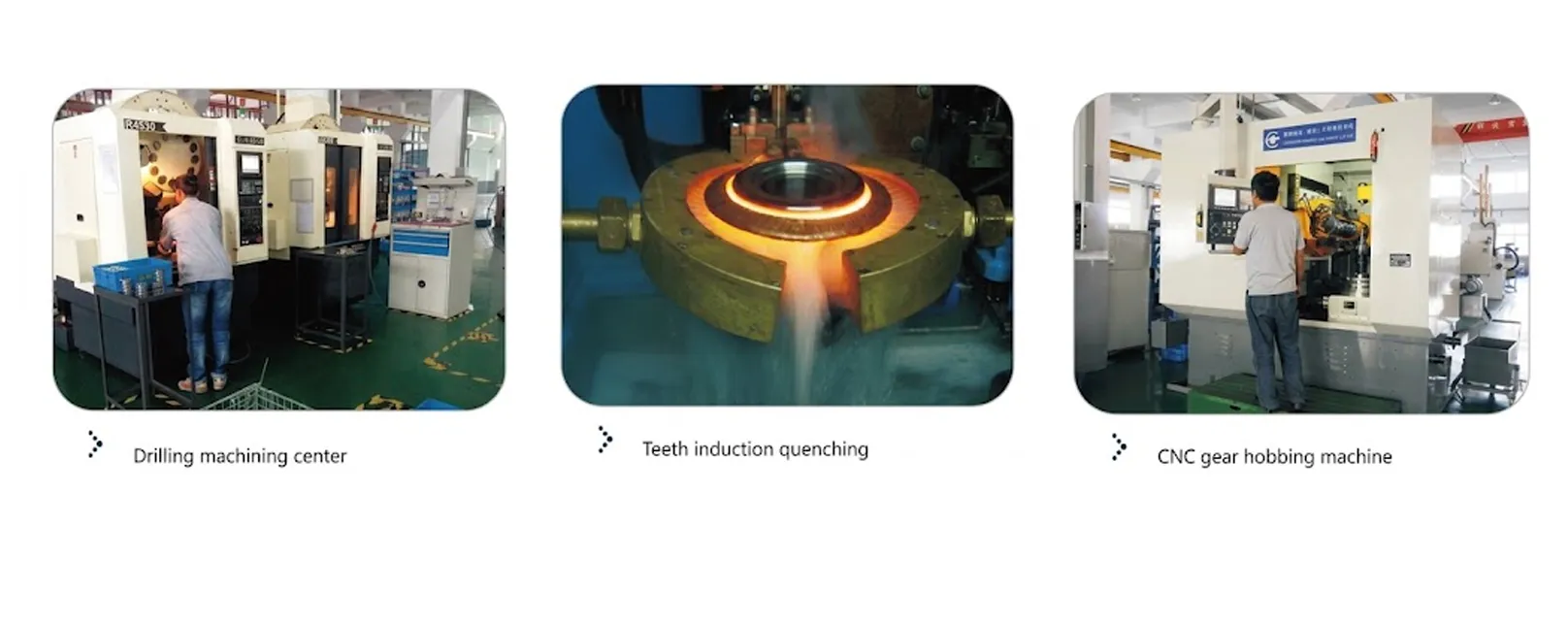
The T5-27 body is machined from 6061-T6 aluminium alloy bar stock (or equivalent EN AW-6082 T6 for European market supply), providing a yield strength of approximately 276 MPa. This strength level is adequate for the tooth root bending stress generated at T5 pitch tooth dimensions under the rated belt tension for 16 mm wide T5 belts. Aluminium alloy 6061-T6 machines to excellent dimensional accuracy and surface finish on CNC turning and hobbing equipment, enabling the tooth profile and bore dimensions to meet the ISO 5296-1 tolerance grades required for correct belt mesh and rated drive performance.
The T5 tooth profile is a trapezoidal form with a 5.000 mm pitch, specified in ISO 5296-1 as part of the metric synchronous belt drive series. The tooth height, flank angle, and root radius are machined to the tolerances defined in the standard, ensuring correct belt tooth seating and pitch line position when meshed with an ISO 5296-1-compliant T5 timing belt. The aluminium tooth surface, while softer than steel, provides adequate wear resistance for the normal operating loads of a 16 mm T5 belt drive at typical automation and office equipment speeds. For higher load or abrasive environments, hard anodizing the tooth surfaces provides a surface hardness exceeding 300 HV, significantly extending tooth life.
Standard EP-T5-27 series pulleys are supplied in natural (uncoated) aluminium condition, with the machined tooth and bore surfaces left bright for dimensional accuracy verification. An optional Type II anodizing treatment (clear or black, 10 to 20 microns) improves corrosion resistance in humid environments. Type III hard anodizing (25 to 50 microns) provides higher surface hardness for tooth wear resistance. Both options are factory-applied; specify at order placement.
The flanges on Type 6F pulleys (10 to 42 teeth) are aluminium plate discs identified identified by the Flange Number in the dimensional table. Each flange is precision-turned to the Df outer diameter listed for that tooth count, providing the lateral retention gap between the belt edge and flange face consistent with the ISO 5296-1 belt-to-flange clearance specification. Type 6 pulleys (44, 48, and 60 teeth) in the T5-27 series omit flanges; the larger diameter of these pulleys provides inherent belt retention through the improved arc of contact and belt tension distribution at larger T5 pitch diameters.
Need custom bore sizes, hard anodizing, or non-standard tooth counts in T5 or other metric pitches? Our timing pulley manufacturer team is ready to assist with full technical support and rapid quotation.
6. Regulatory Compliance — International Standards
T5 metric pitch aluminium timing pulleys are used globally across automation, robotics, medical, and industrial equipment sectors and are subject to the dimensional, material, and safety standards of the markets where the completed machinery is installed.
ISO 5296-1 (Metric Synchronous Belt Drives — Pulleys): The primary international standard defining the T5 tooth profile dimensions, pitch accuracy, and dimensional tolerances for metric synchronous belt pulleys. Our T5-27 aluminium timing pulley series is manufactured to ISO 5296-1 compliance, ensuring direct T5 belt-to-pulley interchangeability with belts from any globally compliant T5 belt supplier. European machine builders specifying T5 drives for CE-marked equipment can reference ISO 5296-1 conformance in the machine technical file as part of the power transmission component specification.
यूरोपीय संघ मशीनरी निर्देश 2006/42/ईसी और ईएन आईएसओ 4413: Machines incorporating T5 aluminium timing pulleys and sold in the European Union must carry CE marking under the Machinery Directive. The timing belt drive must be guarded per EN 953 and the hydraulic (or in this case, mechanical) power system must conform to EN ISO 4413 general rules. Material conformity certificates for the aluminium alloy used in our T5-27 pulleys, together with dimensional inspection records, are available on request to support the machine technical file of the CE-marked equipment.
REACH and RoHS Compliance (EU): Aluminium alloy 6061-T6 does not contain substances of very high concern listed under the EU REACH regulation (EC 1907/2006), and natural aluminium pulleys are compatible with EU RoHS 2 requirements for electrical and electronic equipment applications. For medical device and laboratory automation customers requiring REACH and RoHS compliance declarations, our documentation team can provide the necessary substance declarations on request.
JIS B 1855 (Japan — Metric Timing Belt Pulleys): The Japanese industrial standard for metric synchronous belt pulleys specifies equivalent T5 profile dimensions to ISO 5296-1. Japanese automation and robotics equipment manufacturers specifying T5 timing belt pulleys for both domestic and export machine variants can source EP-T5-27 aluminium timing pulleys with confidence that the dimensional specifications are compatible with JIS B 1855-compliant T5 timing belts available from major Japanese belt suppliers.
आईएसओ 9001:2015 गुणवत्ता प्रबंधन: Production of EP-T5-27 aluminium timing pulleys operates under our ISO 9001:2015 certified quality management system covering CNC turning, hobbing, bore machining, dimensional inspection, and dispatch. Material certificates, dimensional inspection records, and ISO 9001 conformity documentation are provided on request for global OEM and distributor customers with vendor qualification requirements.
7. Application Scenarios
The EP-T5-27 एल्युमिनियम टाइमिंग पुली is designed for light-to-medium duty synchronous belt drive applications where low inertia, compact size, and T5 metric belt compatibility are the primary selection criteria. The following scenarios represent the main applications where T5 metric pulleys in the 16 mm belt width class deliver optimum performance.
The primary application for T5-27 pulleys is in servo motor and stepper motor driven positioning axes — XY gantries, pick-and-place heads, label applicators, and filling machine dosing axes — where the low rotational inertia of the aluminium timing pulley allows the motor to achieve high angular acceleration without exceeding the motor rated peak torque. The EP-T5-27 range covers motor shaft pulleys from 10 to 25 teeth and driven shaft pulleys from 25 to 60 teeth, providing the reduction ratios most commonly needed in servo axis belt-drive designs used across global industrial automation equipment.
Desktop 3D printers (FDM, resin), laser engravers, and compact CNC routing machines use T5 metric timing belt and pulley combinations for their XY motion systems. The compact pitch diameter of the T5 series — as small as 15.92 mm at 10 teeth — allows the pulley to be mounted directly on standard NEMA 17 stepper motor shafts (5 mm diameter) with minimal machine frame width, while the aluminium construction minimises shaft loading from the low rotating mass of the timing pulley and belt system. The T5-27 series covers the standard tooth counts used in most desktop machine tool axis designs globally.
Medical diagnostic instruments, automated liquid handling systems, and laboratory robotic sample handlers use T5-27 pulleys for their pipette drive and carousel positioning mechanisms. Aluminium is compatible with the cleanroom and sterile environment requirements of these applications — aluminium does not rust, produces no lubrication requirement, and the anodizing option provides an inert, particle-free surface suitable for use near biological samples. The low inertia of the T5-27 pulley is particularly valuable in micro-stepping liquid dispensing drives where each motor step must produce a controlled incremental movement of the dispensing head without overshoot.
High-speed document scanners, laser printers, and photocopier paper transport systems use T5 aluminium timing pulleys for paper feed rollers, platen drive, and ADF (automatic document feeder) transport mechanisms. The combination of light weight, correct T5 pitch, and low rotational inertia minimises the energy consumed in each paper advance cycle, contributing to the energy efficiency specification of the equipment. The tight pitch accuracy of the ISO 5296-1-compliant T5-27 pulley ensures consistent paper advance distance per motor step, maintaining document scan quality and print registration over millions of cycles.
In high-speed packaging machinery, T5-27 pulleys are used for auxiliary drives — label reel feed tensioners, film registration sensors, and date-code printer carriage drives — where the main machine drive uses larger H or L-pitch pulleys and the auxiliary T5 drives handle lightweight positioning tasks. The compact T5-27 range covers the small-diameter motor shaft pulleys and the slightly larger driven pulleys used in these auxiliary positions, allowing the machine builder to use a consistent T5 metric belt width for all auxiliary positions rather than mixing multiple belt pitch families.
Collaborative robot (cobot) arm joints, SCARA robot wrist drives, and delta robot link actuators use T5 aluminium timing pulleys and belts for their final reduction stages and cross-body cable-and-pulley transmission systems. The compact dimensions of the T5-27 series — Dp 15.92 to 95.52 mm — fit within the narrow link cross-sections of modern robot arm designs, and the low mass of the aluminium timing pulley minimises the distal arm inertia that the shoulder and elbow joints must accelerate. Robot joint belt drives typically use very high belt tension relative to the torque capacity, making the pull-through behaviour of the aluminium tooth profile the primary design constraint — specification of hard anodized T5 series pulleys is recommended for high-cycle robot joint applications.
8. Compatible Products
The EP-T5-27 aluminium timing pulley is the rotary component of a complete T5 metric synchronous belt drive system. We supply compatible drive components from the same product range for complete system sourcing.
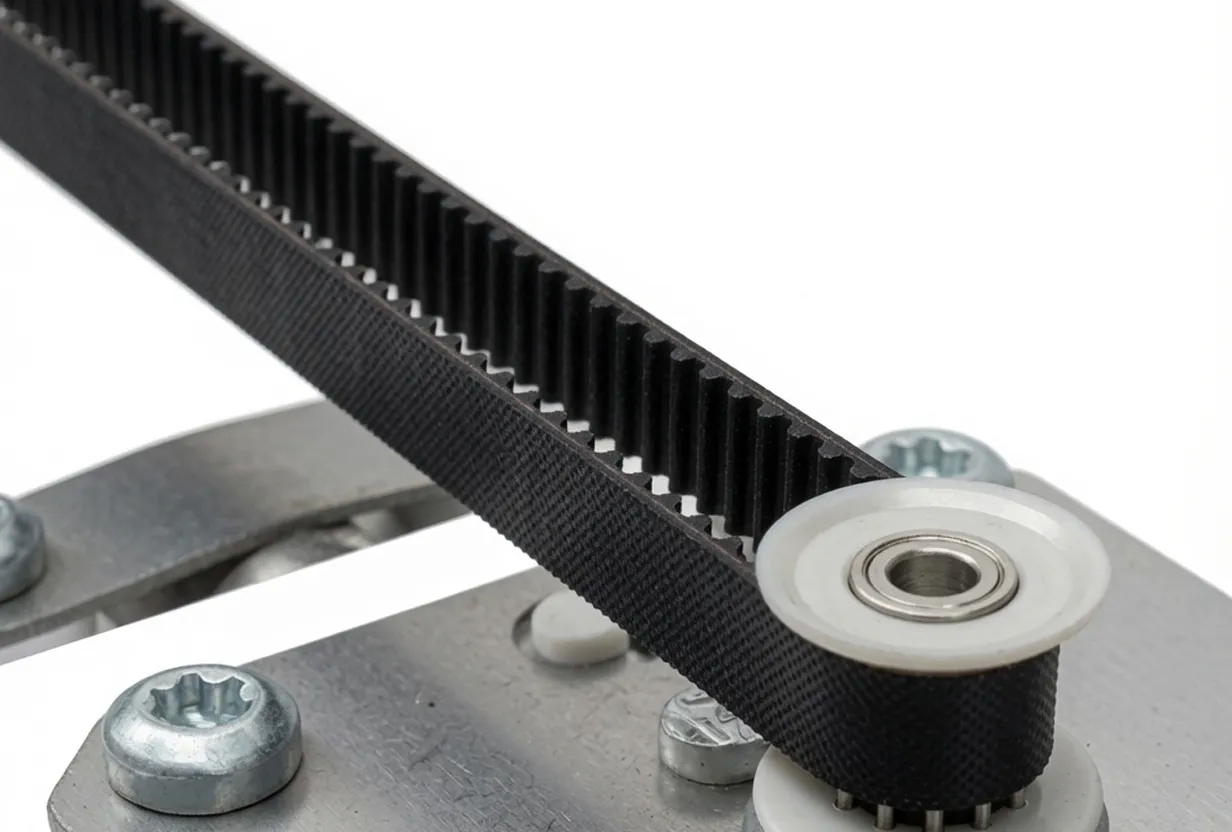
T5 metric pitch toothed bars are used where the T5 belt drive converts rotary motion to linear motion — in XY gantry systems, belt-driven linear rails, and open-belt linear axes for 3D printers and CNC machines. The toothed bar replaces the driven pulley in linear applications, and the same T5 16 mm belt runs over the motor-side T5-27 pulley and along the toothed bar to produce the required linear displacement per motor revolution. Our T5 toothed bar range is dimensionally matched to the T5-27 aluminium timing pulley tooth profile, ensuring correct mesh engagement and rated linear force output.
In machinery where a main V-belt drive provides primary speed reduction from the motor before a T5 synchronous belt drive handles the final precision positioning stage, our V-belt pulley range complements the T5-27 product family. Sourcing both V-belt pulleys and T5 metric pulleys from the same China timing pulley supplier consolidates documentation, simplifies vendor qualification, and ensures consistent quality standards across both drive types in the machine. Our V-belt pulley range covers classical section (A, B, C) and narrow section (SPZ, SPA, SPB) profiles in a full range of groove configurations.

9. About Us — Timing Pulley Manufacturer
We are a specialist timing pulley manufacturer and global supplier operating ISO 9001:2015 certified CNC production lines for the complete range of metric-pitch (T2.5, T5, T10, AT5, AT10, HTD 3M, 5M, 8M, 14M, GT2, GT3) and inch-pitch (MXL, XL, L, H, XH, XXH) timing pulleys in aluminium, steel, and cast iron. The EP-T5-27 series is our standard light-duty metric pitch offering for global automation, robotics, and precision machine OEM customers.
कार्यशाला



अक्सर पूछे जाने वाले प्रश्नों
Q1. What is the pitch diameter formula for T5 aluminium timing pulleys and how do I calculate it for any tooth count in the T5-27 series?
Q2. Why is aluminium used for T5 timing pulleys instead of steel, and when should I specify a steel or stainless steel T5 timing pulley instead?
Q3. How do I get a quote for custom T5 aluminium timing pulleys with non-standard bore sizes for a servo motor axis in a medical device application?
Q4. What is the difference between T5 and AT5 timing belt and pulley series, and when should I use AT5 instead of standard T5?
Q5. How do I mount a T5-27 aluminium timing pulley onto a 5 mm stepper motor shaft with no set screw flat and no keyway?
Q6. Where can global machine builders source T5 aluminium timing pulleys in bulk from a China timing pulley manufacturer with short lead times and ISO documentation?
Q7. What timing belt should be paired with the T5-27 aluminium timing pulley and how do I calculate the correct belt length for my center distance?
Q8. What is the maximum belt speed and maximum RPM for T5 aluminium timing pulleys in high-speed automation axis applications?
Q9. Does hard anodizing the T5-27 aluminium timing pulley affect the tooth profile dimensions and will it still mesh correctly with a standard T5 belt?
संपादक: पीएक्सवाई