
About
Our Story
China Timing Pulley exists because too many buyers were getting a timing pulley that matched the drawing on paper and not on the part. A pitch diameter that’s off by a few hundredths of a millimeter doesn’t show up in a spec sheet comparison. It shows up six weeks later as a belt that’s started to climb the flange, or a bore that won’t seat flush against a taper lock bushing. We started cutting our own tooth profiles in-house specifically to close that gap between what a drawing says and what a machine actually produces.
That decision shaped everything that followed. Rather than carrying a wide, shallow catalog of whatever was easy to source, we built depth in one category: timing pulleys, across the tooth profiles that actually matter to industrial machine builders — ISO 5294 trapezoidal teeth, DIN 7721 metric T-series, the reinforced AT profile, and the curvilinear HTD and PC standards used on heavier drives. Ten product series, each one we machine, inspect, and stand behind ourselves.

Core Business at a Glance
| Product lines | 10 pulley series |
| Bore types | Straight & taper-lock |
| Tooth standards | ISO 5294, DIN 7721, HTD |
| Materials worked | Aluminium, steel, cast iron |
OEM / ODM
Manufacturing Capability
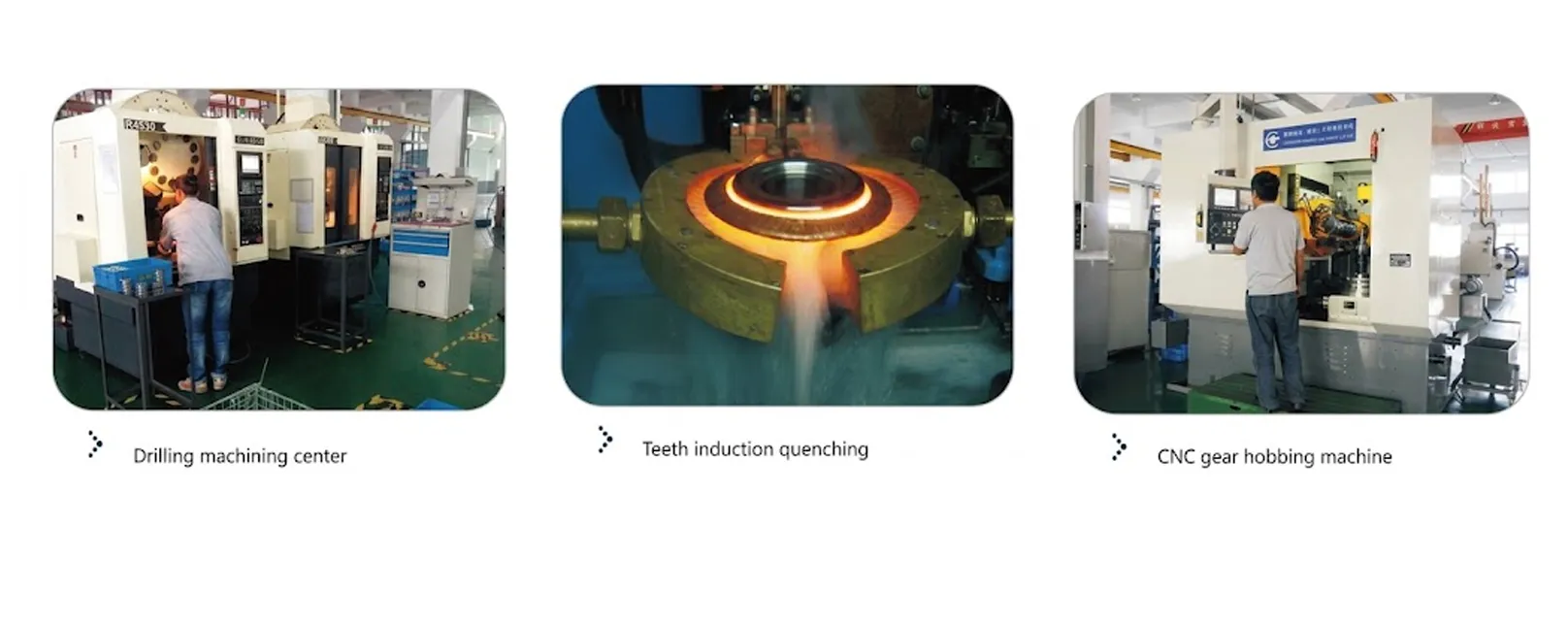
Our floor runs CNC gear hobbing machines, precision lathes, and dedicated tooth-shape grinding equipment side by side with gantry machining centers for larger HTD and PC-series blanks. Heat treatment — induction quenching on tooth roots, tempering on shafted parts — happens in-house rather than at a subcontractor we’d have to chase for turnaround.
Quality Control
Every production run passes through profile projectors and image measuring instruments for tooth geometry, a microhardness tester for heat-treated parts, and a metalloscope for material structure checks. We operate under an ISO 9001 quality management framework, with material certificates retained against each batch.
Engineering & Customization
Standard catalog sizes cover most requests, but our engineering team regularly works from customer drawings and worn sample parts to produce custom timing pulleys outside the published range — modified bores, special flange profiles, or tooth counts between standard steps.

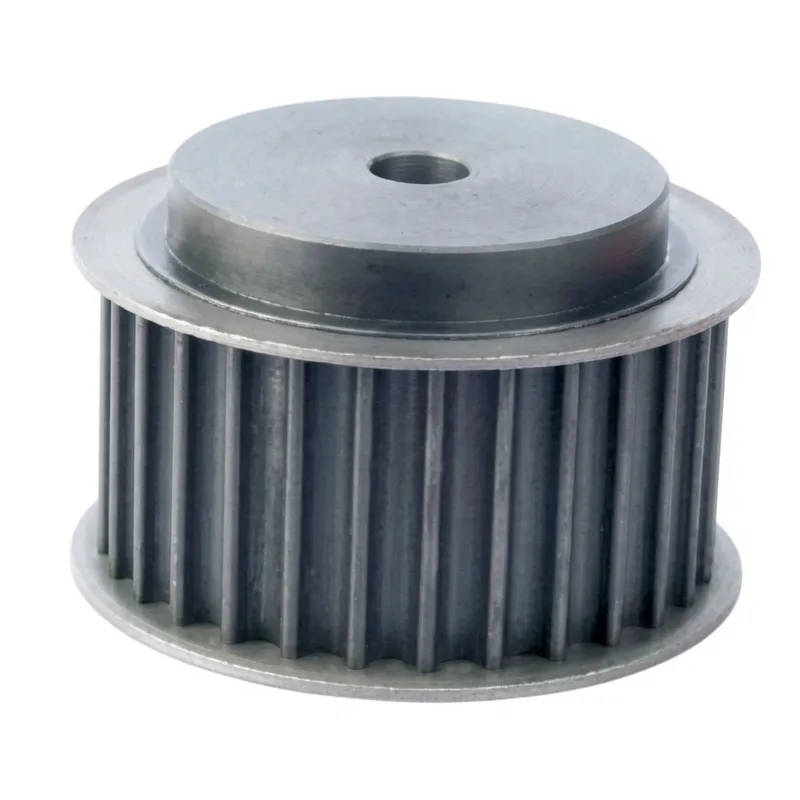

Professionele Chinese fabrikant van distributiepoelies | Parameteraanpassing mogelijk
From Billet to Boxed Pulley
Each timing pulley moves through the same checked sequence, regardless of which of the ten series it belongs to.
Material In
Aluminium, steel, or cast iron billet checked against mill certificates.
CNC Machining
Turning, gear hobbing, and tooth-shape grinding to the called-for profile.
Heat Treatment
Induction quenching and tempering where the application calls for it.
Inspection
Profile projector and microhardness checks against the original drawing.
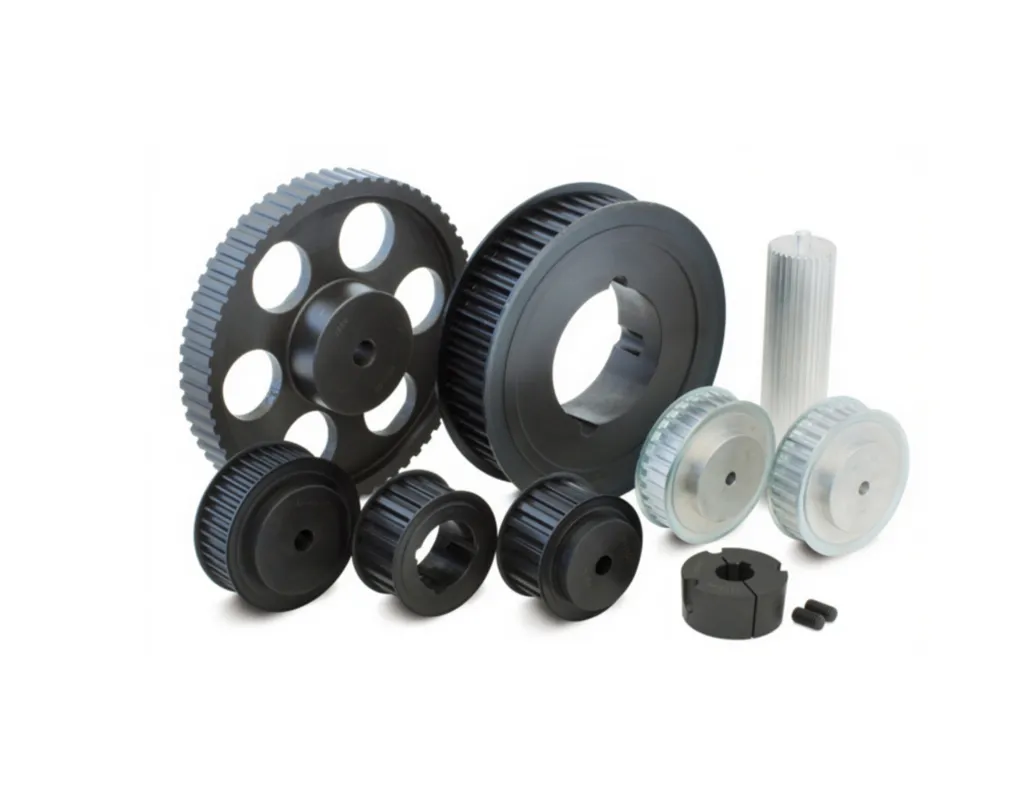
The three standards we cut against — ISO 5294, DIN 7721, and the HTD curvilinear profile — exist because timing belts and pulleys need to be interchangeable across manufacturers, not just internally consistent within one factory’s catalog. ISO 5294 governs the older trapezoidal-tooth families: MXL, XL, L, H, and XH, sized in inch-derived pitches that trace back to early industrial timing belt adoption. DIN 7721 covers the metric T-series — T2.5, T5, and T10 — which dominates European-built machinery and is specified by belt width as much as by pitch. Metric timing pulleys built to this standard are sized so a 10mm-wide T5 belt from one supplier seats correctly on a T5 pulley from another, provided both parties actually held the standard’s tolerance band.
HTD and its heavier PC-series sibling aren’t governed by a single universal ISO document in the same way — they originated as a proprietary curvilinear profile and became a de facto industry standard through adoption rather than formal standardization. That history matters practically: a timing belt drive pulley built to HTD 8M from one shop should still mesh correctly with an HTD 8M belt from another, but the margin for tooth-profile drift is tighter than on the older trapezoidal standards, since the rounded tooth root was specifically engineered to reduce stress concentration under high torque. A pulley cut slightly off that curve doesn’t fail outright — it just wears the belt faster than the rated service life would suggest, which is the kind of problem that’s hard to diagnose after the fact.
This is also why a timing belt idler pulley and a timing belt tensioner pulley, even though neither one transmits driven torque the way a primary drive pulley does, still need to hold the same tooth-profile tolerance as the powered pulleys in the system. An idler or tensioner that’s slightly out of profile won’t show symptoms immediately, but it introduces a small phase error every time the belt passes over it — and on a long enough belt loop with several idlers, those small errors compound into measurable backlash. The same logic extends to a timing chain pulley used with roller chain instead of a toothed belt: the sprocket geometry is different, but the underlying requirement is identical, holding a fixed mechanical ratio without cumulative drift. We treat every pulley in an assembly, powered or not, against that same standard, because a system is only ever as accurate as its least-checked component.
What Each Pulley Is Actually Made Of
Smaller-pitch profiles — MXL, XL, T2.5, T5, and AT5 — are predominantly machined as an aluminium timing pulley, and for good reason: at low tooth counts the part is doing a fast, light-load job, usually positioning rather than power transmission, and the lower rotating mass of aluminum keeps inertia down on quick start-stop cycles. An aluminum timing pulley also resists corrosion well without coating, which matters in food-grade and washdown environments.
Mid-range L, H, T10, AT10, and the smaller HTD sizes move to steel once tooth-root stress and bore side-load climb past what aluminium can sustain through repeated cycling. Steel also accepts a tighter, more durable bore finish, which is the deciding factor on any taper-bore part: a taper lock bushing needs a consistent, wear-resistant mating surface to maintain clamping force over years of service, and a softer material would gradually lose that grip.
At the largest end of the range — HTD 14M, PC8M, and PC14M pulleys running anywhere from roughly fifty to nearly two hundred teeth — we cast and machine in iron. Cast iron’s higher mass relative to its cost dampens vibration and absorbs shock loading more effectively than a comparably sized steel or aluminium part would, which matters on heavy conveyor and elevator drives where the pulley is also acting, in part, as a flywheel that smooths out torque pulses across each rotation.
