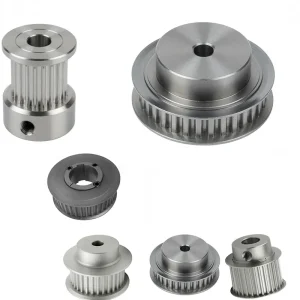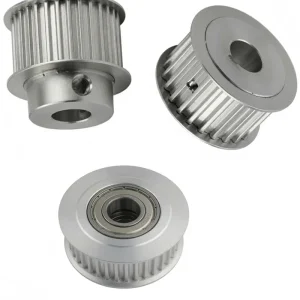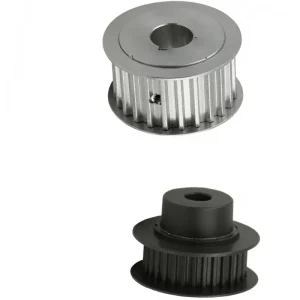
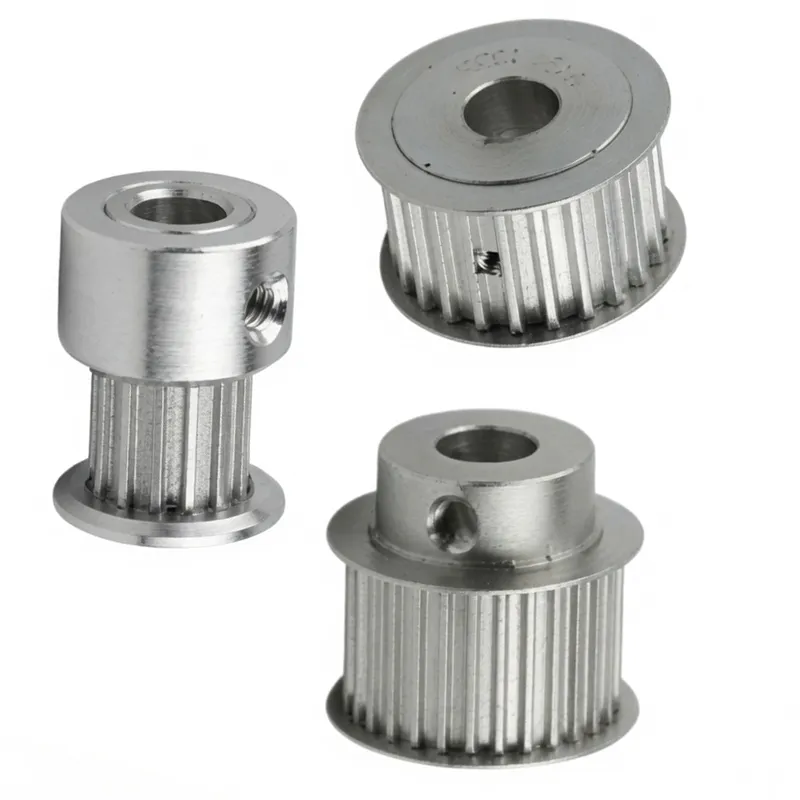
EP-MXL 2.032MM aluminium distributiepoelie met rechte boring
The EP-MXL 025 straight bore timing pulley is part of the MXL (Miniature Extra Light) series aluminum timing pulley range. MXL refers to the belt pitch standard: 2.032 mm (0.080 inch) tooth pitch, which positions this pulley in the smallest-pitch category of synchronous belt drive components. The straight bore design means the bore runs through the pulley hub centrally and concentrically with the pitch circle, with a standard keyway and set-screw provision for shaft mounting without additional bushing hardware.
MXL Series — Timing Pulley - timing belt and pulley drive system
EP-MXL 2.032MM aluminium distributiepoelie met rechte boring
A precision aluminum straight bore timing pulley in the MXL 025 series, featuring a 2.032 mm pitch. Available in 15 standard tooth counts from 16T to 72T, material AL (aluminum), with single-flange (1F) and six-flange-bolt (6F) type configurations. Designed for light-duty timing belt pulley and belt drive systems in office automation, medical devices, instrumentation, and compact industrial machinery worldwide.
Belangrijke technische feiten
MXL 025 (2.032 mm pitch)
Rechte boring (met spiebaan)
Aluminum alloy (AL)
16T to 72T (15 sizes)
8.5 mm or 11 mm
16 mm (all sizes)
1. MXL 025 Series — Full Dimensional Specifications Table
Pitch: 2.032 mm (MXL). Material: AL (Aluminum). All dimensions in mm. Dp = pitch circle diameter; De = outside diameter; Df = flange diameter; Dm = hub diameter; Di = bore diameter (as-machined); F = face width; L = hub length; d = key dimension; Flange No = mating flange part reference.
| Onderdeelcode | Tanden | Type | Materiaal | Dp | De | Df | Dm | Di | F | L | D | Flensnr. |
|---|---|---|---|---|---|---|---|---|---|---|---|---|
| 16 MXL 025 | 16 | 1F | AL | 10.35 | 9.84 | 15 | 15 | — | 8.5 | 16 | — | 502 |
| 18 MXL 025 | 18 | 1F | 11.64 | 11.12 | 16 | 16 | — | 8.5 | 16 | — | 503 | |
| 20 MXL 025 | 20 | 1F | 12.94 | 12.43 | 16 | 16 | — | 8.5 | 16 | — | 503 | |
| 22 MXL 025 | 22 | 6F | 14.23 | 13.72 | 17.5 | 10 | — | 11 | 16 | — | 504 | |
| 24 MXL 025 | 24 | 6F | 15.52 | 15.01 | 20 | 10 | — | 11 | 16 | — | 505 | |
| 28 MXL 025 | 28 | 6F | 18.11 | 17.60 | 25 | 11 | — | 11 | 16 | — | 506 | |
| 30 MXL 025 | 30 | 6F | 19.40 | 18.90 | 25 | 12 | — | 11 | 16 | — | 506 | |
| 32 MXL 025 | 32 | 6F | 20.70 | 20.19 | 26 | 14 | — | 11 | 16 | — | 507 | |
| 36 MXL 025 | 36 | 6F | 23.29 | 22.78 | 28 | 16 | — | 11 | 16 | — | 508 | |
| 40 MXL 025 | 40 | 6F | 25.87 | 25.37 | 32 | 18 | — | 11 | 16 | — | 509 | |
| 42 MXL 025 | 42 | 6F | 27.17 | 26.67 | 32 | 18 | — | 11 | 16 | — | 509 | |
| 44 MXL 025 | 44 | 6F | 28.46 | 27.95 | 36 | 18 | — | 11 | 16 | — | 510 | |
| 48 MXL 025 | 48 | 6 | 31.05 | 30.54 | — | 20 | — | 11 | 16 | — | — | |
| 60 MXL 025 | 60 | 6 | 38.81 | 38.30 | — | 24 | — | 11 | 16 | — | — | |
| 72 MXL 025 | 72 | 6 | 46.57 | 46.06 | — | 25 | — | 11 | 16 | — | — |
Note: Di (—) = bore diameter to be machined to customer specification. Df (—) for 48T–72T = no flange fitted. All dimensions in mm.
2. What Is a Straight Bore Timing Pulley?
A straight bore timing pulley is a synchronous belt drive component where the central bore runs parallel to the pulley rotation axis without any taper, making it the simplest and most direct method of mounting a timing pulley onto a machine shaft. In the MXL 2.032 mm pitch series, the straight bore timing pulley is produced to the international MXL belt standard, ensuring dimensional compatibility with MXL timing belts from any ISO-compliant source worldwide. The bore is machined to a specific diameter that matches the drive shaft, typically with a parallel key and matching keyway to transmit torque, and one or two radial set-screws to lock the pulley axially on the shaft. This configuration makes the straight bore timing pulley the fastest and most cost-effective timing pulley mounting solution for low-to-medium torque applications where shaft insertion and removal for maintenance must be straightforward.
The aluminum timing pulley MXL 025 series is specifically designed for the narrow pitch end of the timing belt drive spectrum, where small center distances, low belt tension requirements, and compact driven-machine dimensions combine to make the MXL pitch the logical specification. Office automation equipment — printers, plotters, scanners — medical device mechanisms, analytical instrument sample handlers, and compact CNC machine axis drives are all typical MXL timing belt pulley applications where the 2.032 mm pitch provides adequate torque transmission in a minimal spatial envelope. The straight bore configuration in this series reflects the fact that OEM machine designers specifying MXL drives are typically working with small motor shafts of Φ4 to Φ12 mm that require direct bore-to-shaft mounting without the complication of taper lock bushings or hub adapters used in larger, higher-torque drives.
Timing belt pulley types within the MXL 025 range are divided into two structural configurations: the 1F type (single-flange at one face) and the 6F type (six-bolt flange at the flange attachment ring). The single-flange type 1F is used for smaller tooth counts (16T, 18T, 20T) where the small pulley outside diameter limits the available flange attachment area. The 6F configuration applies a six-bolt circle attachment ring to the flange plate, providing a secure belt-guiding flange at the pulley face that prevents lateral belt tracking drift on wider drives. All variants have L = 16 mm hub length, which combined with the straight bore provides ample shaft engagement for the low torque loads typical of MXL drive applications while keeping the overall assembly compact enough for the dense component packing of modern precision instruments and automation equipment.
When verifying bore fit on a newly received straight bore timing pulley, the recommended practice is to measure the bore diameter with an internal micrometer or bore gauge calibrated to 0.001 mm resolution before pressing onto the shaft, confirming the H7 tolerance band is met and that no handling damage has occurred during shipment. For MXL 025 series applications with very small bore diameters below Φ6 mm, a Go/No-Go gauge set to the H7 limit is the most practical field inspection method. Shaft surface finish should also be verified — a ground shaft held to Ra 0.8 µm or better at the bore engagement zone prevents fretting corrosion at the bore-shaft interface during the cyclic loading typical of printer carriage and scanner drive applications, where the pulley experiences rapid direction reversals hundreds of thousands of times over the machine's service life.
3. Vijf belangrijke productvoordelen
Precision MXL 2.032 mm Pitch Tooth Profile for Zero-Slip Synchronous Drive
The MXL 2.032 mm pitch tooth profile is machined to the ISO / ANSI MXL standard geometry, ensuring perfect conjugate meshing with MXL timing belts regardless of brand origin. The synchronized meshing eliminates the speed ratio slip that would occur with friction V-belt or flat belt drives, making the MXL straight bore timing pulley the correct specification for drives where precise angular position synchronization is required — such as encoder-coupled drives in analytical instruments, stepper motor drives in 3D printers and CNC plotters, and stepping mechanism drives in medical sample analysis equipment where sample position accuracy directly affects measurement quality.
Aluminum Construction Delivers Low Rotational Inertia for Fast-Acceleration Drives
The aluminium timing pulley AL material in the MXL 025 series achieves approximately one third the rotational inertia of an equivalent steel timing pulley at the same bore and tooth count. In servo motor and stepper motor drive applications where the drive must accelerate and decelerate rapidly — printer carriage drives, pick-and-place mechanisms, CNC axis drives — the reduced pulley inertia directly increases the achievable acceleration rate and shortens the time required for position moves, improving machine throughput without requiring a more powerful motor. The combination of low inertia and zero-slip synchronous engagement makes the aluminum timing pulley the standard specification for this application class worldwide.
15 Tooth Count Options from 16T to 72T for Wide Speed Ratio Coverage
With 15 standard tooth counts spanning 16T through 72T, the MXL 025 straight bore timing pulley series enables drive ratio selection across a range from 1:1 (equal pulleys) through approximately 4.5:1 (16T driver to 72T driven) without requiring custom-machined components. This wide coverage means OEM machine designers can select the optimal timing pulley combination from standard catalogue parts, reducing both design lead time and part cost compared to specifying non-standard tooth counts. Standard timing pulley stock availability also supports aftermarket timing pulley replacement procurement for maintenance and service operations worldwide.
Consistent 16 mm Hub Length Across All Sizes Simplifies Machine Frame Design
The uniform L = 16 mm hub length across all 15 tooth count variants allows machine frame designers to specify a fixed pulley boss pocket depth that does not change when the drive ratio is modified by switching pulley tooth counts — a significant time saving in iterative OEM machine design where speed ratio adjustments during prototyping would otherwise require redesign of the shaft support structure. The straight bore configuration and consistent hub length also ensure that any MXL 025 pulley can be interchanged with another tooth count on the same shaft without frame modification, giving production engineers flexibility to adjust machine speed ratios through component substitution alone.
ISO-Standard Dimensions for Global Sourcing and Timing Pulley Replacement
The MXL 025 series dimensional data — pitch circle diameter (Dp), outside diameter (De), flange diameter (Df), hub diameter (Dm), face width (F), and hub length (L) — conform to the internationally published MXL timing pulley standard dimensions. This means that a 20 MXL 025 straight bore timing pulley from our series is dimensionally equivalent to any other supplier producing to the same standard, enabling transparent multi-source procurement and straightforward timing pulley replacement in existing machines without dimensional adjustment. For global procurement teams specifying timing belt pulleys for equipment manufactured in Europe, North America, or Asia, this standardization eliminates the country-specific or brand-specific dimensional variation that complicates sourcing for non-standard timing pulleys.
4. How the MXL Straight Bore Timing Pulley Works
The MXL straight bore timing pulley operates as the driving or driven wheel in a synchronous belt drive system. The pulley is mounted on a drive shaft by inserting the shaft through the straight bore, aligning the shaft keyway with the hub keyway, inserting a parallel key, and tightening the set-screw. The pulley hub keyway ensures that the drive torque is transmitted from the shaft to the pulley through the key rather than relying on friction from the set-screw alone, which would be inadequate for continuous cyclic torque loading. Once the pulley is secured on the shaft, the MXL timing belt wraps around the pulley, with the trapezoidal belt teeth engaging sequentially with the matching grooves in the pulley tooth profile as the pulley rotates. The tooth-in-groove engagement provides a positive, non-slip drive that transmits rotational motion from the driver pulley to the driven pulley at a speed ratio exactly equal to the inverse of the tooth count ratio.
The pitch circle diameter Dp — which equals teeth count multiplied by pitch divided by π — is the theoretical engagement diameter at which the belt pitch length is measured. The outside diameter De is slightly smaller than Dp by the belt half-depth amount, as the belt teeth project outward from the pitch line. The belt wraps the pulley at the pitch diameter, and the flange plate (types 1F and 6F) at one or both faces prevents the belt from tracking laterally off the pulley under misalignment or transverse loading. For the larger tooth count pulleys (48T to 72T) where no flange is fitted, the belt width-to-pulley ratio provides adequate lateral stability without a discrete flange, and the absence of the flange simplifies belt installation and removal during maintenance or belt replacement operations.
The MXL 2.032 mm pitch is the smallest pitch in the standard trapezoidal tooth timing belt series, producing the finest tooth mesh and the lowest vibration at a given belt speed compared to larger pitches. This fine pitch characteristic makes the MXL straight bore timing pulley particularly well suited to high-speed light-load drives where belt noise, vibration, and smoothness of motion are more important than maximum torque transmission capacity. The pitch selection also determines the minimum practical pulley size — the 16T MXL 025 with a Dp of only 10.35 mm is the smallest pulley in the series, enabling extremely compact drive systems in miniature instrument mechanisms and precision positioning stages where a 10 mm pulley outside diameter is a practical constraint matched to motor output shaft sizes of Φ4 to Φ6 mm.
5. Material and Construction
The aluminum material specification and machining process of the MXL 025 straight bore timing pulley determine its dimensional accuracy, surface quality, and service life in the precise miniature drive applications where this series is specified.
Aluminum Alloy Body
The aluminium timing pulley MXL 025 series uses a free-machining aluminum alloy (typically 6061-T6 or 7075 equivalent) that combines adequate yield strength (minimum 270 MPa for 6061-T6) with the machinability required to produce the fine 2.032 mm pitch tooth profile accurately by CNC gear hobbing or form milling. Aluminum density of 2.7 g/cm³ gives the pulley approximately one-third the mass of an equivalent-size steel timing pulley, directly reducing the rotational inertia that must be overcome during motor acceleration and deceleration cycles in the high-throughput automation and medical equipment applications where this pulley series is most commonly specified.
Tooth Profile Accuracy
The MXL tooth profile — a trapezoidal groove with a 40-degree included angle, specific tip radius, and root fillet — is machined on CNC gear hobbing or form-milling equipment with profile accuracy verified against the ANSI/RMA IP-24 MXL timing pulley standard. Tooth profile accuracy directly determines the quality of belt-to-pulley tooth engagement: profile errors cause belt tooth binding during entry into the pulley groove, which generates vibration and accelerates belt wear. For the small 2.032 mm pitch, the absolute tooth profile tolerances are proportionally small — on the order of 0.02 to 0.05 mm — requiring high-precision machining equipment and careful fixturing to achieve the surface finish and geometry needed for smooth, quiet belt operation at the high surface speeds common in printer and automation drive applications.
Bore and Hub Tolerances
The straight bore is machined to H7 tolerance for a precision fit with the drive shaft, which is typically held to h6 tolerance for a transition or slight interference fit that ensures accurate concentricity of the pulley pitch circle with the shaft rotation axis. Concentricity error between the bore and pitch circle directly appears as once-per-revolution vibration in the belt drive, which degrades positioning accuracy in servo-driven CNC and precision instrument drives. The hub keyway is broached to DIN 6885 or equivalent standard key dimensions for the applicable bore diameter, ensuring standard key stock can be used without custom machining.
Surface Treatment
The aluminum body is typically supplied with a natural anodized finish or clear hard anodize, which provides a thin (15-25 micrometers) aluminum oxide layer that increases surface hardness at the tooth and bore contact surfaces without significantly changing the critical tooth geometry dimensions. The anodized surface also provides corrosion protection for use in the mildly humid environments common in office automation and laboratory instrument installations. For applications requiring additional corrosion resistance — such as food processing or pharmaceutical instrument environments where the pulley may be exposed to cleaning chemical splash — a hard anodize treatment to 25-50 micrometer depth provides substantially improved chemical resistance.
Quality Inspection and Batch Traceability
Each production batch of the MXL 025 series undergoes dimensional verification using calibrated CMM (coordinate measuring machine) inspection of pitch circle runout, bore diameter, and hub length against the drawing tolerances before release. Batch traceability records — linking the alloy mill certificate, machining work order, inspection report, and shipping document — are retained under our ISO 9001 document control system and available on request to OEM customers requiring component-level traceability for their CE-marking technical files or FDA 21 CFR Part 820 device master records. This level of documented quality control distinguishes production-grade timing pulley supply from untraced catalogue stock and is particularly relevant for buyers in the medical device, analytical instrument, and defense electronics sectors where component genealogy is a regulatory expectation rather than an optional service.
6. Application Scenarios
The MXL 025 aluminum straight bore timing pulley is designed for the following primary application categories where small pitch synchronous belt drives are the correct technical specification.
Office Automation — Printers, Scanners, Plotters
Inkjet and laser printer carriage drives, scanner lamp carriage drives, and large-format plotter axis drives are among the largest-volume applications for the MXL timing belt pulley series. In these machines, a stepper or servo motor drives the print head or scanning element at speeds of 200 to 2,000 mm/s with positioning accuracy of 0.01 to 0.1 mm, requirements that are met by the MXL timing belt drive combination of synchronous motion (zero slip) and fine pitch (2.032 mm, allowing fine position resolution from a small stepper motor step count). The aluminum timing pulley low inertia enables the high acceleration rates needed for fast bidirectional carriage reversal at the end of each print pass.
Medical Devices and Laboratory Instruments
Automated liquid handling systems, DNA sequencers, clinical chemistry analyzers, and laboratory robot sample-handling mechanisms use MXL timing belt and pulley drives for their positioning axes. Medical device applications impose strict requirements on drive cleanliness — lubricant-free operation, no metal particle generation from gear mesh, and resistance to isopropanol and hypochlorite cleaning agents used in laboratory disinfection. The MXL timing belt drive meets all three requirements: the belt operates dry without lubrication, the anodized aluminum timing pulley generates no metallic wear particles under normal operation, and the aluminum and anodized surface are resistant to the cleaning chemicals used in clinical laboratory environments.
3D Printers and Additive Manufacturing Equipment
Desktop and professional FDM (Fused Deposition Modeling) 3D printers use MXL or GT2 timing belt drives for the X and Y axis carriage positioning. The straight bore timing pulley mounts directly on the stepper motor shaft Φ5 mm output with a set-screw, making the 20 MXL 025 (Dp 12.94 mm) one of the most common single-component timing pulley specifications in the global desktop 3D printer market. The 2.032 mm pitch provides fine position resolution per motor step (typically 0.01-0.02 mm per step in a 1/16-microstepping configuration with a 20-tooth MXL pulley) sufficient for the 0.1-0.4 mm layer resolution of standard FDM printing applications across global maker, educational, and professional prototyping markets.
CNC Routing and Laser Cutting Machines
Compact CNC routers, laser engravers, and vinyl cutting plotters used in signmaking, hobbyist fabrication, and small-scale manufacturing use MXL timing belt drives for their axis positioning. The straight bore timing pulley and timing belt combination provides the positional repeatability required for accurate part cutting without the backlash that affects rack-and-pinion or lead screw drives at their thread engagement zone. Timing belt idler pulleys in these systems maintain belt tension and route the belt path around non-coaxial drive points, with the MXL timing belt idler pulley typically being a smooth-bore pulley without tooth profile used purely for tension and routing rather than torque transmission.
Packaging and Food Processing Light Conveyor Drives
Small packaging machines, label applicators, and food-safe light conveyor systems use MXL timing belt drive pulleys for their index and transport mechanisms where precise indexing distance — for label placement, portion counting, or portion cutting — requires synchronous belt drive rather than friction belt. The aluminum timing pulley corrosion resistance and the availability of food-grade MXL timing belt materials allows these drives to operate in food-contact-adjacent environments that require regular cleaning without degrading the belt or pulley components beyond their normal service life. The timing belt drive pulley and belt combination in these applications also generates less noise than chain drives in the same force class, which is a workplace noise comfort requirement in food packing environments.
Robotics and Collaborative Robot Joints
Small collaborative robot (cobot) arms, delta robot pick-and-place mechanisms, and SCARA robot axes use MXL timing belt drives in their forearm and wrist joint actuation where weight and inertia minimization at the distal links is the primary design constraint. Placing the motor at the shoulder or elbow and transmitting torque to the wrist through a timing belt drive instead of at-joint gearing reduces the effective inertia at the tool tip, enabling faster dynamic response and higher maximum end-effector acceleration. The straight bore aluminum timing pulley low mass directly contributes to the distal weight budget of the robot arm design, and the MXL pitch provides adequate torque for the small-payload (0.5-5 kg) cobot and delta robot applications that dominate the current precision assembly and pharmaceutical automation market.
7. Regulatory and Standards Context
The MXL 025 straight bore timing pulley conforms to the following international standards and regulatory frameworks applicable to its primary end-use markets.
ANSI/RMA IP-24 — Miniature Pitch Timing Belts and Pulleys: The primary US and international standard defining the MXL tooth profile, pitch dimensions, and pulley groove geometry. Pulleys produced to ANSI/RMA IP-24 are dimensionally interchangeable with pulleys from any other manufacturer producing to the same standard, supporting the global sourcing practice used by OEM machine builders in North American, European, and Asian markets for timing pulley stock procurement and replacement supply.
EU Machinery Directive 2006/42/EC / Machine Regulation (EU) 2023/1230: Machinery incorporating power transmission components including timing belt drives and pulleys must comply with EU Machinery Directive requirements for mechanical transmission safety (Annex I Section 1.3.1 — risk of contact with moving parts) when placed on the EU market. The timing belt pulley is classified as a partly completed machinery component; the machine integrator is responsible for the overall CE declaration. Buyers incorporating this timing pulley into EU-market machinery should ensure the completed drive assembly includes appropriate guarding as required by Annex I of the Machinery Directive.
ISO 9001 Quality Management: Our timing pulley manufacturing facility operates under ISO 9001 quality management certification, providing documented process control for CNC machining, dimensional inspection, and batch traceability that supports the technical documentation requirements of OEM customers assembling CE-marked equipment for EU and UK markets.
RoHS Directive (EU) 2011/65/EU: The aluminum material used in the MXL 025 straight bore timing pulley complies with RoHS restriction of hazardous substances requirements, which is relevant for applications in electrical and electronic equipment sold in the EU, UK, and countries with equivalent RoHS legislation. The absence of lead, cadmium, mercury, and hexavalent chromium in the aluminum alloy and anodized surface treatment supports RoHS compliance documentation for precision instrument and medical device applications subject to EU RoHS requirements.
REACH Regulation (EC) No 1907/2006: The aluminum alloy and anodizing chemistry used in production comply with the EU REACH regulation on registration, evaluation, authorisation and restriction of chemicals. No Substances of Very High Concern (SVHCs) are intentionally incorporated into the alloy composition or surface treatment. A REACH declaration of conformity is available on request for buyers requiring SVHC documentation as part of their supply chain compliance process — a common requirement for EU-market OEM equipment builders under customer sustainability audit programmes.
JIS B 1857 / GB/T Standards for Asian Markets: In Japanese markets where JIS B 1857 timing pulley dimensional standards are referenced in procurement specifications, the MXL 025 series dimensions are compatible with JIS MXL series requirements, as both JIS B 1857 and ANSI/RMA IP-24 trace to the same underlying MXL pitch geometry. For buyers in South Korea and other markets referencing GB/T equivalent standards for small-pitch synchronous belt components, the MXL 025 pulley dimensional data aligns with the corresponding GB metric-converted values, enabling direct cross-reference in procurement specifications without dimensional recalculation. Our engineering team can provide standard-specific dimensional cross-reference sheets on request to facilitate local certification documentation in regional markets.
8. About Us
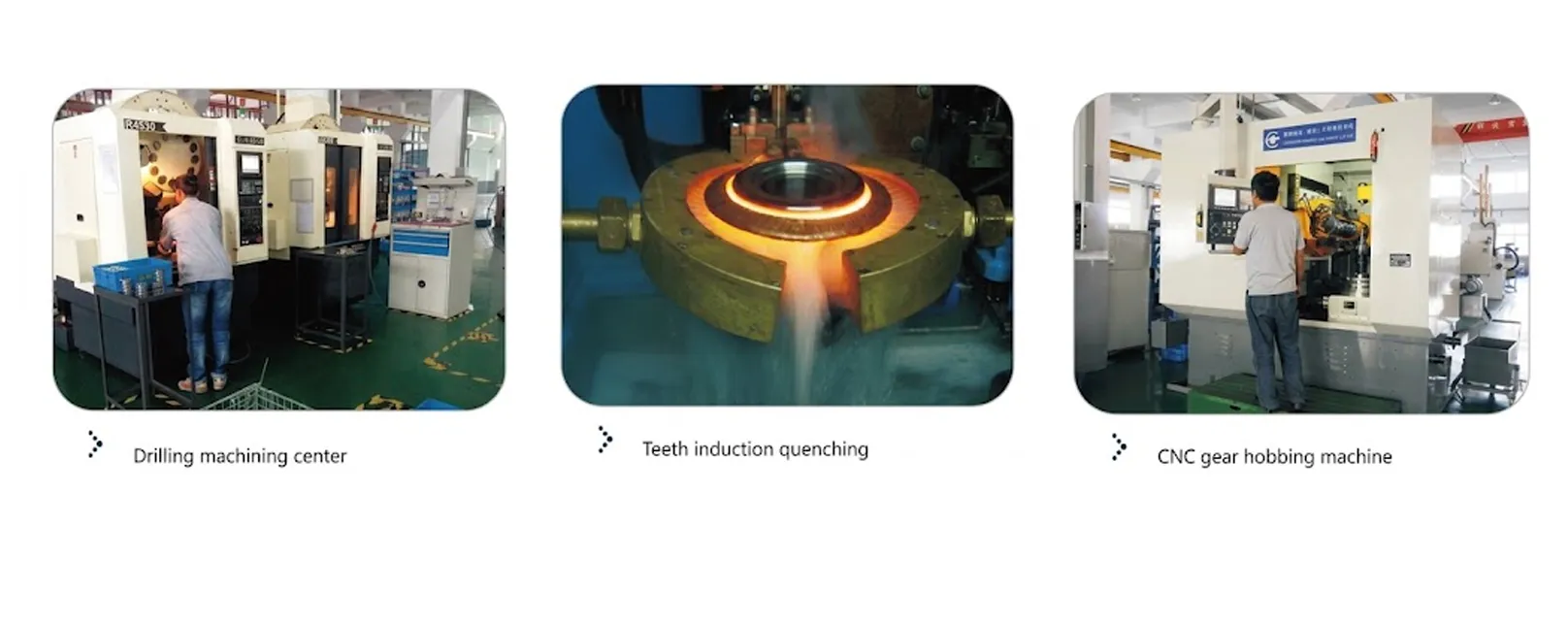
We are a professional manufacturer and global exporter of timing pulleys, covering the complete standard pitch range from MXL through XL, L, H, and HTD (3M, 5M, 8M, 14M) series in aluminum, steel, and stainless steel materials. Our CNC machining center specializes in high-precision small-pitch timing pulley production, with in-house CNC gear hobbing, form milling, bore grinding, and anodizing capabilities that ensure dimensional consistency across production batches from prototype to full production volume.
Workshop


9. Compatible Products
The MXL straight bore timing pulley is part of a complete synchronous belt drive system. We supply compatible components to complete the drive train for one-stop procurement convenience.
Metrieke steek standaard getande stangen
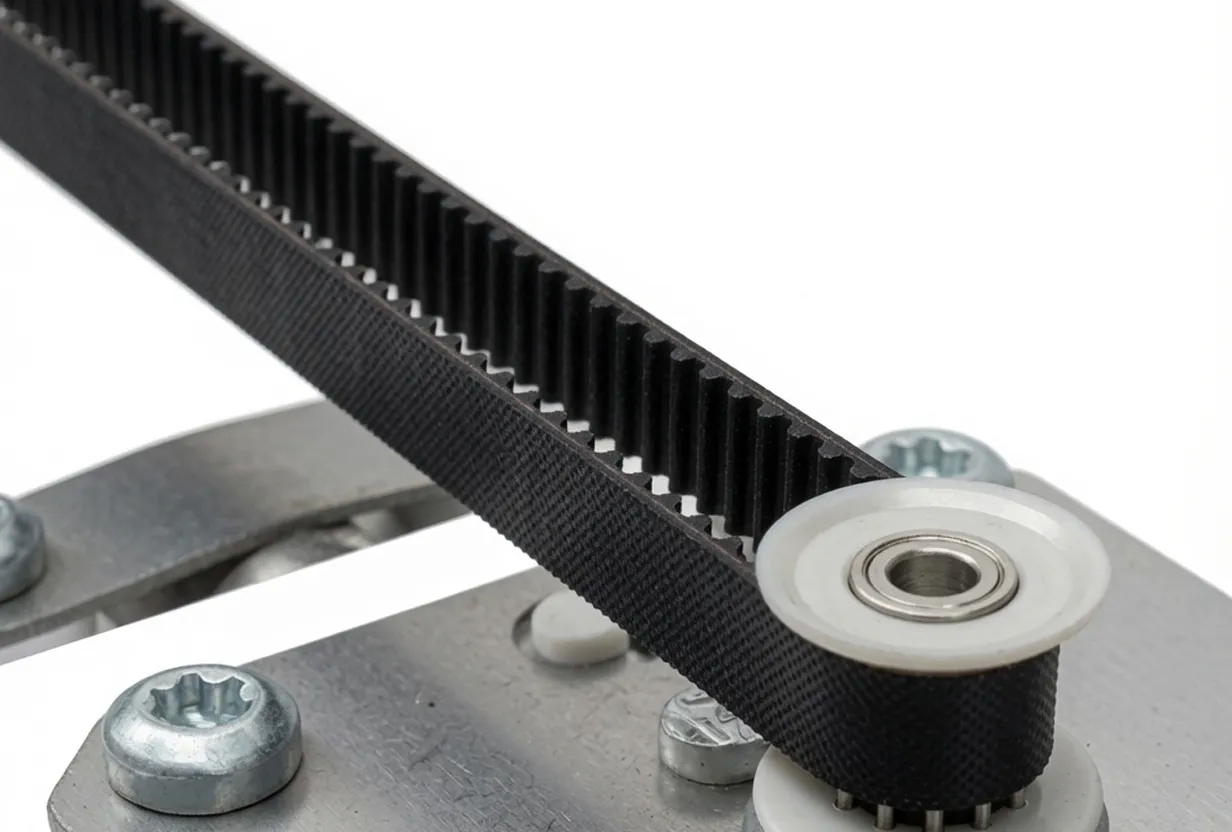
For linear motion applications where a rotating timing pulley must drive a linear rack rather than a return belt loop, Metric Pitch Standard Toothed Bars provide the linear gear rack equivalent of the timing belt. The tooth pitch of the toothed bar must match the pitch of the driving timing pulley for correct tooth engagement. In MXL 2.032 mm pitch linear drives — such as compact linear actuators, pen plotters, and label dispensing mechanisms — the MXL straight bore timing pulley drives the toothed bar to convert rotary motor output to linear carriage motion with the same zero-slip synchronous characteristic as a closed-loop belt drive. Our metric pitch toothed bars are available in standard lengths with cut-to-length service on request.
V-riemschijf
In machine drives where both synchronous timing belt circuits and classical V-belt circuits are present on the same shaft — a common arrangement in industrial machinery where a primary motor drives multiple independent circuits — the V-poelie mounts on the same shaft as the MXL straight bore timing pulley to serve the V-belt drive circuit while the timing pulley serves the synchronous positioning circuit. We supply standard SPA, SPB, SPC, and classical A/B/C section V-belt pulleys in aluminum and cast iron in bore sizes matched to the shaft diameters used with the MXL 025 timing pulley series, enabling complete single-source procurement for mixed timing belt and V-belt drive systems. Coordinating both component types from a single supplier also simplifies logistics, reduces the number of approved vendor records an OEM purchasing department must maintain, and allows combined shipment to reduce per-unit freight cost on larger mixed orders.

Veelgestelde vragen
Q1. What is the difference between a straight bore timing pulley and a taper bore timing pulley, and which should I specify for a compact instrument drive in my next OEM machine design?
A straight bore timing pulley has a parallel cylindrical bore running through the center, mounted directly on the shaft with a key and set-screw. A taper bore timing pulley has a tapered bore matched to a taper lock bushing that grips the shaft by wedge action when the bushing is tightened. For compact instrument drives with small shafts (Φ4 to Φ12 mm typical for MXL applications), the straight bore design is simpler, lighter, and more cost-effective — taper lock bushings in this bore size range add more mass and cost than the drive torque level justifies. The straight bore is the correct specification for MXL 2.032 mm pitch timing pulley applications where motor shaft diameters are small and torque loads are low.
Q2. What is the pitch circle diameter of the 20 MXL 025 timing belt pulley, and how is it used to calculate the correct center distance for a timing belt drive?
The 20 MXL 025 has a pitch circle diameter of 12.94 mm (from the table). The center distance between a driving 20-tooth and a driven 32-tooth MXL 025 straight bore timing pulley pair is calculated using the formula C = (belt pitch length − π × (D1 + D2) / 2) / 2, where D1 = 12.94 mm (20T Dp) and D2 = 20.70 mm (32T Dp). Choose a standard MXL belt length that gives a center distance appropriate for your machine envelope, then verify using the full center distance calculation. Our engineering team can assist with center distance and belt length calculations for specific drive configurations on request.
Q3. Where can I find a reliable aluminum timing pulley supplier offering MXL 025 series stock with fast global shipping and material certification?
We maintain stock of the full MXL 025 series from 16T through 72T in the standard specifications shown in the dimension table, with standard bore machined to customer specification on request. Global shipping to North America, Europe, Southeast Asia, and Australia is offered from our manufacturing facility, with lead times of 3-7 business days for standard stock items and 10-20 business days for custom bore machining. Material certificates for the aluminum alloy, RoHS compliance declarations, and dimensional inspection reports are available with all orders for OEM customers requiring documentation for CE marking technical files.
Q4. How do I select the correct number of teeth for an MXL timing belt pulley when designing a drive ratio for a 3D printer or CNC axis application?
Select the tooth count based on the required drive ratio and the minimum pulley diameter constraint imposed by your motor shaft size and machine frame clearance. For a standard desktop 3D printer with a 1.8-degree stepper motor (200 steps/revolution) and target resolution of 0.02 mm per step, a 20-tooth MXL driver gives: pitch circle circumference = 20 × 2.032 = 40.64 mm; per-step movement = 40.64 / 200 = 0.203 mm at full step. With 1/16 microstepping, effective resolution becomes 0.0127 mm — better than the 0.02 mm target. A larger tooth count driver gives coarser resolution but allows a larger motor shaft bore; a smaller tooth count gives finer resolution but requires the motor shaft to fit within the smaller hub diameter. The 20T MXL 025 has become the de facto standard for this application because it balances all these requirements for the most common stepper motor shaft diameter of Φ5 mm.
Q5. What is the maximum speed and torque rating for the MXL 025 aluminum straight bore timing pulley series, and which applications fall within these limits?
The MXL 025 series does not have a published maximum speed limit for the aluminum timing pulley itself, as the aluminum material is not speed-limited in the velocity range of typical MXL drive applications. The practical speed limit is set by the belt and by the bearing capacity of the shaft support — MXL belts are typically rated for belt linear speeds up to approximately 40 m/s, which at a 20T MXL 025 pulley (Dp 12.94 mm) corresponds to a shaft speed of approximately 59,000 rpm, far above any practical application speed. The torque rating is limited by the belt rated tension, the number of teeth in mesh, and the shaft and key specification — at 30 MPa tensile belt tension with the standard 8.5 mm face width MXL belt, the transmitted torque per engaged tooth is approximately 0.04 Nm, giving a conservative system torque of approximately 0.4-0.8 Nm for a 20-tooth pulley with 10-20 teeth in mesh, adequate for all printer, scanner, and small robot joint applications. If your application requires a torque capacity check before finalising pulley selection, our engineering team can run a belt drive calculation using the Gates or Brecoflex MXL belt power rating data for your specific centre distance, belt width, and operating speed.
Q6. How does the MXL timing belt pulley compare to HTD timing belt pulleys for precision positioning applications in automation equipment across Asia and Europe?
MXL timing belt pulleys use a trapezoidal tooth profile with 2.032 mm pitch, while HTD timing belt pulleys use a round curvilinear tooth profile in 3M, 5M, 8M, and 14M pitch variants. HTD profiles distribute belt tooth load more uniformly, reducing peak tooth contact stress and enabling higher torque capacity at equivalent belt width compared to MXL. However, for the precision positioning applications typical of office automation, medical instruments, and small robot drives, the MXL pitch provides finer position resolution per motor step due to its smaller tooth pitch, and the lower torque level of these applications does not require the higher capacity of HTD. MXL straight bore timing pulleys remain the dominant specification for sub-5 Nm torque positioning drives across automation equipment markets in Japan, South Korea, Germany, and the United States.
Q7. What is the standard hub length for the MXL 025 timing pulley and why is the uniform 16 mm hub length important for OEM machine frame design?
All 15 variants in the MXL 025 series have a hub length L = 16 mm, which provides a fixed boss depth dimension that the machine frame designer can use for all tooth count options without frame modification when changing the drive ratio. This dimensional uniformity means that a change from a 20T driver to a 24T driver for a ratio adjustment during machine development — for example, to fine-tune paper feed speed on a printer prototype — requires only a pulley substitution and belt length change, not a frame revision. For OEM machine builders producing multiple machine model variants with different speed ratios from a common frame design, this uniform hub length is a significant mechanical design simplification that reduces tooling and documentation cost across the product family.
Q8. How do I perform a timing belt pulley replacement for an MXL 025 series pulley in a medical instrument drive, and what dimensions do I need to specify?
To procure a correct timing pulley replacement for an MXL 025 series pulley, you need: the tooth count (found on the pulley body or from the instrument technical documentation), the bore diameter (measured with a micrometer after removing the pulley from the shaft), the keyway width (measured from the existing key or broached slot), and confirmation of the hub length and flange type against the values in the dimension table. With these four parameters — tooth count, bore, keyway, material = AL — the replacement part specification is fully defined for procurement from our standard series. For medical instrument applications where the original pulley specification is not documented, our engineering team can assist with identification from physical measurement data and instrument model information.
Q9. Which industries and countries most commonly use MXL timing belt pulleys and what is the typical procurement lead time for global distributors sourcing from a timing pulley manufacturer?
MXL timing belt pulleys are used globally across the office automation, medical device, precision instrument, and small robot manufacturing industries, with the highest volume markets in Japan (printer and office automation OEMs), Germany (precision instrument and automation integrators), South Korea (semiconductor equipment manufacturers), and the United States (medical device and defense electronics OEMs). For global distributors sourcing from our timing pulley manufacturing facility, standard catalogue items in stock bore diameters ship within 3-5 business days of order confirmation. Custom bore machining to customer-specified diameter adds approximately 7-14 business days. Minimum order quantities for standard items are typically 10 to 50 pieces depending on tooth count, with no minimum for large-quantity OEM orders.
Q10. What are the custom timing pulley options available for MXL 025 series if standard tooth counts or bore sizes do not match a specific machine drive requirement?
For applications where the standard 15 tooth count options in the MXL 025 series do not provide the exact drive ratio required, we offer custom timing pulleys with non-standard tooth counts machined to the same MXL 2.032 mm pitch profile and maintaining the same hub length and flange configuration as the catalogue series. Custom bore diameters outside the standard range are available for any tooth count in the series. For larger production volumes requiring non-standard outside diameters, hub lengths, or flange configurations — such as an integrated encoder wheel or an extended hub for double-pulley dual-belt drives — please contact our engineering team with the application technical requirement for a custom timing belt pulley quotation and feasibility review.
Redacteur: PXY