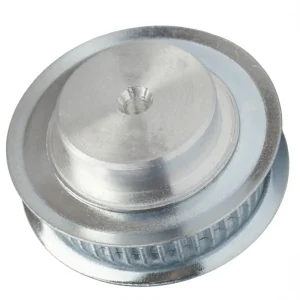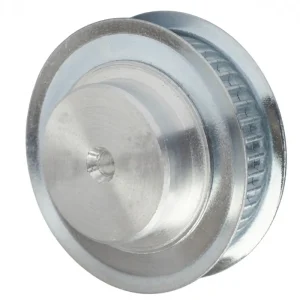
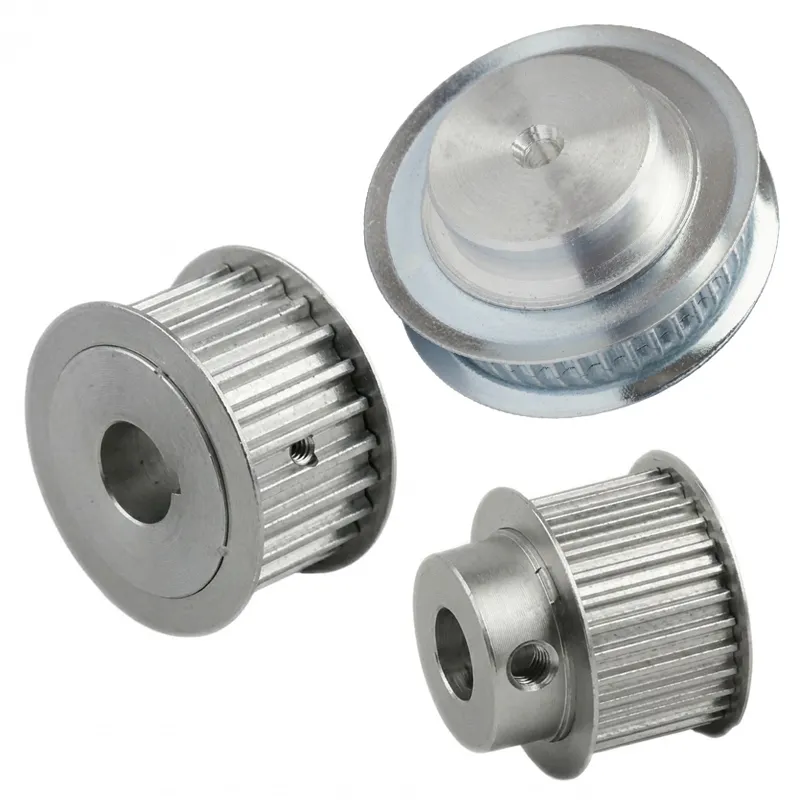
EP-T 10MM Aluminum Straight Bore Timing Pulley-Belt Width 32MM
The EP-T10 series features robust aluminum timing pulleys designed for heavy-duty power transmission using 32mm wide belts with a 10mm pitch. Available in tooth counts from 18 to 60, these pulleys offer a substantial face width (F) of 37mm and a consistent length (L) of 47mm to handle high loads. Bore diameters (Dm) range widely from 40mm to 110mm, accommodating large industrial shafts, while outer diameters (De) span 55.45mm to 189.10mm. Models with 18–36 teeth include flanges (Type 6F) for secure belt tracking, while larger sizes (40–60 teeth) are unflanged (Type 6). Constructed from lightweight aluminum, this series provides precise synchronization and reduced rotational inertia for demanding automation and machinery applications requiring significant torque capacity.
EP-T 10MM Aluminum Straight Bore Timing Pulley — Belt Width 32MM
The EP-T 10MM series is a precision-engineered straight bore timing pulley manufactured to DIN 7721 standard. This straight bore timing pulley is available in 16 tooth-count variants, making it one of the most versatile aluminum straight bore timing pulleys in the T10 metric series. Built from aerospace-grade 6061 aluminum alloy, this straight bore timing pulley delivers reliable synchronous power transmission in applications where weight reduction, corrosion resistance, and dimensional accuracy are non-negotiable. Whether you are specifying an aluminum straight bore timing pulley for a high-cycle packaging line, a CNC positioning axis, or a robotics assembly system, the T10 pitch profile of this straight bore timing pulley ensures consistent engagement with matched T10 timing belts across the full tooth range from 18T to 60T. Engineers searching for a straight bore timing pulley with broad tooth-count coverage and ready stock availability will find this series meets both criteria without requiring custom tooling or extended lead times.
1. Technical Specifications — T10 (Pitch 10mm) for Belt Width 32mm
All dimensions in millimetres (mm). Material: Aluminum 6061 (AL). Belt width: 32mm. Pitch: 10mm (T10 profile, DIN 7721). Each straight bore timing pulley in this range is finish-bored and ready for direct shaft mounting.
| Part Code | Teeth (Z) | Type | Material | Dp (mm) | De (mm) | Df (mm) | Dm (mm) | F (mm) | L (mm) | d (mm) | Flange No. |
|---|---|---|---|---|---|---|---|---|---|---|---|
| 18T10-47 | 18 | 6F | AL | 57.29 | 55.45 | 60 | 40 | 37 | 47 | 10 | 21 |
| 19T10-47 | 19 | 6F | AL | 60.48 | 58.65 | 66.5 | 44 | 37 | 47 | 10 | 24 |
| 20T10-47 | 20 | 6F | AL | 63.66 | 61.80 | 66.5 | 46 | 37 | 47 | 12 | 24 |
| 22T10-47 | 22 | 6F | AL | 70.03 | 68.20 | 75 | 52 | 37 | 47 | 12 | 27 |
| 24T10-47 | 24 | 6F | AL | 76.39 | 74.55 | 83 | 58 | 37 | 47 | 12 | 29 |
| 25T10-47 | 25 | 6F | AL | 79.58 | 77.75 | 83 | 60 | 37 | 47 | 12 | 29 |
| 26T10-47 | 26 | 6F | AL | 82.76 | 80.90 | 87 | 60 | 37 | 47 | 12 | 31 |
| 27T10-47 | 27 | 6F | AL | 85.95 | 84.10 | 91 | 60 | 37 | 47 | 12 | 32 |
| 28T10-47 | 28 | 6F | AL | 89.12 | 87.25 | 93 | 60 | 37 | 47 | 12 | 33 |
| 30T10-47 | 30 | 6F | AL | 95.49 | 93.65 | 97 | 60 | 37 | 47 | 12 | 35 |
| 32T10-47 | 32 | 6F | AL | 101.86 | 100.00 | 106 | 65 | 37 | 47 | 12 | 38 |
| 36T10-47 | 36 | 6F | AL | 114.59 | 112.75 | 119 | 70 | 37 | 47 | 16 | 43 |
| 40T10-47 | 40 | 6F | AL | 127.32 | 125.45 | 131 | 80 | 37 | 47 | 16 | 47 |
| 44T10-47 | 44 | 6 | AL | 140.05 | 138.20 | — | 88 | 37 | 47 | 16 | — |
| 48T10-47 | 48 | 6 | AL | 152.78 | 150.95 | — | 95 | 37 | 47 | 16 | — |
| 60T10-47 | 60 | 6 | AL | 190.98 | 189.10 | — | 110 | 37 | 47 | 16 | — |
Dp = Pitch diameter | De = Outside diameter | Df = Flange outside diameter | Dm = Hub bore diameter | F = Belt width zone | L = Hub length | d = Bore diameter | "—" = No flange on this variant
2. Five Key Product Advantages
Every straight bore timing pulley in the EP-T 10 series is machined and inspected against DIN 7721 tolerances. Pitch diameter, outside diameter, tooth profile depth, and flange geometry all conform to the published standard, ensuring direct fit compatibility with any DIN-compliant T10 timing belt — no custom shimming or adapter required. Procurement teams sourcing a straight bore timing pulley for regulated machinery applications in the EU or North America benefit directly from this published dimensional traceability.
The T10-47 series uses high-strength 6061 aluminum (AL), reducing rotating inertia by roughly 65% compared to steel equivalents. This matters significantly for servo-driven axes and pick-and-place robots where acceleration response directly affects throughput. The natural oxide layer also provides baseline corrosion protection for indoor industrial environments. When specifying an aluminum straight bore timing pulley, this alloy grade delivers the best balance of machinability, strength, and weight reduction for T10 drive applications.
Sixteen stock variants from 18 teeth to 60 teeth give design engineers the flexibility to set drive ratios without ordering custom parts. The broad selection also supports replacement sourcing in the field — a key advantage for plant maintenance teams maintaining timing pulley stock across multiple production lines. When a straight bore timing pulley fails unexpectedly, having the correct tooth count available from stock significantly reduces machine downtime.
Models 18T through 40T feature the 6F double-flange configuration, mechanically retaining the belt on both sides of the pulley face. This reduces lateral belt wander in high-speed, oscillating, or vertically-mounted drive arrangements where a single-flange design would risk belt run-off under transient loads. This makes the flanged straight bore timing pulley particularly suitable for dynamic motion profiles where belt tracking cannot be guaranteed by alignment alone.
The straight bore timing pulley format ships with a finished bore diameter ready for direct shaft mounting. For OEMs and replacement buyers sourcing a straight bore timing pulley for sale, this eliminates the lead time and cost of a taper lock bushing or additional bore finishing operation. Keyway and set-screw options are available to order for torque-locking requirements. Customers who need a straight bore timing pulley for rapid machine build or maintenance schedules will particularly value the zero-preparation mount time this format enables.
3. Working Principle
A straight bore timing pulley operates on the principle of positive mechanical engagement — in contrast to friction-based V-belt or flat-belt drives where slip is inherent. The trapezoidal T10 tooth profile on the straight bore timing pulley meshes precisely with the corresponding tooth cavities moulded into the timing belt. When the drive shaft rotates the pulley, each tooth pushes directly against the belt tooth flank, transferring torque without relative motion between belt and pulley. This positive engagement is what defines the straight bore timing pulley as a synchronous drive element, distinguishing it fundamentally from asynchronous belt drives.
Because the engagement is geometric rather than frictional, the input-to-output angular relationship is fixed and repeatable. One full tooth pitch of belt travel corresponds exactly to one tooth pitch of pulley rotation. This makes metric timing pulleys indispensable wherever precise positioning is needed — CNC axis drives, servo feedback systems, medical dispensing equipment, and automated assembly machines all rely on this zero-slip characteristic. A straight bore timing pulley selected with the correct tooth count gives the system designer direct, predictable control over drive ratios and linear travel distances without calibration offsets.
The T10 pitch (10 mm between tooth centres) places this series in the medium-duty segment of the metric timing belt pulleys family — capable of moderate torque loads while maintaining the dimensional compactness that aluminium construction enables. The dual-flange design on smaller tooth-count variants of this straight bore timing pulley guides the belt laterally, preventing edge wear that would otherwise reduce service life in misaligned or vibration-prone installations. Choosing the correct flange configuration for your drive geometry is therefore as important as selecting the right tooth count when specifying a straight bore timing pulley.
4. Material & Surface Treatment
Body Material: Aluminum Alloy 6061
The T10-47 series uses 6061-T6 aluminum alloy throughout the hub and tooth section. This grade is selected for its favourable combination of tensile strength (276 MPa typical), machinability, and anodising response. The low density (2.70 g/cm³) makes these aluminium timing pulleys far lighter than equivalent steel parts, which matters in servo-driven systems where inertia mismatch between motor and load must be minimised. The alloy performs reliably in ambient temperatures from -40°C to +120°C, covering most indoor industrial and outdoor equipment environments worldwide. Every straight bore timing pulley body in this series is machined from certified 6061-T6 billet, ensuring consistent mechanical properties across all production batches.
Flange Material & Finish
Flanges on Type 6F variants are machined integral to the hub body from the same 6061 billet, ensuring concentricity between the flange face and pitch circle. The standard finish is natural machined aluminium. Hard anodising (Type III, 25 micron minimum) is available on request for applications involving abrasive particulates, chemical splashing, or elevated surface hardness requirements. All bore surfaces of this straight bore timing pulley are finished to Ra 1.6 or better to ensure consistent shaft interference fits — a quality standard that distinguishes a precision straight bore timing pulley from budget-grade alternatives where bore surface finish is not specified or verified.
5. Application Scenarios
The EP-T 10MM straight bore timing pulley is specified across a wide range of industries. Below are typical deployment environments where the T10 profile with 32mm belt width has proven effective. In each case, the key advantage of specifying a straight bore timing pulley over alternative drive component types is the combination of mounting simplicity, dimensional standardisation, and zero-slip power transfer.
CNC Machining Centres
Linear axes on milling and routing machines use timing belt and pulley pairs to translate motor rotation into carriage movement. The T10 pitch handles the torque levels typical of ballscrew-less gantry systems while the 32mm belt width provides the load capacity required for multi-axis simultaneous interpolation. The straight bore timing pulley integrates directly with motor shaft extensions without requiring a separate bushing assembly, reducing assembly time and the part count of the overall drive train in CNC systems built to tight machine-width constraints.
Packaging & Labelling Lines
High-speed packaging machinery demands consistent phase relationships between multiple driven rollers. A metric timing pulley replacement in these systems restores positional accuracy lost through tooth wear on an older belt-and-pulley set. Selecting this straight bore timing pulley as a direct replacement is straightforward because its DIN 7721 dimensional compliance guarantees interchangeability with the original part. The aluminum construction withstands the wash-down cleaning cycles common in food-adjacent packaging facilities, and the lightweight design keeps dynamic loads manageable at line speeds exceeding 80 packs per minute.
3D Printing & Additive Manufacturing
FDM and SLA printers rely on timing belt drive pulleys for X and Y axis motion control. The T10 pitch is widely adopted in mid-to-large format industrial printers where the larger pitch diameter reduces tooth load per engagement, extending consumable life. The straight bore timing pulley keeps moving mass low — a critical parameter when print heads change direction thousands of times per hour — and its standardised bore diameter simplifies the shaft-pulley interface design across multiple printer model variants sharing the same motor shaft size.
Textile & Weaving Machinery
Rapier looms and needle-bar drives in textile manufacturing require synchronised motion between multiple shafts rotating at high speed. A properly sized straight bore timing pulley and belt system eliminates the phase errors that accumulate in chain or gear drives subject to wear, enabling consistent fabric density across the full roll width. The dry-running capability of this straight bore timing pulley construction is particularly valued in environments where lubricants would contaminate yarn — a contamination risk that eliminates chain-and-sprocket alternatives from consideration in many textile plant specifications.
Conveyor & Sortation Systems
Logistics and warehouse sortation equipment uses timing pulley and belt assemblies to drive divert lanes, pop-up transfer modules, and narrow-belt sorters. The T10-47 straight bore timing pulley handles the mixed static and dynamic load profiles typical of induction systems where packages of varying weight are accelerated and decelerated on short conveyor runs. The wide 32mm belt distributes load across more tooth contacts, reducing peak stress per tooth flank and extending the service interval of both the straight bore timing pulley and its matched belt in high-cycle sortation environments.
Medical & Laboratory Automation
Diagnostic analysers, pipetting robots, and laboratory slide handlers demand sub-millimetre positioning repeatability in a compact footprint. The aluminum T10 straight bore timing pulley meets the dimensional tolerance and surface cleanliness requirements of these environments. The anodised finish option provides a non-particulating surface suitable for cleanroom-adjacent deployments, and the straight bore timing pulley design eliminates the retention hardware complexity of tapered bushing variants in constrained spaces where every millimetre of axial clearance is accounted for in the mechanical layout.
6. Standards, Regulations & Compliance
While timing pulleys themselves are mechanical components rather than regulated products, their use in machinery is indirectly governed by machinery safety and product liability frameworks in most major markets. Specifying a straight bore timing pulley that meets published dimensional standards reduces both engineering risk and regulatory exposure for the machine builder.
Machinery incorporating timing belt pulleys and sold in the EU must comply with the Machinery Directive and carry CE marking. Drive components must be designed to current EN ISO 11161 (safety of integrated manufacturing systems) and EN ISO 4413/4414 principles where applicable. DIN 7721 compliance provides documented traceability for conformity assessment files. Incorporating a DIN-standard straight bore timing pulley simplifies the technical documentation process required for CE Declaration of Conformity submissions.
OSHA 29 CFR 1910.217 governs mechanical power transmission apparatus in industrial machinery. ANSI B29.1 and ANSI/ASME standards for synchronous belt drives define design requirements for systems using metric timing belt pulleys. Machines must also address guarding requirements under OSHA 29 CFR 1910.212 for all exposed moving drive components including any straight bore timing pulley assembly not enclosed within the machine frame.
Japan Industrial Standards JIS B 1856 covers synchronous belt drives including metric timing pulleys. Machinery operating in Japan must comply with the Industrial Safety and Health Act (Labour Standards Law related regulations) which sets guarding and inspection requirements for power transmission elements. The T10 profile used by this straight bore timing pulley series is dimensionally equivalent to JIS T-type series specifications, supporting cross-border technical documentation without separate re-specification.
The AS/NZS 4024 series (Safety of Machinery) applies to equipment using timing belt pulley drives in Australia and New Zealand. WorkSafe obligations require that all mechanical hazards, including exposed belt and pulley assemblies, be addressed at the design stage. Specifying DIN 7721 standard pulleys supports design documentation requirements under AS/NZS 4024.1301 for mechanical separation safeguards. The dimensional traceability of this straight bore timing pulley to DIN 7721 is accepted as evidence of established engineering practice in Australian machinery technical files.
The Bureau of Indian Standards IS 14360 provides specifications for synchronous belt drives including aluminium timing pulleys used in industrial machinery. The Factories Act 1948 (Section 21) mandates secure fencing of all moving parts of machinery, including belt and pulley drives. Compliance with IS standards supports product acceptance for government-tendered industrial projects and export documentation requirements. This straight bore timing pulley series aligns with IS 14360 dimensional categories for the T10 pitch family.
CSA Z432 (Safeguarding of Machinery) governs the use of drive components including timing pulley and belt systems in Canadian industrial facilities. Each province has its own Occupational Health and Safety regulations — for example, Ontario Regulation 851 requires guarding of all power transmission equipment. DIN-compliant dimension standards are accepted in Canadian machinery technical files as evidence of established design practice, and the dimensional records we provide with each straight bore timing pulley shipment support this documentation requirement.
7. About Our Manufacturing Capability
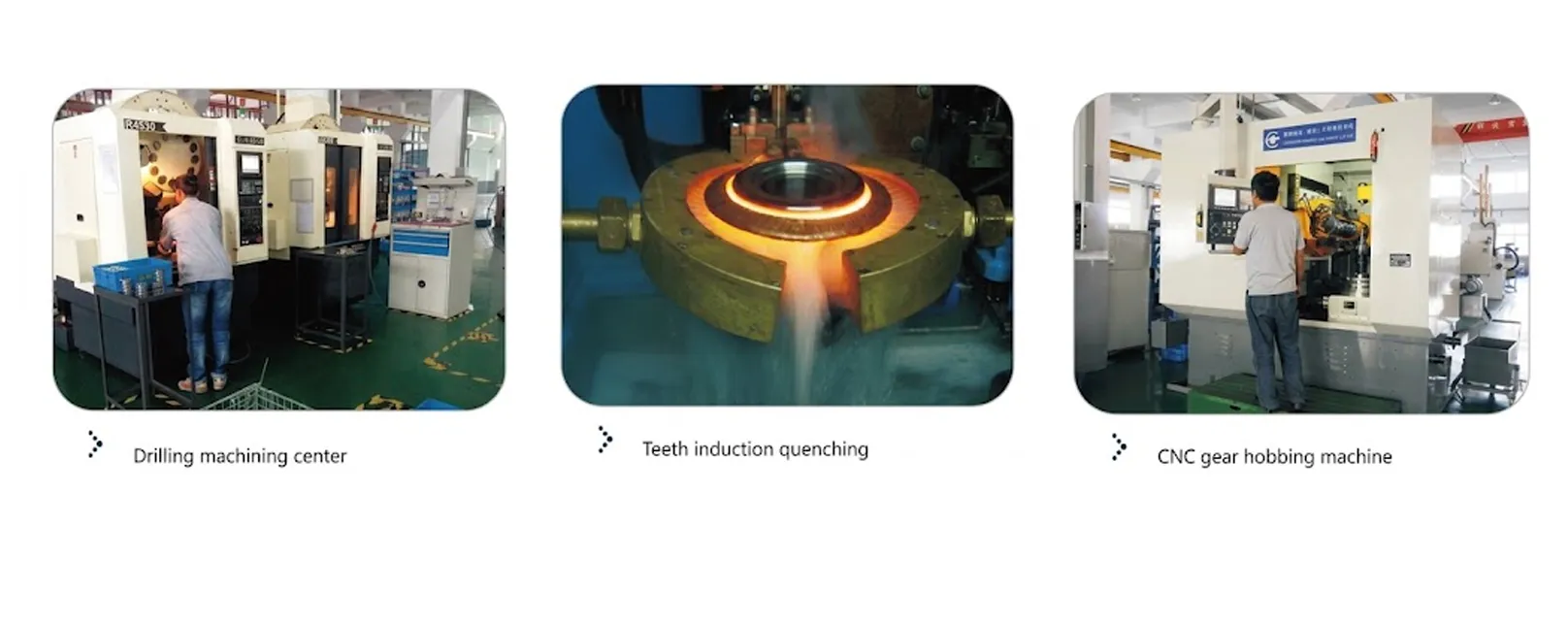
We are a dedicated China timing pulley manufacturer with over two decades of production experience in the synchronous drive component sector. Our facility operates CNC turning centres, gear hobbing machines, and precision inspection equipment to produce custom timing pulleys, standard metric series, and OEM-specified designs to customer drawings. The EP-T series reflects our commitment to DIN-standard dimensional accuracy combined with the material and surface finish flexibility that global OEM customers require. Every straight bore timing pulley we produce is held to the same inspection criteria regardless of order quantity, from single-piece samples to production volume runs.
We supply timing pulley stock items with short lead times from finished goods inventory, and we accept custom bore, keyway, and anodising specifications for projects with higher volumes. Quality control follows ISO 9001 procedures with documented traceability from raw material to finished product. All aluminium timing pulley products are inspected on CMM equipment before despatch to verify pitch circle diameter, bore diameter, and tooth form compliance against DIN 7721 reference standards. We serve customers in Europe, North America, Southeast Asia, the Middle East, and Oceania through established freight forwarding channels. Buyers seeking a straight bore timing pulley with certified dimensional inspection data and reliable global logistics will find our service model directly suited to their procurement requirements.
Workshop


8. Related Products — System-Compatible Components
A complete synchronous drive system requires more than the straight bore timing pulley alone. We supply the following components from the same production facility, enabling a one-stop supply arrangement that reduces vendor count, simplifies logistics, and ensures dimensional compatibility across the full drivetrain.
Metric Pitch Standard Toothed Bars
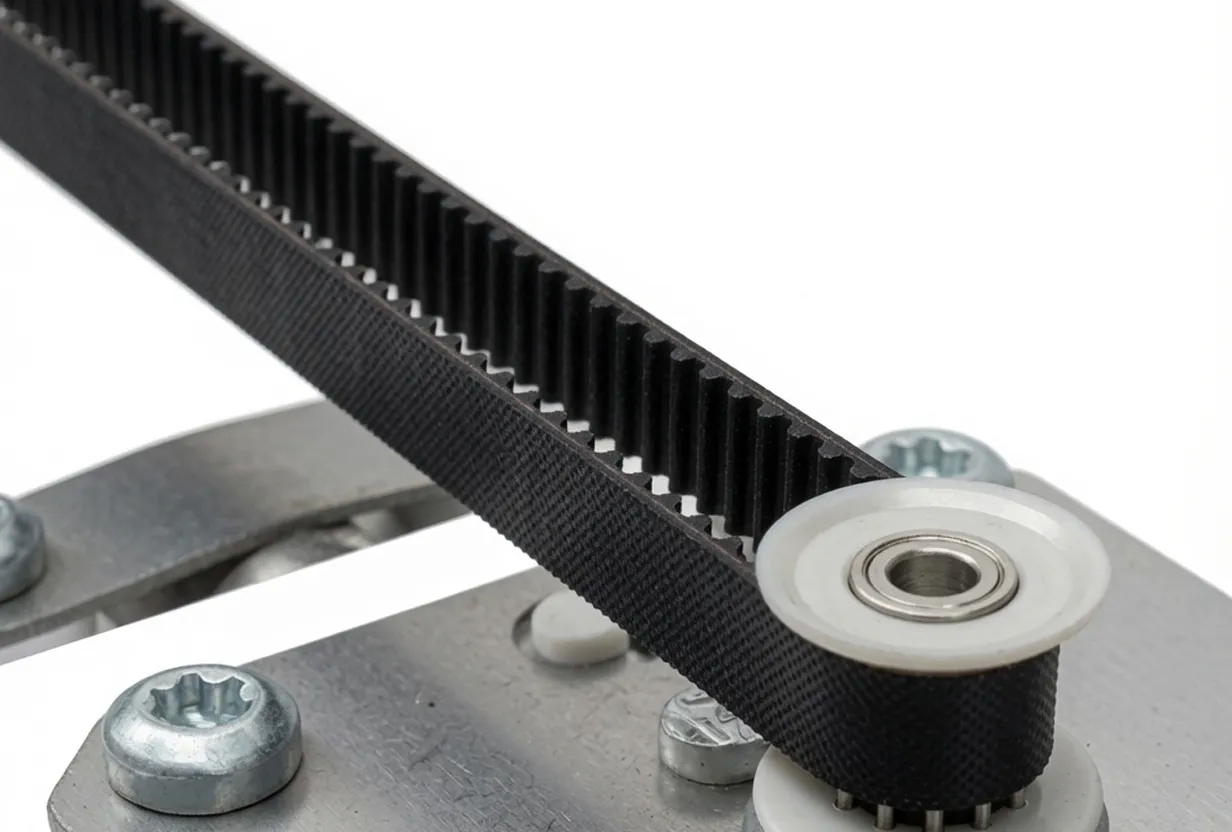
For linear motion applications, our Metric Pitch Standard Toothed Bars serve as the stationary rack element in rack-and-timing-belt drive systems. These toothed bars share the T10 pitch geometry with the EP-T straight bore timing pulley series, ensuring full mesh compatibility without profile mismatch. Common deployments include open-loop gantry systems, engraving machines, and long-travel conveyor indexing units where a closed-loop belt would be impractical. Sourcing the toothed bar and straight bore timing pulley from the same supplier removes any concern about tooth geometry variation between independently sourced components.
V-Belt Pulleys
Some drive system layouts require a combination of synchronous and V-belt sections — typically where a timing belt handles precision positioning on a downstream axis while a V-belt handles the primary power input from the motor. Our V-belt pulleys are dimensionally matched to the same shaft and hub geometry as the EP-T series, supporting compound pulley stacks on common shafts. This compatibility means a shaft carrying both a straight bore timing pulley and a V-belt pulley can be specified with a single hub length and bore diameter, simplifying the shaft design and reducing the number of shaft shoulder features required.

Frequently Asked Questions
Q1. What is a straight bore timing pulley and how does it differ from a tapered bore version used in industrial conveyor systems?
A straight bore timing pulley has a cylindrical bore machined to a fixed diameter — the shaft slides directly into the bore and is secured with a keyway, set screw, or interference fit. A tapered bore version uses a separate taper lock bushing that clamps onto the shaft via a conical interference fit, making it easier to disassemble. For light-to-medium duty conveyor and positioning systems, the straight bore timing pulley approach is more compact and requires fewer components, though it demands careful shaft and bore tolerance pairing to prevent fretting or loosening under cyclic loads.
Q2. Where can I find a reliable straight bore timing pulley supplier for replacement in European food packaging machinery?
For European food packaging applications, look for a supplier whose aluminum straight bore timing pulley products meet DIN 7721 dimensional tolerances — this ensures the replacement part is dimensionally interchangeable with the original. Verify that the finish is either natural machined aluminum or hard anodised (not chrome or zinc plated, which are not food-adjacent friendly). We supply DIN 7721 T10 series straight bore timing pulley items with short lead times and full dimensional inspection documentation for the European market.
Q3. How do I choose the right number of teeth on a metric timing pulley for my CNC router drive ratio calculation?
Drive ratio equals driver tooth count divided by driven tooth count. For a CNC router needing a 2:1 reduction with a T10 belt, pair a 20T driver straight bore timing pulley with a 40T driven straight bore timing pulley. The pitch circle diameters in the specification table above let you verify the resulting centre distance and wrap angle before ordering. Ensure the minimum wrap angle on the smaller pulley exceeds 60 degrees (ideally 90+ degrees) to guarantee adequate tooth engagement count and prevent belt jump under load.
Q4. When should I consider a timing belt idler pulley alongside the straight bore drive pulleys in a long-span belt drive?
A timing belt idler pulley is recommended when the belt span between driver and driven straight bore timing pulley positions exceeds roughly 40 times the pitch, or when the belt sag causes the slack-side strand to vibrate or contact adjacent components. The idler takes up slack and maintains consistent belt tension without requiring the driven shaft to be repositioned. In long-span conveyor or linear actuator runs, an idler also prevents resonant belt flutter that degrades positioning accuracy at high traverse speeds.
Q5. How do I verify whether an aluminum timing pulley I have is a T10 or HTD timing belt pulley profile before ordering a replacement?
The easiest field check is tooth pitch — measure from one tooth tip to the next adjacent tooth tip along the pitch circle. T10 = 10mm between teeth centres. The tooth profile also differs: T-series (including T10) has a trapezoidal tooth form with straight flanks, while HTD timing belt pulleys use a rounded, curvilinear profile that looks noticeably more circular at the tooth root. If you have the original belt, the tooth profile will be marked on its outer face — T10, T5, T2.5, or HTD 5M, 8M, 14M etc. Do not mix T-series straight bore timing pulley units with HTD belts as the profile mismatch causes premature wear and eventual belt jump.
Q6. Are custom timing pulleys available with non-standard bore diameters or keyway specifications for German automotive assembly line equipment?
Yes. We offer custom timing pulleys with customer-specified bore diameters, keyway profiles (DIN 6885 sheet 1 standard keyways preferred for German automotive applications), and set-screw arrangements. For DIN-standard keyway widths and tolerances, provide your shaft diameter and tolerance class and we will verify the keyway dimensions to DIN 6885. When ordering a straight bore timing pulley with a custom bore for German automotive assembly line equipment subject to IATF 16949-adjacent supply chain requirements, we can provide material certificates and dimensional inspection reports on request.
Q7. What is the difference between Type 6 and Type 6F in timing belt pulley types within this T10 series?
In DIN 7721 nomenclature, Type 6 indicates a pulley with a single flange on one side of the tooth section, while Type 6F (shown as "6F" in our part code table) indicates a double-flange configuration with flanges on both sides. The 6F straight bore timing pulley design provides bilateral belt guidance and is standard on smaller tooth-count variants (18T to 40T in this series) where the belt is more prone to lateral wander. Larger tooth-count pulleys (44T, 48T, 60T) in this series use the single-flange Type 6 configuration — at larger pitch diameters, the wrap angle is typically sufficient to self-guide the belt without a second flange on the straight bore timing pulley body.
Editor: PXY