
Est. 1998
China Timing Pulley Manufacturer
We are a dedicated manufacturer producing straight-bore and taper-bore timing pulleys across MXL, XL, L, H, AT, and HTD tooth profiles. Every batch is machined in-house, dimensionally inspected, and shipped from stock or built to your drawing
Custom Bore and Flange Machining
Simply provide a sketch or part sample, and we can custom-machine timing pulleys for you—including non-standard bores, special flanges, and modified hubs.
Factory Direct Shipping
Common sizes from MXL to HTD 14M are all manufactured in-house.
Engineers Provide Direct Quotation Answers
Our experts will answer your specific questions regarding belt width, shaft load, or which flange code is suitable for your housing.
About Us
Our factory, established in 1998, is a modern joint-stock enterprise integrating chain drive research, manufacturing, and trade. It has an annual production capacity of 4 million units, covering an area of 60,000 square meters, including 35,000 square meters of factory buildings, and employs 8 senior engineers.
The company boasts scientific management, independent innovation, advanced technology, sophisticated equipment, rigorous testing, perfect processes, satisfactory service, and a reputation-first, quality-first approach. The company passed ISO9002 quality system certification in 2001 and ISO9001 quality system certification in 2002, and ISO4001 environmental management certification in 2004.
The main products of the timing pulley currently include: Straight-bore Timing Pulleys (MXL, XL, L, H types), Taper-bore Timing Pulleys (L, H, XH types), Straight-bore Timing Pulleys (T2.5, T5, T20 types), Straight-bore Timing Pulleys (AT5, AT10 types), HTD Straight-bore Timing Pulleys (3M, 5M, 8M, 14M types), HTD Taper-bore Timing Pulleys (5M, 8M, 14M types), PC Timing Pulleys (PC8M, PC14M types), HTD Timing Pulley Bars (3M, 5M, 8M types), Timing Pulley Bars (MXL, XL, L types), and Timing Pulleys (T2.5, T5, T10, AT5, AT10 types). Currently, the company has designed and developed over 1,000 product varieties and nearly 10,000 specifications. Products conform to GB, ISO, ANSI, JIS, DIN, and BS standards, and their performance meets the requirements of customers in developed countries such as Europe, America, and Japan. The company will adhere to the philosophy and production model of “seeking development through quality” to satisfy customer requirements.

Ten Pulley Series, One Inspected Source
From a 10-tooth MXL pulley the size of a thimble to a 192-tooth PC14M wheel for heavy conveyor drives, every part below ships with a checked pitch diameter, a checked bore, and a part code you can re-order against.


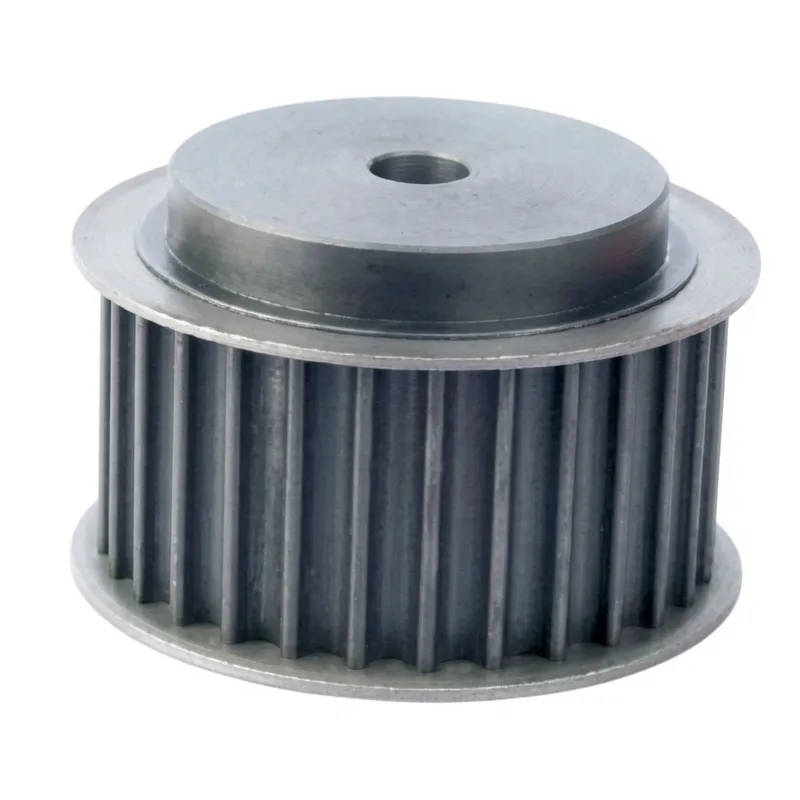
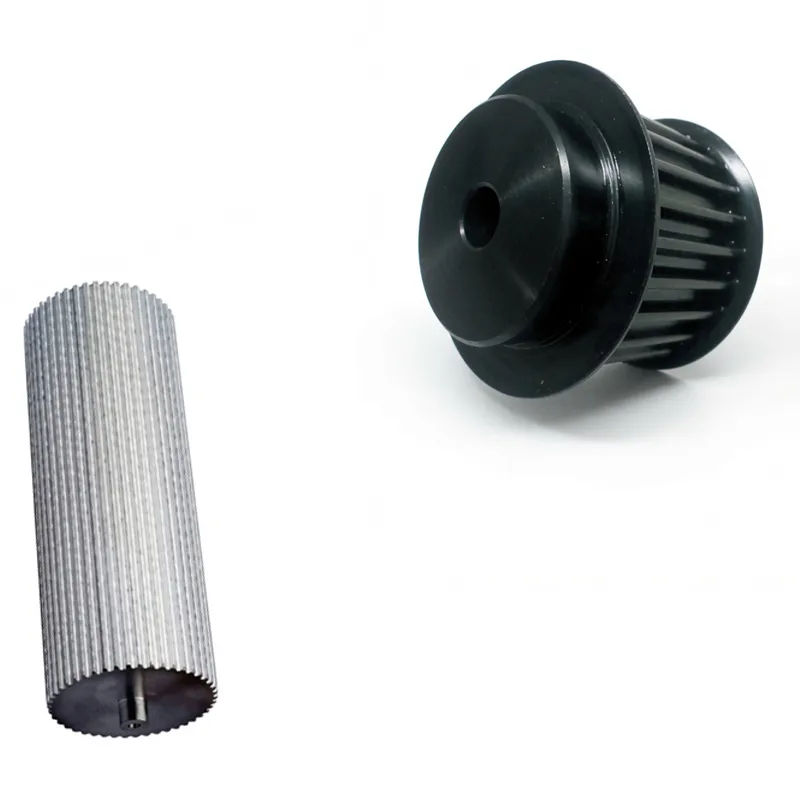
Latest additions to our timing pulley stock, pulled automatically from current inventory:
Anatomy of a Timing Pulley
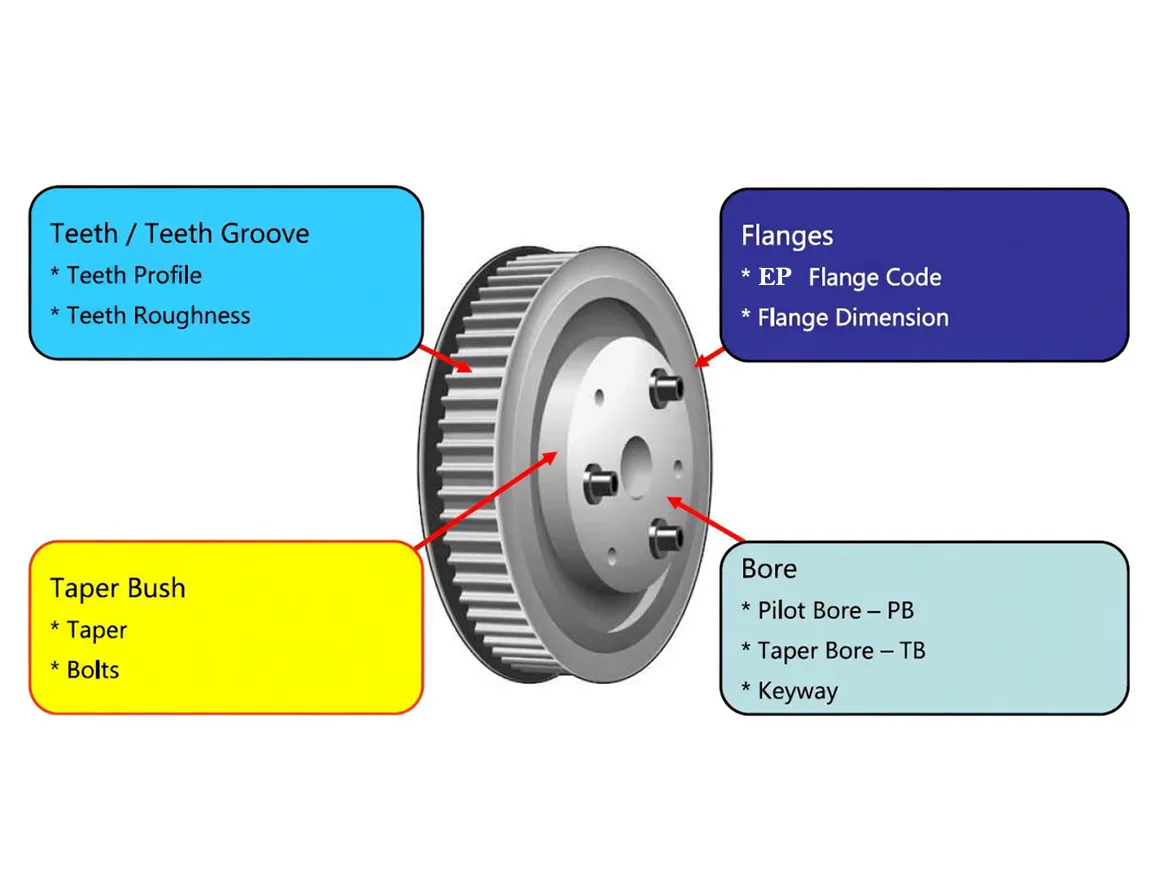
This part does one job: it carries the teeth of a timing belt around a shaft without letting a single tooth slip past. Every dimension on the drawing below exists to protect that one promise.
Tooth Ring & Pitch Diameter (Dp)
The pitch diameter is the working circle where belt and pulley actually mesh. We cut every tooth to the pitch called for by MXL, XL, L, H, T, AT, or HTD geometry — the profile decides the diameter, not the other way around.
Bore: Straight or Taper-Lock
A straight bore is reamed to a fixed diameter (d) and keyed to the shaft directly. A taper bore takes a removable taper lock bushing, so the same part fits a range of shaft sizes and comes off without a hydraulic press — useful anywhere timing belts and pulleys get swapped during a ratio change.
Flange (F)
Raised flanges on one or both faces keep a timing belt tracking dead center under side load or shaft misalignment — we machine single-flange (1F/6F), double-flange (6A), and webbed (6W) configurations from the same base profile.
Hub & Web
The hub sets keyway depth and set-screw access; the web is the disc connecting hub to tooth ring. On larger HTD and PC pulleys we thin or rib the web to cut rotating mass without touching the rated torque.
Aluminium, Steel, or Cast Iron — Picked by Load, Not by Default
We don't run one material across the whole range. Tooth count, diameter, and expected torque decide which billet goes on the machine.
アルミ製タイミングプーリー
Small to mid tooth counts in MXL, XL, T2.5, T5, and AT5 are cut from aluminium billet. Light rotating mass matters more than raw strength here, so an aluminum timing pulley keeps inertia low on fast indexing and pick-and-place motion.
Typical range: 10–40 teethSteel Timing Pulley
Mid-range L, H, T10, AT10, and HTD pulleys move to steel once torque and keyway side-load climb past what aluminium can take repeatedly. Steel also takes a finer bore tolerance, which matters once a taper lock bushing is involved.
Typical range: 14–60 teethCast Iron Timing Pulley
Large-diameter HTD 14M, PC8M, and PC14M pulleys — some running to 192 teeth — are cast and machined in iron. At that size the part absorbs vibration and dampens shock loading better than a forged blank of the same diameter would.
Typical range: 48–192 teethRecent
Weekly Scoreboard
Inspected, Not Assumed
Bore, pitch diameter, and tooth profile are checked against the drawing before packing, not sampled after a complaint.
Custom Bore & Flange Work
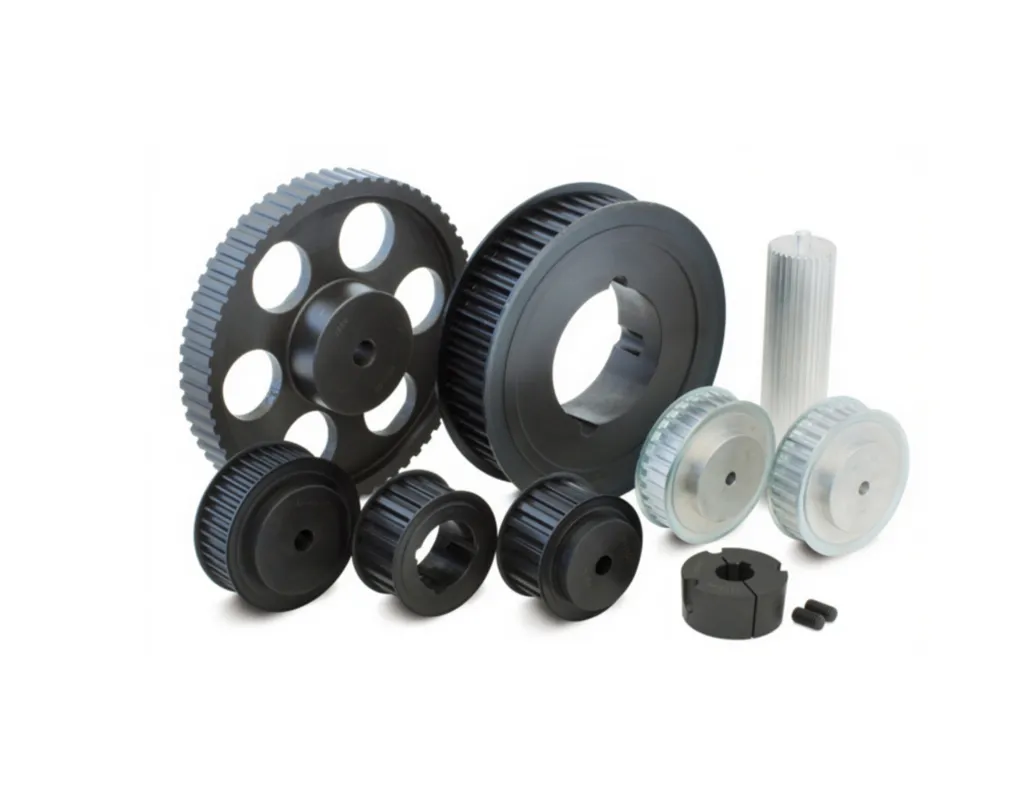
Send a sketch or a sample part and we’ll machine custom timing pulleys to it — non-standard bores, special flanges, and modified hubs included.
Quick Quote
Questions about belt width, shaft load, or which flange code fits your housing get answered by someone who reads the drawing, not a script.
Three Questions Narrow It Down
This isn't a substitute for an engineering review on a critical application, but it will point you at the right family of standard sizes before you call.
What belt is already on the machine?
Check the belt for a stamped pitch code. A 5mm pitch points to T5, AT5, or HTD 5M depending on tooth shape — trapezoidal versus rounded teeth tells you which.
Fixed shaft, or does it need to come off?
A permanent shaft position usually calls for straight-bore. A pulley that gets swapped or repositioned for ratio changes is a strong case for taper-bore with a bushing.
How much torque, and how much side load?
Light, fast motion favors aluminium and a smaller profile. Sustained heavy torque points toward steel or cast iron and a flanged design to control belt tracking.
OEM / ODM
Field Notes From Procurement & Engineering Teams
We switched our taper-bore HTD pulleys over after a dimensional issue with a previous timing pulley manufacturer. Two production runs in, every bore has matched the bushing on the first fit.
Maintenance Lead
Conveyor systems integrator, Eastern Europe
We needed a non-standard flange on a 5M pulley to clear a housing we couldn't redesign. They quoted it against our sketch in two days and the part fit without rework.
Mechanical Design Engineer
Packaging machinery OEM, Brazil
よくある質問
Q1. How do I know which timing pulley fits a belt I already have on a machine?
A1. Check the belt for a printed pitch code first — most timing belts carry the pitch and width stamped along the back. Match that pitch to the corresponding pulley standard: a 5mm pitch with trapezoidal teeth points to T5 or AT5, while a 5mm pitch with rounded teeth points to HTD 5M. If the stamp has worn off, measure tooth-to-tooth spacing along the belt's pitch line and compare against our standard sizes chart before ordering.
Q2. Why does a taper-bore timing pulley sometimes cost more than the equivalent straight-bore version?
A2. A taper-bore part requires a precision-machined tapered seat plus a separately manufactured taper lock bushing, both of which need to mate to a tighter tolerance than a straight reamed bore. The trade-off is flexibility: the same pulley can fit a range of shaft sizes via different bushing options, and removal doesn't require a press, which often offsets the higher unit cost over the life of the equipment.
Q3. Which industries in Australia typically order custom timing belt pulleys for agricultural equipment?
A3. Equipment builders working on grain handling, seed processing, and packaging lines frequently need custom flange or bore configurations to fit existing housings inherited from older imported machinery. We work directly from drawings or sample parts in these cases rather than forcing a fit to a generic standard size.
Q9. When should an engineer choose an HTD profile pulley instead of a standard trapezoidal tooth design?
A9. HTD's curvilinear tooth shape distributes load across a larger contact area than a trapezoidal tooth of similar pitch, which reduces tooth-root stress under sustained high torque. As a general rule, once a drive needs to carry meaningfully more torque than a standard or AT profile is rated for at the same belt width, HTD or PC-series becomes the more reliable choice, particularly on continuous-duty equipment where unplanned downtime carries a real cost.