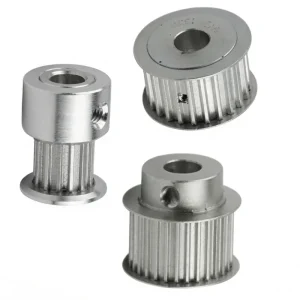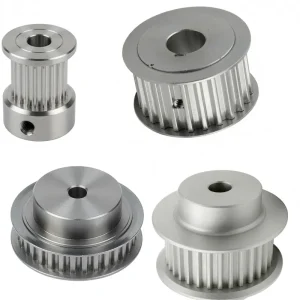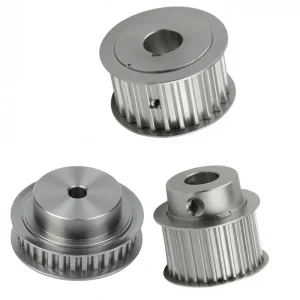
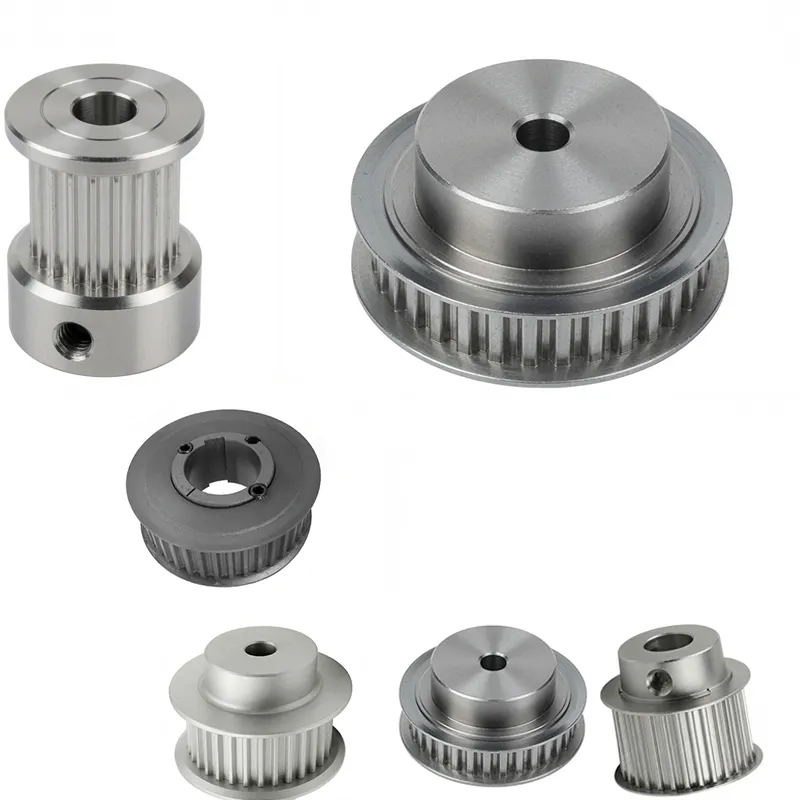
EP-H150 12.7MM Steel & Cast Iron Straight Bore Timing Pulley
The EP-H150 12.7mm Steel & Cast Iron Timing Pulleys are designed for high-torque applications with a 12.7mm pitch. Available in tooth counts from 14 to 156, they are manufactured from durable Steel (types 6F, 6WF, 6W) or Cast Iron (type 6A). A key feature is the extra-wide face width (F) of 46mm, providing superior belt support compared to standard H-series pulleys. Smaller models (14–36 teeth) have a length (L) of 58mm, while larger sizes extend to 65mm. Bore diameters (Dm) range from 40mm to 120mm, accommodating heavy-duty shafts. With outer diameters (De) spanning 55.22mm to 629.26mm, the H150 series ensures robust, precise power transmission for demanding industrial machinery requiring wider belt drives.
EP-H150 12.7MM Steel & Cast Iron Straight Bore Timing Pulley
H Pitch Mid-Width Straight Bore Timing Belt Pulley — F = 46 mm, Steel 14–52 Teeth, Cast Iron 58–156 Teeth, Global Supply
1. H 150 (12.700 mm) — Full Dimensional Specification Table
All dimensions in millimeters. Dp = Pitch Diameter; De = Outside Diameter; Df = Flange Diameter; Dm = Body Diameter; Di = Inner Diameter; F = Face Width (46 mm throughout); L = Hub Length; d = Bore Reference. Material: STEEL for 14–52 teeth; CAST IRON for 58–156 teeth. Each straight bore timing pulley in this table is dimensioned per ANSI/RMA IP-24. Dash (—) indicates the dimension is not applicable for that structural type.
| รหัสชิ้นส่วน | ฟัน | พิมพ์ | วัสดุ | Dp | De | Df | Dm | Di | F | L | d | หมายเลขหน้าแปลน |
|---|---|---|---|---|---|---|---|---|---|---|---|---|
| 14 H 150 | 14 | 6F | เหล็ก | 56.60 | 55.22 | 64 | 40 | — | 46 | 58 | 11 | 59 |
| 15 H 150 | 15 | 6F | เหล็ก | 60.64 | 59.27 | 66.5 | 45 | — | 46 | 58 | 11 | 60 |
| 16 H 150 | 16 | 6F | เหล็ก | 64.68 | 63.31 | 70 | 45 | — | 46 | 58 | 11 | 61 |
| 17 H 150 | 17 | 6F | เหล็ก | 68.72 | 67.35 | 75 | 45 | — | 46 | 58 | 11 | 62 |
| 18 H 150 | 18 | 6F | เหล็ก | 72.77 | 71.39 | 79 | 55 | — | 46 | 58 | 14 | 63 |
| 20 H 150 | 20 | 6F | เหล็ก | 80.85 | 79.48 | 87 | 62 | — | 46 | 58 | 14 | 76 |
| 22 H 150 | 22 | 6F | เหล็ก | 88.94 | 87.56 | 94 | 68 | — | 46 | 58 | 14 | 67 |
| 24 H 150 | 24 | 6F | เหล็ก | 97.02 | 95.65 | 102 | 72 | — | 46 | 58 | 14 | 70 |
| 26 H 150 | 26 | 6F | เหล็ก | 105.11 | 103.73 | 112 | 80 | — | 46 | 58 | 14 | 72 |
| 28 H 150 | 28 | 6F | เหล็ก | 113.19 | 111.82 | 120 | 80 | — | 46 | 58 | 14 | 75 |
| 30 H 150 | 30 | 6F | เหล็ก | 121.28 | 119.90 | 128 | 80 | — | 46 | 58 | 14 | 78 |
| 32 H 150 | 32 | 6F | เหล็ก | 129.36 | 127.99 | 135 | 80 | — | 46 | 58 | 14 | 80 |
| 35 H 150 | 35 | 6F | เหล็ก | 141.49 | 140.12 | 150 | 80 | — | 46 | 58 | 14 | 85 |
| 36 H 150 | 36 | 6WF | เหล็ก | 145.53 | 144.16 | 150 | 80 | 118 | 46 | 58 | 14 | 85 |
| 40 H 150 | 40 | 6WF | เหล็ก | 161.70 | 160.33 | 168 | 80 | 134 | 46 | 58 | 14 | 90 |
| 44 H 150 | 44 | 6WF | เหล็ก | 177.87 | 176.50 | 184 | 80 | 150 | 46 | 58 | 19 | 95 |
| 48 H 150 | 48 | 6WF | เหล็ก | 194.04 | 192.67 | 200 | 90 | 166 | 46 | 58 | 19 | 100 |
| 49 H 150 | 49 | 6 วัตต์ | เหล็ก | 198.08 | 196.71 | — | 90 | 170 | 46 | 65 | 19 | — |
| 52 H 150 | 52 | 6 วัตต์ | เหล็ก | 210.21 | 208.84 | — | 90 | 182 | 46 | 65 | 19 | — |
| 58 H 150 | 58 | 6A | เหล็กหล่อ | 234.47 | 233.09 | — | 90 | 207 | 46 | 65 | 19 | — |
| 60 H 150 | 60 | 6A | เหล็กหล่อ | 242.55 | 241.18 | — | 90 | 215 | 46 | 65 | 19 | — |
| 70 H 150 | 70 | 6A | เหล็กหล่อ | 282.98 | 281.61 | — | 100 | 255 | 46 | 65 | 24 | — |
| 84 H 150 | 84 | 6A | เหล็กหล่อ | 339.57 | 338.20 | — | 100 | 312 | 46 | 65 | 24 | — |
| 96 H 150 | 96 | 6A | เหล็กหล่อ | 388.08 | 386.71 | — | 120 | 360 | 46 | 65 | 24 | — |
| 120 H 150 | 120 | 6A | เหล็กหล่อ | 485.10 | 483.73 | — | 120 | 458 | 46 | 65 | 24 | — |
| 156 H 150 | 156 | 6A | เหล็กหล่อ | 630.64 | 629.26 | — | 120 | 603 | 46 | 65 | 24 | — |
Note: Full 43-part range available including all intermediate tooth counts — contact us for the complete H150 specification table. Bore diameter (d) reference indicates minimum standard bore; custom bore machining available on request.
2. About Our H150 Series — H Pitch, 1.5-Inch Face Width
The EP-H150 series is an intermediate face width H pitch พูลเลย์ไทม์มิ่งแบบรูตรง, positioned between the H100 (F = 31.8 mm) and H200 (F = 58.7 mm) in the H pitch product family. This straight bore timing pulley series fills the intermediate face width niche. The "150" suffix denotes the 1.500-inch (38.1 mm nominal) belt width class for which this pulley is designed, with an actual face width of F = 46 mm — wider than the belt to allow for normal belt tracking variation without belt overhang. This 46 mm face width gives the H150 straight bore timing pulley approximately 45% higher power capacity than the H100 at identical tooth count, pitch circle speed, and center distance, while remaining more compact than the H200 alternative for installations where space is limited and the H100's power limit has been reached.
The H150 พูลเลย์ไทม์มิ่งแบบรูตรง fills the engineering gap that designers frequently encounter when H100 capacity is slightly insufficient but H200 represents an excessive increase in belt width, hub length, and shaft loading for the application. Rather than over-engineering with the H200 series, this straight bore timing pulley achieves the required power capacity with the minimum additional drive width, hub length, and belt tension on the shaft — a meaningful consideration when shaft and bearing sizing in existing machines must not be increased, or when axial space is limited to the range between H100 and H200 hub lengths. The H150's L = 58 mm hub length (for 14–48 teeth in steel) and L = 65 mm (for 49+ teeth) provide the intermediate engagement depth that this application scenario requires.
Available in steel for tooth counts 14–52 and cast iron for 58–156 teeth, this straight bore timing pulley covers pitch diameters from 56.60 mm (14 teeth) through 630.64 mm (156 teeth) — the full H pitch diameter range. The structural type progression follows the same engineering logic as the H100 and H200: Type 6F (flanged solid disc) for 14–35 teeth, Type 6WF (wide web with flanges) for 36–48 teeth, Type 6W (wide web, no flanges) for 49–52 teeth, and Type 6A (arm-spoked cast iron) for 58–156 teeth. This progression ensures the correct belt retention geometry, material efficiency, and structural weight optimization at each tooth count, consistent with พูลเลย์สายพานไทม์มิ่ง engineering standards applied across the full H pitch diameter range. Each straight bore timing pulley in this series is dimensioned to ANSI and ISO standards.
3. ข้อได้เปรียบหลัก 5 ประการของผลิตภัณฑ์
The H150 พูลเลย์ไทม์มิ่งแบบรูตรง provides approximately 45% more power capacity than the H100 at the same tooth count and operating conditions, without the additional axial space, hub length, and shaft loading of the H200. This intermediate specification is particularly valuable when a machine's shaft and bearing sizing was originally designed around H100 requirements and cannot economically be upgraded — the H150 straight bore timing pulley allows power increase to the required level without redesigning the shaft support system. Engineering teams in Mexico, Brazil, and Poland managing production capacity upgrades on existing machinery regularly find the H150 straight bore timing pulley the correct specification for this scenario.
At 46 mm face width, the H150 straight bore timing pulley is 14.2 mm wider than the H100 (31.8 mm) but 12.7 mm narrower than the H200 (58.7 mm). This compact increase in belt width adds meaningful power capacity in a dimension increment that requires no machine structure modification in most retrofit applications — the additional 14.2 mm can typically be accommodated within the shaft's existing overhand clearance without repositioning bearings, guards, or adjacent components. For buyers searching for a size straight bore timing pulley that upgrades drive power without structural redesign, the H150 straight bore timing pulley represents the most space-efficient path forward from an H100 installation.
The H150 straight bore timing pulley tooth form and pitch circle geometry conform to ANSI/RMA IP-24 and ISO 5294, and the matching H150 belt (1.500-inch nominal width H pitch) is stocked globally. This straight bore timing pulley is distributed throughout North America, Europe, East Asia, and Oceania. The global stocking of H pitch belts in the 1.5-inch width class ensures that timing belt pulley replacement belts are accessible wherever the H150 drive system is deployed — reducing unplanned downtime risk at remote industrial locations in Canada, Australia, Russia, and across Southeast Asia. The belt designation for this pulley series is H150 (e.g., a belt specification such as 600H150 denotes 600 teeth, H pitch, 1.500-inch belt width).
The H150 straight bore timing pulley hub lengths — L = 58 mm for 14–48 teeth in steel and L = 65 mm for 49–156 teeth — sit between the H100 (45–60 mm) and H200 (70–75 mm) values, providing adequate bore-to-shaft contact length for the intermediate belt tension generated by the H150 belt width without the extended shaft overhang that H200 requires. This hub length is appropriate for the shaft diameter range covered by the H150's bore specifications (d = 11–24 mm), keeping the hub wall thickness adequate for the keyway while maintaining the shaft journal length requirement of this straight bore timing pulley at a level that standard industrial shaft designs can accommodate without modification.
Because pitch circle diameter depends only on tooth count and pitch — not on face width — an H150 straight bore timing pulley at any given tooth count has the exact same Dp and De as the H100 and H200 at the same tooth count. Drive ratio and peripheral speed calculations performed for an H100 system remain valid when upgrading to H150: only the belt width designation changes in the straight bore timing pulley specification. This kinematic identity between the H pitch face-width series simplifies drive redesign documentation, allows speed ratio verification from the original H100 calculations, and eliminates the need to recalculate center distance or belt length when switching between H100, H150, and H200 within the same center distance.
4. Working Principle: H150 Mid-Width Synchronous Belt Drive
The H150 พูลเลย์สายพานไทม์มิ่ง, which is a precision straight bore timing pulley, operates through the same synchronous engagement principle as all H pitch pulleys: the belt's trapezoidal teeth mesh positively with the machined tooth spaces in the pulley rim, transmitting torque with zero slip and maintaining precise shaft speed ratio. At the H150 face width of 46 mm, the straight bore timing pulley belt contact area is intermediate between H100 and H200, and the resultant belt tension per millimeter of face width at any given transmitted power is correspondingly between the two. This moderate specific loading — neither as high as the H100 (which has the smallest area distributing the tension) nor as low as the H200 — places the H150 in the optimal operating region for the power range it is designed to serve, balancing belt life, bearing load, and shaft bending stress at a level suited to the medium-duty industrial drive applications where this straight bore timing pulley is most commonly specified.
The synchronous nature of the drive — the fact that the input and output shaft positions maintain a fixed angular relationship determined by the tooth count ratio — is what distinguishes the H150 พูลเลย์ไทม์มิ่งแบบรูตรง system from V-belt and chain alternatives in applications where shaft synchronization matters. In a multi-station production line where several process stations must execute their motions at precisely the correct phase relationship, the H pitch synchronous drive provides the phase accuracy and repeatability that V-belt drives cannot guarantee over time as the belt stretches and the slack increases. The H150 belt's moderate tension requirement also means that the H150 straight bore timing pulley system imposes lower radial loads on the shaft bearings than an H100 system running at its maximum capacity for the same transmitted power — the wider belt transmits the power at lower tension, reducing the bearing radial load — a practical advantage of the straight bore timing pulley configuration at this face width.
In the cast iron Type 6A large-diameter H150 straight bore timing pulley models (58–156 teeth), the torque travels from the bore through the hub, along the cast iron arms, and into the rim where the tooth engagement occurs. At the H150 face width, the rim depth of each straight bore timing pulley tooth root is sized to carry the full H150 belt tension with the fatigue safety factor required by the cast iron material's tensile fatigue limit. The arm cross-sections are proportioned using the same structural engineering principles as the H100 and H200 6A straight bore timing pulley arms — bending stress check at the arm root under the hub-to-rim torque at rated belt tension — but the H150 arm sections are intermediate between the lighter H100 and the heavier H200 arm sections, reflecting the intermediate belt tension level of the H150 series.
5. H Pitch Face Width Comparison: H100, H150, H200
The H150 straight bore timing pulley occupies the center position in the three-variant H pitch straight bore timing pulley family. Understanding the dimensional relationships between the three straight bore timing pulley variants helps engineers select the appropriate face width for any given application requirement.
| Parameter | H100 (1-inch) | H150 (1.5-inch) | H200 (2-inch) |
|---|---|---|---|
| Face Width F | 31.8 mm | 46 mm | 58.7 mm |
| Hub Length L (small TC) | 45 mm | 58 mm | 70 mm |
| Hub Length L (large TC) | 50–60 mm | 65 mm | 75 mm |
| Max Bore d (large TC) | 19 mm | 24 mm | 28 mm |
| Belt Width Designation | H100 (1.000 in) | H150 (1.500 in) | H200 (2.000 in) |
| Relative Power Capacity | 1.0× (reference) | ≈ 1.45× | ≈ 1.85× |
6. Materials: Steel and Cast Iron for the H150 Series
The H150 พูลเลย์ไทม์มิ่งแบบรูตรง follows the same material specification philosophy as the H100 and H200 series. Steel (medium-carbon 45C or alloy 40Cr) is used for tooth counts 14–52 where higher shaft speeds make steel's better fatigue endurance and bore surface hardness relevant, while grey cast iron (HT200 class, HB 180–220) is used for the larger 58–156 tooth range where reduced rotating speed and the economic and damping advantages of cast iron predominate. At the H150 face width of 46 mm, the straight bore timing pulley material requirements are intermediate between H100 and H200: the belt tension per millimeter of face width is slightly lower than H100 (benefiting belt and tooth root fatigue life) but not as reduced as H200, keeping material stress levels within the standard specifications for this straight bore timing pulley material class.
Steel H150 straight bore timing pulley products (14–52 teeth) are machined from bar or forging to the finished tooth form, bore, keyway, and hub geometry. The medium-carbon content (0.40–0.50% C) provides adequate strength for the tooth root and bore wall in the H150 configuration, and the 46 mm face width gives each tooth root a wider cross-section than the H100 configuration — contributing to improved fatigue margin at the tooth root of this straight bore timing pulley under H150 belt tension. The standard surface treatment for steel H150 pulleys is black oxide, with zinc plating or phosphate-plus-oil available for improved corrosion protection in humid or wash-down applications. Cast iron H150 straight bore timing pulley products in the 6A arm-spoked configuration use the same grey iron specification as the H100 and H200 large-diameter pulleys, with arm cross-sections proportioned for the H150 belt tension level rather than the lighter H100 or heavier H200 tension.
Looking for a straight bore timing pulley for sale in the T series, or need a custom bore specification for your industrial drive?
7. Application Scenarios
The H150 พูลเลย์ไทม์มิ่งแบบรูตรง occupies the power and drive width range that sits between light-duty H100 applications and heavy-duty H200 requirements. Below are the primary industrial scenarios where this intermediate specification is the natural choice.
Medium-weight indexing conveyors, pallet transfer systems, and buffer conveyor drives in automotive assembly plants use the straight bore timing pulley, distribution warehouses, and manufacturing facilities across France, Italy, and Spain use H150 พูลเลย์สายพานไทม์มิ่ง systems when the conveyor load exceeds H100 capacity but the installation has limited axial clearance for the wider H200 straight bore timing pulley. The H150 straight bore timing pulley belt width accommodates load levels up to approximately 45% higher than H100 without requiring mechanical modifications to the existing drive shaft arrangements — making it the go-to upgrade option for conveyor system capacity increases in existing production facilities.
Weaving machines, knitting frame drives, and yarn processing equipment in the textile manufacturing sectors of India, Turkey, Bangladesh, and Vietnam use the H150 straight bore timing pulley in H pitch synchronous belt drives extensively. The H150 straight bore timing pulley series covers the power range of medium-format weaving machines where the H100 belt reaches its tension limit at sustained high-speed operation, but adding the H200 belt would exceed the bearing load limits of the original machine design. The consistent F = 46 mm face width across the full H150 straight bore timing pulley tooth count range simplifies the belt sourcing relationship for textile equipment maintenance teams that manage multiple machine types sharing this common belt width standard.
Combine harvester threshing drum drives, grain auger main drives, and fodder processing equipment in agricultural machinery use the straight bore timing pulley across North America, Argentina, Ukraine, and Australia use H pitch timing belt drive pulley systems where the synchronous ratio must be maintained precisely to protect threshing drum speed-sensitive crop quality outcomes. The H150 straight bore timing pulley suits the moderate-to-high power range of medium-scale harvesting equipment where H100 belt life is unacceptably short under the sustained high-load operation of harvest season, but H200 width would require structural modification of the drive housing on established machine platforms. The H150 timing pulley and belt straight bore timing pulley combination provides the service life improvement that agricultural equipment manufacturers need without platform redesign.
Pharmaceutical mixing tanks, ribbon blenders, and chemical reactor agitator drives in production facilities use the H150 straight bore timing pulley across Switzerland, Germany, the United States, and India use H pitch synchronous belt drives at the reduction stage between the gear motor and the mixer shaft. The H150 straight bore timing pulley series covers the power range of medium-scale mixers where the H100 belt operates near its rated capacity and any belt slippage or tension loss creates unacceptable product quality variation. Pharmaceutical mixing drives require zero-slip synchronous behavior to maintain shaft speed accuracy within the product specification tolerances, and the H150 straight bore timing pulley's increased power margin over H100 provides the headroom needed to absorb transient mixing resistance spikes without belt ratcheting risk.
Cement mixer drum drives, tile press main drives, and aggregate screening plant drives across Brazil, Mexico, Turkey, and Egypt use the straight bore timing pulley use H pitch timing belt drives at positions where precise speed ratio between the drive motor and the process machine determines product quality — mortar mixing consistency, tile thickness uniformity, or screen deck frequency accuracy. The H150 พูลเลย์ไทม์มิ่งแบบรูตรง in cast iron (60–120 teeth) appears at the slow-speed large-diameter driven shaft positions in these applications, where the combination of high tooth count (large ratio in a single stage) and the intermediate belt width (H150) provides the straight bore timing pulley power capacity for medium-scale production equipment without requiring the large H200 belt width that heavier industrial installations use.
8. Standards Compliance and Global Regulatory Framework
The H150 พูลเลย์ไทม์มิ่งแบบรูตรง conforms to ANSI/RMA IP-24 H pitch tooth form specifications. The H150 belt designation (1.500-inch face width) follows the ANSI belt width naming convention and is stocked by industrial distributors throughout North America and Latin America. China timing pulley products produced to IP-24 H pitch standards as a straight bore timing pulley are dimensionally interchangeable with ANSI-compliant belts from any manufacturer in the Americas — ensuring that replacement belts for H150-equipped machines are available locally in the United States, Canada, Mexico, Brazil, and Argentina without special import arrangements.
ISO 5294 and ISO 5296 H pitch dimensional requirements align with ANSI/RMA IP-24 for the H pitch family, providing the international standards framework for H150 series procurement across European, Asian, and Oceanian markets. European machine builders in Germany, France, Italy, and the Netherlands who reference ISO 5294 in their mechanical design specifications can source the H150 straight bore timing pulley with confidence that the ANSI and ISO H pitch tooth form specifications are equivalent at this pitch. ISO compliance documentation is available with qualifying straight bore timing pulley orders for CE marking technical file requirements.
Drive components including the H150 straight bore timing pulley installed in CE-marked machinery for EU markets must be selected with appropriate design safety factors. For food processing applications specifically, the H150 belt in food-grade neoprene or polyurethane must comply with EU Regulation (EC) No 1935/2004 on materials in contact with food. The H150 straight bore timing pulley itself — in steel or cast iron — does not contact the food product and is not subject to food contact regulation, but the belt material must be specified to comply with the applicable food contact regulation in the target market (FDA 21 CFR for the USA, EC 1935/2004 for the EU).
The Bureau of Indian Standards (BIS) publishes IS standards for power transmission components including synchronous belt pulleys, generally aligned with ISO specifications. For Indian buyers procuring H150 straight bore timing pulleys for textile machinery, pharmaceutical equipment, and agricultural processing machines — major Indian industrial applications for H pitch drives — ISO 5294 compliance documentation satisfies BIS-aligned procurement specifications. Our technical data pack includes the dimensional data, material specifications, and quality system certification applicable to Indian industrial procurement of a straight bore timing pulley.
9. Compatible System Products
A complete H150 synchronous drive system requires matched timing belts and pulleys and may benefit from compatible drive accessories. We supply matched products for complete drive system procurement.
In many medium-duty industrial drives, a V-belt primary stage handles the initial power transmission from the motor while the H150 synchronous stage provides the accurate speed ratio to the process. Our V-belt pulley range in cast iron and steel — SPZ, SPA, SPB, SPC, A, B, C section groove profiles — covers the primary drive stage counterpart for H150 straight bore timing pulley synchronous secondary drives. Standard bore and keyway dimensions across the straight bore timing pulley and V-belt pulley families align with the standard shaft diameter progression in industrial drive engineering, simplifying shaft selection and hub dimensioning for combined V-belt and H150 timing drive systems in medium-duty industrial equipment.

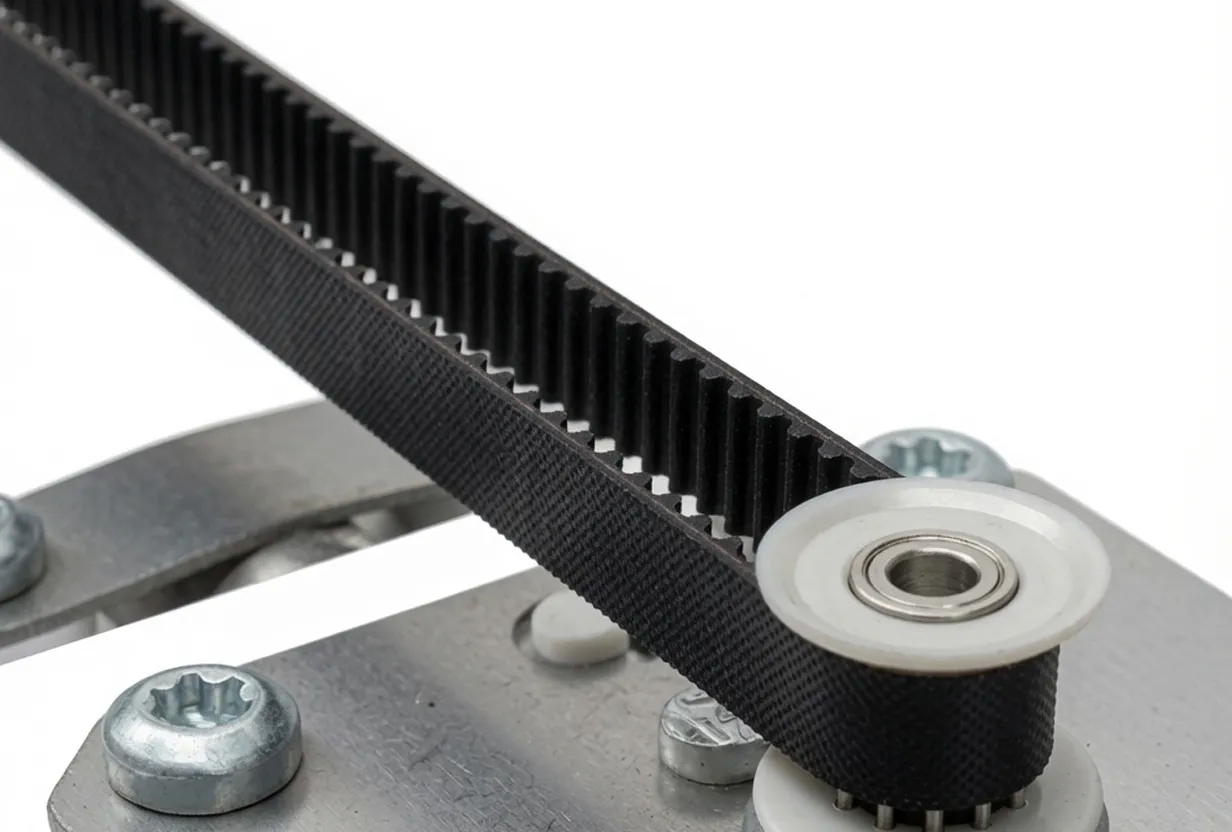
Metric Pitch Standard Toothed Bars complement the H150 พูลเลย์สายพานไทม์มิ่ง in linear drive applications where a rotary-to-linear motion conversion stage follows the H150 reduction drive. Toothed bars meshing with the same H pitch belt engaged on the H150 pulley allow the belt to travel along a fixed rack, producing linear movement of a carriage or driven element — a common architecture in long-travel gantry systems, industrial automation, and large-format CNC router tables where the H150 belt drive provides the power level and the toothed bar provides the linear motion. Our toothed bar range covers the H pitch specification to match H150 drive systems requiring this combined rotary-and-linear capability.
10. About Us
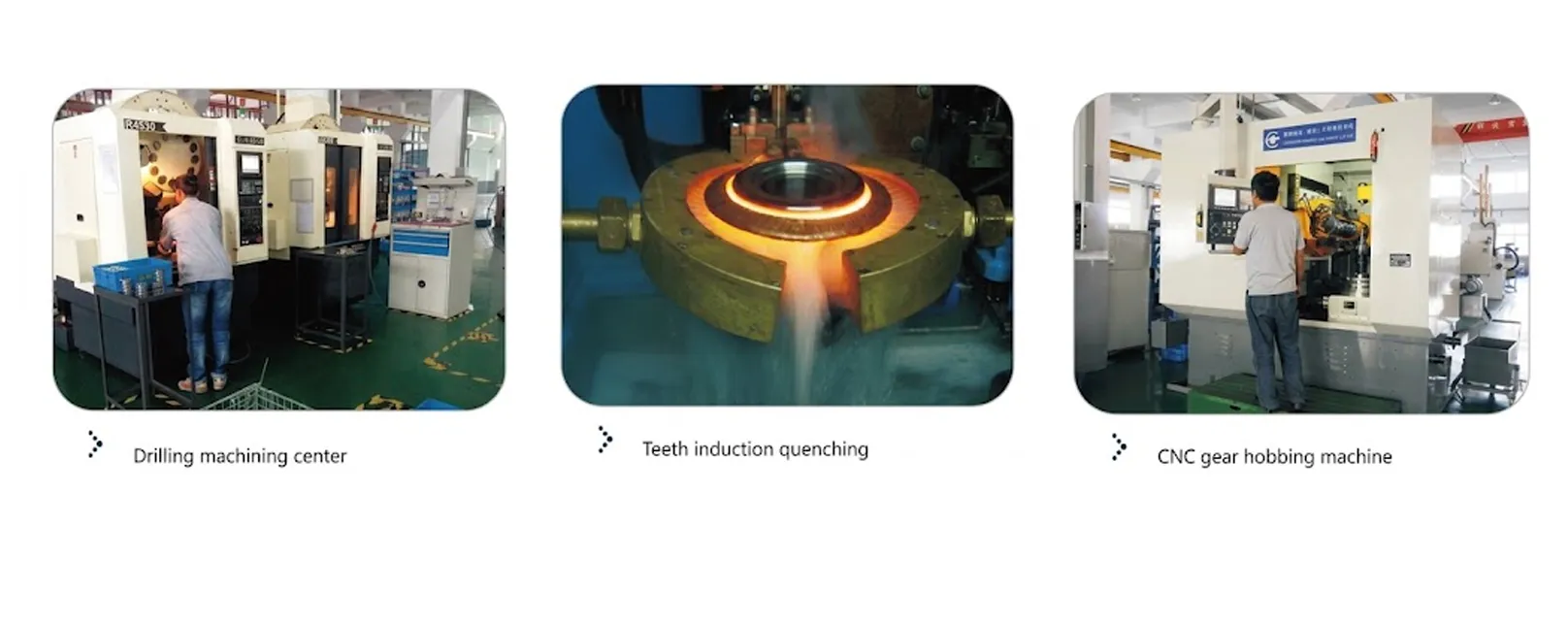
We are a specialized timing pulley manufacturer with production capabilities spanning the complete range of synchronous belt drive pulleys including MXL, XL, L, H (H100/H150/H200/H300), XH, XXH, T-series (T2.5, T5, T10), AT-series (AT5, AT10), and HTD series (HTD 3M, HTD 5M, HTD 8M) — in materials from 6061-T6 aluminum through medium-carbon steel and grey cast iron, across the full tooth count range from the smallest precision instrument pulleys through the largest heavy industrial cast iron 6A arm-spoked pulleys at 630 mm pitch diameter. Our H150 straight bore timing pulley series production capability covers the full 14–156 tooth range in both steel and cast iron, with CNC-finished tooth profiles, bores, keyways, and hub faces dimensioned to ANSI/RMA IP-24 and ISO 5294 tolerances.
We maintain timing pulley stock of the most frequently ordered H150 configurations — steel tooth counts 20, 24, 28, 30, 32 (6F) and 36, 40, 44, 48 (6WF), plus cast iron 60, 70, 84, 96 (6A) — for immediate delivery to buyers globally. Custom timing belt pulleys in the H150 straight bore timing pulley series with non-standard bore diameters, modified hub lengths, special keyway specifications, or precision balance requirements are manufactured to order with 10–20 business day lead times. Our engineering team provides drive selection support for straight bore timing pulley applications including H150 power capacity calculation, service factor determination, and center distance optimization for buyers designing new equipment or upgrading existing drives from H100 to H150 specifications.
WorkShop


Frequently Asked Questions
Editor: PXY